Industry Brief, August 24, 2026: Essay day: digital twins, machine babel, robot mowers
Monday’s brief is an essay day: the weekend feeds brought three practitioner columns rather than hard news, and all three are written by vendors with something to sell, so we read them with the pitch filtered out and tell you which arguments survive. Our own words, links to the original outlet, vendor numbers labelled as vendor numbers.
RoboDK’s founder: model the cell before you spend the capital
The Robot Report ran a contributed column from Albert Nubiola, founder and CEO of digital-twin vendor RoboDK, a software seller making the case for software, so weigh it accordingly. The argument holds up anyway: for a first-time automation buyer facing thousands of robots, end effectors, and layouts, a digital twin (a virtual model of the prospective cell) answers the expensive questions before any hardware arrives. Will the robot reach every position? What’s the real cycle time once chuck cycles and part settling eat into it? Does the gripper actually handle your part geometry, or would a dual-grip design fix the sequence? His machine-tending example is the useful part: the brochure version looks simple, and the simulation is where the idle time and collision risks surface. Nubiola’s own numbers (RoboDK supports 1,400+ robot models from 80 manufacturers) are vendor figures, and his most defensible claim is the modest one: twins don’t replace integrators, they make you a better-informed customer before the quote.
Why it matters: This slots directly into the process we map in our RFQ guide: the buyers who get accurate quotes are the ones who show up with constraints, cycle-time targets, and layout questions already explored, and a twin is the cheapest way to get there. It also de-risks the question our small-manufacturer Q&A gets at: you can now find out whether the ROI story survives your actual part geometry without buying anything. The filter to keep: “digital twin” spans everything from free simulators to six-figure enterprise platforms, and the column (reasonably) argues the light end is where first-timers belong.
Source: The Robot Report, August 23, 2026.
The babel problem: why 95% of industrial AI pilots go nowhere
Robotics Tomorrow carries an essay by Ryan Gordon of Foundry
Labs (the company behind the open FoundryNet schema, so
this too argues its author’s book), built on a genuinely
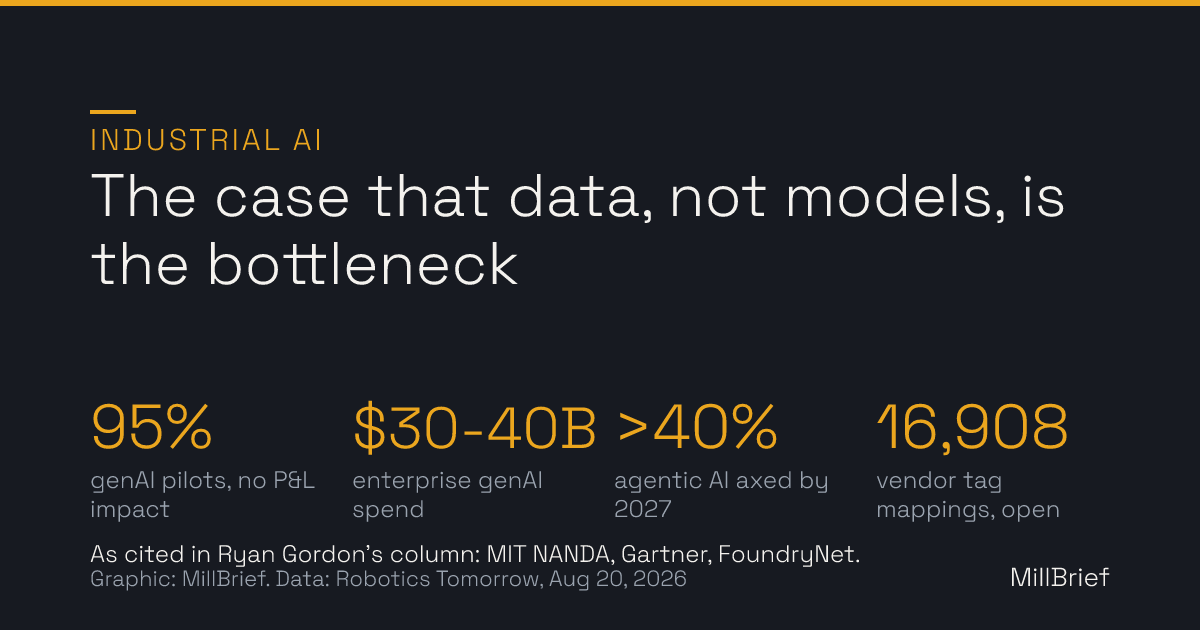
uncomfortable stack of citations: MIT’s Project NANDA review
of 300+ enterprise AI initiatives found 95 percent of
generative-AI pilots produce no measurable P&L impact on
$30-40 billion of spend, and Gartner expects over 40 percent
of agentic-AI projects to be canceled by the end of 2027.
Gordon’s diagnosis is concrete: a Fanuc CNC and a Siemens PLC
twenty feet apart both report spindle load (one as
SP_LOAD_PCT, the other as SPINDEL_AUSLASTUNG), and at
fleet scale no model can know those are the same field.
Bridging the gap today costs adapters, data dictionaries, and
months of integration per vendor pair. His proposed fix is
his product, but it’s an open one: 366 canonical fields and
16,908 curated vendor tag mappings across 18 OEM families,
MIT-licensed on GitHub.
Why it matters: Strip the vendor framing and the core claim matches what plant people already know: you can’t compare machines that don’t share a vocabulary, which is why so much OEE work starts as a data-cleaning project. It’s also the missing infrastructure under yesterday’s workforce column: those emerging teleoperator and QA-validator roles spend their hours reconciling exactly this babel. The skeptical read: canonical schemas for industrial data have been attempted for decades (OPC UA and MTConnect exist precisely for this), and the essay doesn’t explain why this attempt escapes the adoption trap that caught the others. The 95 percent failure number is real either way, and worth quoting at anyone selling you an “AI-ready” factory.
Source: Robotics Tomorrow, August 20, 2026.
Sunseeker’s CEO predicts robot mowers on half of American lawns
The Robot Report’s third weekend column comes from Terry Ma, founder and CEO of robot-mower maker Sunseeker, who argues the category is having its breakout: RTK satellite positioning at centimeter accuracy plus AI navigation has killed the buried boundary wire, and on the company’s own market analysis, U.S. robotic-mower penetration “could approach 50% of households over the next eight years.” That prediction is the vendor’s bet, not a measurement, and one market-size figure in the column (a “global lawn mower market” of $35.2 million) is off by roughly three orders of magnitude from any published estimate, so we’re not repeating its trajectory here. The commercial half of the argument is sturdier: U.S. landscaping employs well over a million people, the column says, with chronic recruiting problems for seasonal outdoor work in worsening heat, and lightweight commercial mowing robots are already shipping into that gap. Sunseeker itself closed a Series B of roughly $74.3 million in early 2026, by its own account.
Why it matters: The labor argument is the same shortage math driving welding and warehouse automation, transplanted outdoors: repetitive work, hostile conditions, nobody applying. For anyone running the numbers on service-side automation, the first reader comment under the column is the sharpest analysis in it: adoption floodgates open when the robot costs about the same as the self-propelled mower it replaces. That’s a payback question, and the 50-percent-of-lawns prediction stands or falls on it, not on the navigation tech.
Source: The Robot Report, August 22, 2026.
Sources
- Use a digital twin to explore automation before committing capital (The Robot Report, 2026-08-23)
- One Language: What happens the moment every machine on the floor speaks the same one (Robotics Tomorrow, 2026-08-20)
- The technology that could bring robot mowers to one in two American lawns (The Robot Report, 2026-08-22)