Industry Brief, August 23, 2026: Shipyard humanoids, Serve adds Grubhub, robot staffing
Sunday’s three items: a humanoid company that skipped the warehouse and went straight to the shipyard, a sidewalk delivery operator whose growth numbers deserve a second look, and a staffing executive’s argument about who actually runs the robots. Our own words, links to the original outlet, vendor numbers labelled as vendor numbers.
Persona AI’s humanoids will learn one job first: shipyard welding
While most humanoid companies chase warehouses and general labor, Persona AI has committed to a single beachhead: long, linear welds in shipyards, IEEE Spectrum reports. The founders’ credentials are unusually deep (Nicolaus Radford led NASA’s Valkyrie humanoid program, Jerry Pratt led IHMC’s DARPA Robotics Challenge team and spent two years as CTO of Figure), and their thesis inverts the industry default: target expensive skilled trades, not cheap unskilled labor. The task fits robots unusually well. Welding speed is capped by how fast metal melts (around a centimeter per second), and quality depends on millimeter-scale repeated motions sustained for hours, exactly where machines beat tired humans. Shipbuilding needs hundreds of kilometers of linear welds per ship, by Radford’s account, and Persona’s two public partners are HD Hyundai, the world’s largest shipbuilder, and steel giant POSCO. The pitch to them is top-line, not bottom-line: both run labor-constrained backlogs, so robots that weld mean more ships sold, not cheaper ships. Legs earn their keep here too: open-air shipyards are a couple hundred meters long and threaded with spars to step over, with work on the ground, overhead, and through portholes.
Why it matters: This is the most disciplined economic-viability argument we’ve seen from a humanoid company, and it lands squarely on the trend line we’ve been tracking: the welder shortage is already pulling conventional welding robots into steel fabrication, and Schaeffler’s factory-floor humanoid training shows industrial incumbents positioning for the same wave. Persona’s “last-mover” framing (pick the task where robot physics beats human physiology, in a market with no competing bidders) is a useful test any automation buyer can apply to their own floor. The honest caveats are in the article too: the skill still needs tens of thousands of hours of demonstration data, and no humanoid company has yet proven useful scale anywhere.
Source: IEEE Spectrum, August 17, 2026.
Serve Robotics lands Grubhub, and half its delivery revenue is ads
Serve Robotics will put its sidewalk robots on the Grubhub marketplace starting in Chicago, Los Angeles, and Alexandria, Virginia (more than 100 participating merchants in Chicago and nearly 200 in LA), while separately entering Washington, D.C. and San Jose with DoorDash, The Robot Report reports. The company-reported Q2 numbers are where it gets interesting: $3.2 million in revenue, up 9 percent from Q1 and 404 percent year over year, with advertising making up nearly half of food-delivery revenue (robots wrapped in brand designs, now extended to “Characters” customers can talk to), and recurring revenue above half of the total. Operationally, Serve is launching its first “microdepot” in Miami (a small-footprint staging, charging, and dispatch site meant to enter new neighborhoods without a full facility build-out) and previewed Beacon, a countertop box that needs only power to alert restaurant staff when a robot arrives. One sour note via Bloomberg: Uber, Serve’s original parent, has sold off its remaining stake.
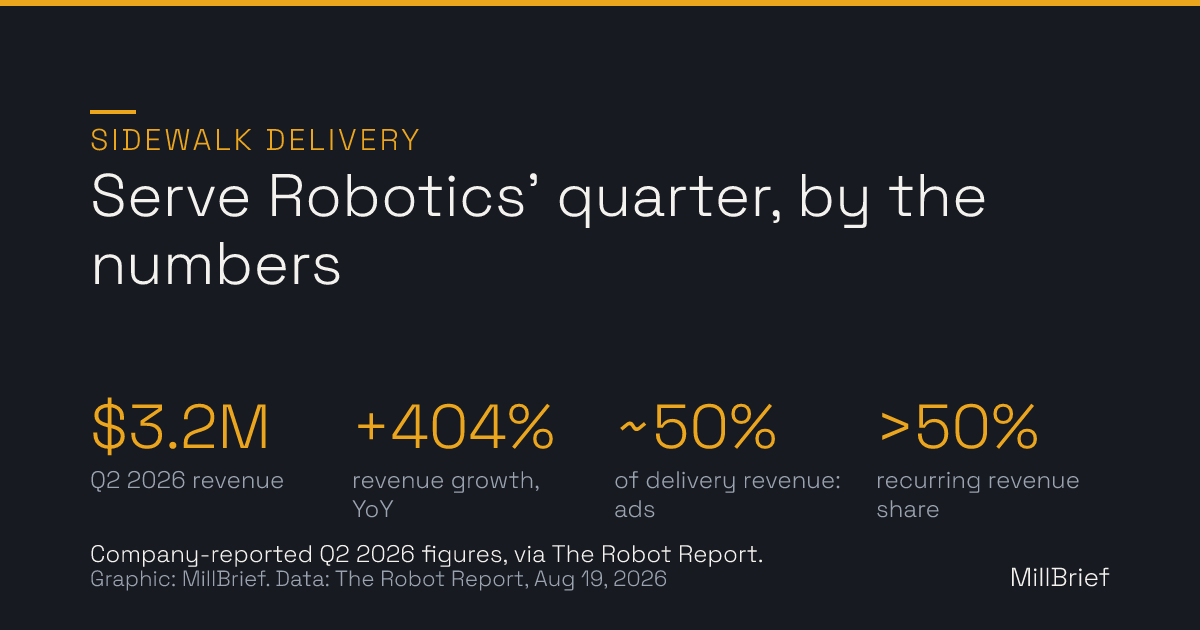
Why it matters: The last-mile robot race we covered via Amazon’s Prime Air expansion has a ground-level counterpart, and Serve’s revenue mix is the tell: at $3.2 million a quarter, delivery fees alone don’t yet carry the fleet; advertising and recurring contracts do. That’s worth noticing beyond food delivery, because it’s the same lesson industrial RaaS models keep teaching: the robot is the entry ticket, and the durable margin often sits in what rides on top of it. The Uber stake sale and the modest absolute revenue are the counterweight to the 404 percent headline; growth rates off a small base are the most quotable and least informative numbers in robotics.
Source: The Robot Report, August 19, 2026.
A staffing exec’s case: the bottleneck in scaled robotics is the humans
The Robot Report ran a contributed column from Christopher Bower, co-founder and chief revenue officer of HireArt, a contract-workforce platform, so read it as a vendor’s perspective with a commercial stake in its own conclusion. The argument is still worth your time: as robot deployments scale from a handful of pilots to dozens of sites across shifts, the limiting factor is rarely the robot; it’s the people who operate, maintain, and adapt it. The tight engineer-operator loop that works at five or ten robots breaks down at distributed scale, and gig-style task labor struggles where shift coverage, safety training, and escalation procedures matter. The pattern Bower says is emerging: a stable core of trained hourly W-2 operators and technicians owning baseline execution, with a flexible surge layer for pilots and new site launches (commonly an even split), plus new role types (robot operators, field technicians, teleoperators, QA validators, data-capture specialists) that sit between engineering and operations. Notably, he argues speed-only metrics actively degrade performance in physical environments; the better incentives weight procedure adherence, documentation quality, and escalation accuracy.
Why it matters: Every automation ROI model we’ve published assumes somebody competent is running the cell, and that assumption is exactly what breaks at scale: uptime is a workforce output as much as a machine spec, which is why it sits at the center of OEE. The column also names the quiet job categories automation actually creates (teleoperators and field techs, not just engineers), the same layer MIT’s excavator interface is trying to make trainable in days instead of years. Discount the source’s incentives, keep the checklist: if your automation plan has no answer for who covers third shift when the robot faults, it isn’t a plan yet.
Source: The Robot Report, August 22, 2026.
Sources
- Is Shipyard Welding the Right First Job for Humanoid Robots? (IEEE Spectrum, 2026-08-17)
- Serve Robotics to deploy its autonomous delivery robots with Grubhub (The Robot Report, 2026-08-19)
- Robots don't run themselves: The workforce powering physical AI (The Robot Report, 2026-08-22)