Industry Brief, August 30, 2026: Hidden layers: safety OS, training data, old iron
A quieter Saturday, so today’s brief digs into the layers you don’t see on the trade-show floor: the safety-certified operating system running inside the robot, the labeled data that trained its model, and the seven-decade arc of the factory it might one day replace. Our own words, links to the original outlet, vendor numbers labelled as vendor numbers.
BlackBerry wants its car OS inside your robots
CNBC’s tech newsletter looks at BlackBerry’s second act: QNX, its embedded operating system, ships in 275 million vehicles by the company’s count, and CEO John Giamatteo now calls robotics one of the “fastest-growing businesses inside the QNX portfolio.” The pitch is safety certification: the same real-time OS discipline used for digital cockpits and driver-assist systems, applied to machines that work next to people. Notably, BlackBerry says it is targeting industrial, factory, and medical robots rather than humanoids. The company reports a QNX order backlog of $950 million and says “a portion of that is robotics,” without breaking out a specific figure; treat both numbers as vendor-reported.
Why it matters: Buyers rarely ask what OS a robot runs until an update breaks something or a safety audit asks for certification artifacts. A certified RTOS under the vendor’s application layer is one more thing to put on the RFQ checklist, and one more recurring license somebody pays for, the same software-fee creep we flagged in farm-equipment earnings yesterday. When a supplier leans on “automotive-grade” language, ask which components are actually certified and who holds the support contract.
Source: CNBC, August 28, 2026.
EXL buys iMerit: the training-data supply chain consolidates
ExlService Holdings, a New York data-analytics firm founded in 1999 with roughly 68,000 employees, has completed its acquisition of iMerit, the San Jose company (founded 2012) whose annotators label training data for robotics, autonomous mobility, and healthcare AI, The Robot Report writes. iMerit founder Radha Ramaswami Basu joins EXL as an executive vice president running the unit. The interview around the deal is the useful part: Basu argues that physical-AI models routinely pass benchmarks yet fail on edge cases, and that expert-labeled domain data, not architecture, is the bottleneck. Her example is iMerit’s work with Carbon Robotics, digesting millions of plant images so a weeding machine can tell crop from weed in the field.
Why it matters: When you evaluate a “physical AI” product, the model’s training-data provenance is now a supply chain with its own M&A, concentration, and vendor risk, just like gearboxes and grippers. It’s the diligence angle we raised when an undisclosed-data startup launched this week: ask vendors where the labeled data came from, who owns it, and what happens to model updates if that supplier changes hands.
Source: The Robot Report, August 28, 2026.
A 183-year-old toolmaker winds down a 1951 factory
Stanley Black & Decker will close its Hampstead, Maryland plant, laying off 55 workers (layoffs begin October 23, 2026, with closure by March 26, 2027, per the WARN notice), citing a “steady decline in volume,” Yahoo Finance reports. The history is the story: Black & Decker built the 374-acre site in 1951 for power-tool manufacturing, grew it to 3,800 employees by 1969, and ended tool production there in December 1985 after efforts to modernize the plant failed. The site spent its last decades on powdered-metal manufacturing and warehousing. The parent company (roots back to 1843, world’s largest toolmaker since the 2010 merger, $15.13 billion in 2025 revenue) is consolidating the volume elsewhere.
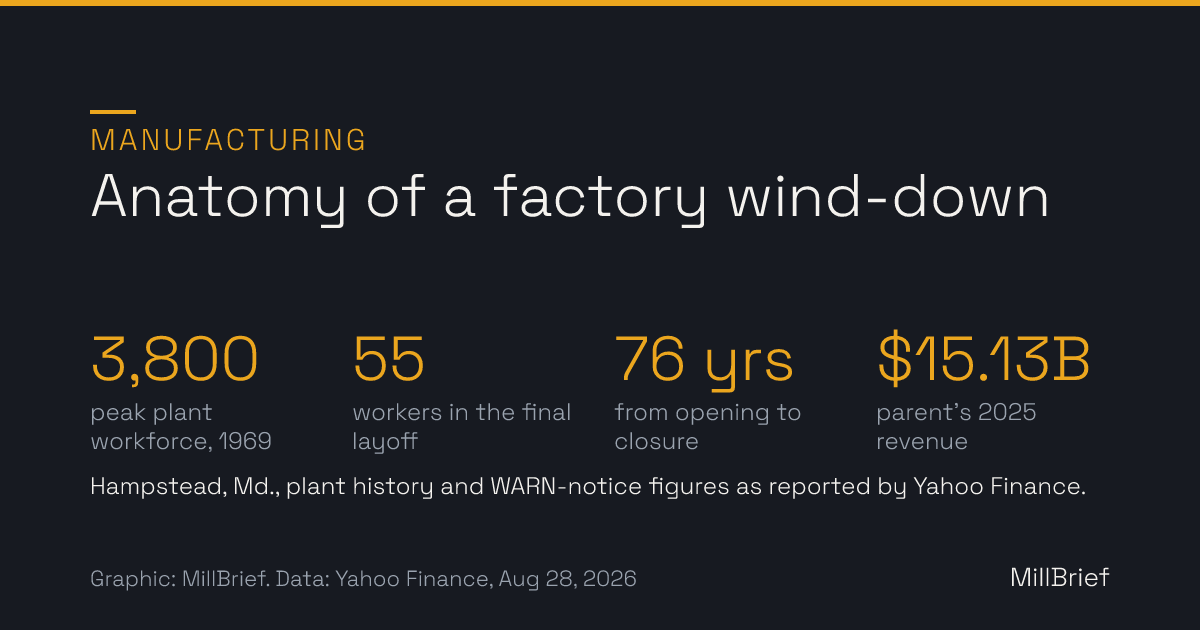
Why it matters: The pivotal line in the plant’s history is 1985: tool production ended “when efforts to modernize the plant failed.” Modernization windows are real and they close, a lesson that cuts both ways for the small manufacturer weighing automation. Automating too late left this site doing warehousing for forty years; automating badly fails faster. The honest takeaway isn’t “automate or die,” it’s that the justification math has to work while volumes still support the investment, not after they’ve left.
Source: Yahoo Finance, August 28, 2026.
Centralized or swarm power: how robot fleets stay charged
A contributed piece in The Robot Report (by Lou Farrell of the trade-education site Revolutionized) walks through the three power-and-coordination architectures behind robot fleets. Centralized control gives synchronized precision (Amazon’s fleet of more than a million warehouse robots runs on central orchestration, and Ocado’s grid swarms can pick a 50-item grocery basket in under five minutes), but concentrates risk in a single point of failure. Decentralized swarms keep working when individual units or the network drop out, at the cost of message-traffic congestion as the fleet scales. The emerging middle path is hybrid: edge AI on each robot for local decisions, central oversight for fleet-level planning and charging schedules.
Why it matters: For a buyer, the architecture question translates to two practical ones. What happens to the fleet when the server or Wi-Fi goes down: does everything stop, or degrade gracefully? And how is charging orchestrated? Because chargers, spare batteries, and the floor space they occupy are a classic hidden cost that scales with fleet size, whichever architecture you pick.
Source: The Robot Report, August 29, 2026.
Sources
- BlackBerry is betting on robots (CNBC, 2026-08-28)
- EXL acquires physical AI model developer iMerit (The Robot Report, 2026-08-28)
- 183-year-old giant tool company closing factory, laying off workers (Yahoo Finance, 2026-08-28)
- Differences between decentralized and centralized power in swarm robotics (The Robot Report, 2026-08-29)