Industry Brief, August 27, 2026: Deployment day: dirt, freight, and factory eyes
Yesterday we wrote about the gap between humanoid spectacle and paid work. Today’s items are the other side of that ledger: machines already doing jobs (moving dirt in Texas, hauling groceries in Arkansas) plus the perception software and cheap silicon that the next wave will run on. Our own words, links to the original outlet, vendor numbers labelled as vendor numbers.
Bedrock’s excavators are now digging without anyone in the cab
The Robot Report has the deployment story of the week: Bedrock Robotics, the Waymo-veteran startup with $350 million in venture backing, is running fully autonomous retrofitted excavators on active infrastructure projects, with no operator in the seat. Named jobs: a water-treatment facility with Sundt Construction in Nevada, a multi-million cubic yard earthwork site with Champion Site Prep in Texas, and a 1.2 million cubic yard civil sitework project with Zachry Construction. The scope is deliberately narrow (cut and fill, foundation prep, rough cuts) after a year of supervised testing on live sites. Two honest caveats from the company’s own CTO: the machines still phone home for a person in the loop when stuck, and today Bedrock deploys only equipment outfitted and tested at its own HQ (customer fleet retrofits are the end-of-year goal, not the present). The why-excavators logic is worth reading: they’re often 25 percent of a contractor’s fleet, take five-plus years to master, and nothing else on the schedule (concrete, steel, mechanical) can start until earthwork is done.
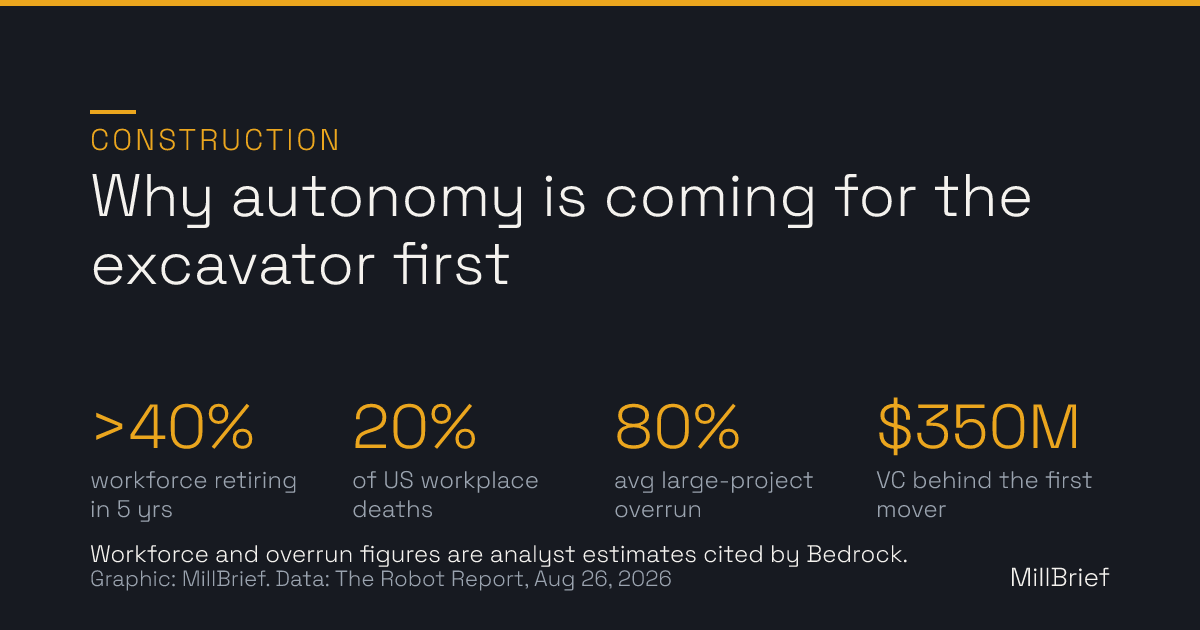
Why it matters: This is the vertical-first playbook from yesterday’s brief executed to the letter: one machine class, one task family, safety case first, human backstop retained. The transferable buyer lesson is in the sequencing: Bedrock sells predictability on the critical-path phase, which is where schedule and cost overruns compound. Note the labor math driving it: analysts cited in the piece expect more than 40 percent of the construction workforce to retire within five years.
Source: The Robot Report, August 26, 2026.
Gatik raises $200M on freight that’s already moving
The same day, Gatik announced a $200 million Series D led by Qatar Investment Authority and Koch Disruptive Technologies. What separates this from the humanoid raises we’ve been tracking is that the numbers attached are operating numbers, not specs (though all are the company’s own): more than $600 million in contracted revenue, 85,000 fully driverless orders completed, 99 percent on-time delivery, and dozens of driverless trucks running regional routes for PepsiCo, Kroger, Tyson Foods, and Georgia-Pacific. The PepsiCo relationship dates to 2022 and now spans Texas, Arizona, and Arkansas. The model is deliberately unglamorous: short, high-frequency, repeatable routes between distribution centers and stores, not long-haul moonshots.
Why it matters: Contracted revenue and completed-order counts are the metrics a buyer can diligence; “capability” demos are not. If you’re evaluating any autonomy vendor (trucks, tugs, or AMRs), Gatik’s disclosure list is a useful template for what to ask: orders completed without a human, on-time percentage, and named repeat customers. That’s payback evidence, not promise.
Source: The Robot Report, August 26, 2026.
Ex-Meta scientists release an open-weight vision model for the factory floor
TechCrunch profiles Perceptron, founded in late 2024 by two former Meta FAIR research scientists, which just launched Isaac 0.5, a vision model built to let industrial robots “perceive, reason and act” in warehouses and on factory floors, released open-weight so anyone can inspect the parameters. The pitch targets a real pain point: today you choose between generalist foundation models that need dedicated cloud GPUs per robot, or narrow models that do perception or control but not both (the company’s framing). Training ran on a claimed one million hours of video, including ego-video (task footage shot from workers’ head-mounted cameras), though the sources aren’t disclosed. Funding so far is modest by physical-AI standards: $16 million per PitchBook, with a new round reportedly closing.
Why it matters: An open-weight perception layer is the kind of infrastructure that eventually shows up inside the vision systems and cobot cells buyers actually purchase. Compare the closed, per-vendor stacks in Monday’s data-babel essay. The skeptical read: “general-purpose” is exactly the claim this week’s market repricing punished, and undisclosed training data is a diligence question if the footage came from real workplaces. Worth watching, not yet worth specifying.
Source: TechCrunch, August 26, 2026.
NVIDIA’s next entry-level robot brain: 78 TOPS, first half of 2027
Engineering.com covers the Jetson Orin Nano 2, NVIDIA’s new entry-level robotics computer: 78 trillion operations per second of AI compute, 8GB of memory, an 8-core Arm CPU, and (per NVIDIA) twice the inference performance of the current Orin Nano Super, or the same performance at 40 percent less power in 15-watt mode. It’s sized for vision systems, inspection drones, and small robots, and runs memory-efficient language and vision-language models on device. Cognex (machine vision), Doosan Bobcat, and Alphabet’s Wing delivery drones are among those adopting or evaluating it. Module and dev kit land in the first half of 2027.
Why it matters: For scale: yesterday’s XPeng IRON humanoid carries 2,250 TOPS of onboard compute; this puts 78 TOPS (plenty for inspection cameras and line-side vision QC) at entry-level pricing. When machine-vision inference runs on a module this size, adding a vision check to a cell stops being a server-room project, which changes the is-it-worth-it math for small shops. The date matters too: H1 2027 availability means don’t let a vendor spec tomorrow’s silicon for this year’s project.
Source: Engineering.com, August 26, 2026.
Sources
- Bedrock Robotics' first operator-free excavator deployments take off (The Robot Report, 2026-08-26)
- Gatik brings in $200M to continue expanding autonomous trucking operations (The Robot Report, 2026-08-26)
- Ex-Meta scientists want to bring visual AI to the factory floor (TechCrunch, 2026-08-26)
- NVIDIA introduces Jetson Orin Nano 2 for edge AI development (Engineering.com, 2026-08-26)