Industry Brief, September 26, 2026: Amazon's Indiana plant, suppliers eye defence, Optimus
Today’s lead is Amazon deciding to make more of its own equipment: it plans a fabrication and assembly plant in Indiana and will hire the same welders, CNC operators and controls engineers that smaller plants in the region employ. After that: European car suppliers with empty capacity looking to defence work, a report that the hands on Tesla’s Optimus robots are still assembled by people, and Agility Robotics saying it is exploring robots on wheels. As always, the writing is ours, each item links to the original outlet, and vendor numbers are labelled as vendor numbers.
Amazon will build its own fabrication plant in Indiana, and hire welders and controls engineers to run it
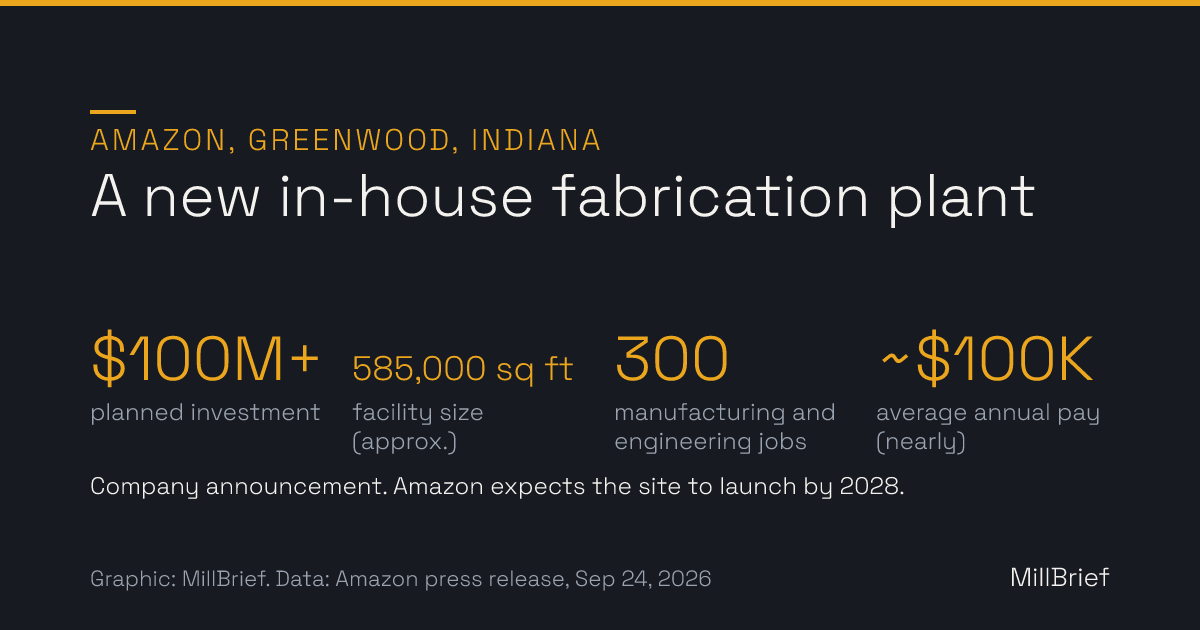
Amazon has announced plans to invest more than $100 million in an advanced manufacturing facility of about 585,000 square feet in Greenwood, Indiana (our conversion: about 54,300 square metres), the company said in a press release on September 24. The plant will combine fabrication, robotic welding, automated powder coating and assembly, and will make products used in Amazon’s fulfillment centers across North America. Amazon expects it to launch by 2028, and says it is bringing these manufacturing capabilities in-house to strengthen its supply chain.
The company says the site will create 300 jobs paying an average of nearly $100,000 a year. The roles it lists include CNC operators, welders, powder coating technicians, assemblers, manufacturing engineers, quality assurance specialists, controls engineers and program managers. Amazon says it chose Greenwood for Indiana’s manufacturing workforce, costs, logistics and business climate. The plant follows an August announcement of a robotics manufacturing investment in Texas. The Robot Report carries the same figures and notes Amazon’s claim that it has made more than one million robots in the U.S., now deployed across more than 300 facilities worldwide.
Why it matters: Two things for smaller manufacturers. First, if you fabricate, weld or coat parts that end up in warehouse equipment, one of the largest buyers of that equipment has just said it will make more of it in-house. Second, and nearer to hand for plants around Indianapolis, a new employer will be recruiting welders, CNC operators and controls engineers at an advertised average of nearly $100,000. That is a reason to plan for skills you cannot easily hire, including who will maintain any robot cell you buy. Our questions to ask a system integrator cover training and support after handover.
Sources: Amazon, September 24, 2026 (company press release); The Robot Report, September 25, 2026.
Europe’s car suppliers have spare capacity, and some are looking at defence
A long BBC News report looks at car makers and their suppliers turning to military work as car volumes fall. Ford’s Dagenham plant in east London has seen engine output fall from 90,000 a year to about half that over the last decade. Ford is in a joint venture with General Dynamics and Ricardo bidding for a UK Ministry of Defence contract for 9,000 light vehicles over five to seven years, and Jaguar Land Rover (JLR) is bidding for the same contract. Renault has an agreement with Thales to make military drones, targeting up to 1,000 a month, and Volkswagen has agreed to sell an under-used factory in Osnabruck to become a military manufacturing hub.
The supplier side is the part that matters here. JLR had announced about two weeks earlier that it would cut 4,000 of its 30,000 UK jobs. In an open letter, JLR suppliers, representing businesses with more than 8,600 direct employees, together with the Confederation of British Metalforming (about 75,000 workers), argued that the supply chain was “not in decline” but “in the wrong market”. Industry estimates cited by the BBC put western Europe’s spare car-plant capacity at roughly 2.5 million vehicles a year.
Not everyone thinks defence fills the gap. Sigrid de Vries of the European car makers’ association ACEA told the BBC that security protocols, political and economic rivalries, and the fact that peacetime volumes will not replace the mass consumer market, make them “two very different worlds”. Ford UK’s Lisa Brankin called the vehicle contract “a drop in the ocean”. Our arithmetic: 9,000 over five to seven years is roughly 1,300 to 1,800 a year (9,000 divided by 7 is about 1,286; divided by 5 is 1,800), against about 45,000 engines a year now at Dagenham (half of 90,000).
Why it matters: For a supplier weighing defence work, the volumes described here are low and the requirements are different (the BBC’s sources point to security protocols among them), and winning a first contract can take time. That changes the automation case. Equipment sized for a few long car programmes may not suit many short runs, so flexibility and changeover time matter more than peak rate. Before buying for a new market, run the numbers at the new volumes with our automation ROI and payback guide.
Source: BBC News, published September 22, 2026, updated September 25, 2026.
Optimus hands are reportedly still assembled by hand
Tesla is finding it hard to reach its goal of making 20,000 Optimus humanoid robots a week, The Verge reports, citing The Information. According to that reporting, Tesla made “several hundred robots a week” last month after converting its Model S and Model X production lines to Optimus earlier this year. The conversion has reportedly caused manufacturing problems, such as lining up parts precisely, because Optimus parts are much smaller and must fit together far more precisely than car parts.
Even in the “V3” robots now being built, the hands and forearms reportedly have more than 100 screws and other small components that a worker currently assembles by hand. The Verge adds that the robots are still used internally for specific tasks in limited areas, and that Tesla reportedly plans to lease them at first rather than sell them. The Verge’s piece does not include a comment from Tesla.
Why it matters: A car plant is being retooled for a product whose small, precise parts it was not built to handle, and part of the job is still done by people. The same thing happens at smaller scale: a line or cell that suits one product may not suit the next, and small fasteners and tight tolerances are often where automation stops. If you are scoping an assembly cell, start with the steps that are already stable. Our guide to what to automate first covers the questions to ask.
Source: The Verge, September 25, 2026 (citing The Information).
Agility Robotics, the legged-robot company, says it is exploring wheels
When Agility Robotics launched its Digit 5 humanoid earlier this month, a rendering of a humanoid on wheels appeared near the end of its launch video. The Robot Report asked why, and Jonathan Hurst, the company’s chief robot officer, confirmed that Agility is “exploring a range of robot designs and form factors, including wheels” for different environments and customer needs. Asked whether that means a wheeled Digit or a new robot, he said it was “too early to say”; there is no timeline.
The Robot Report sets this against Agility’s finances as it goes public through a SPAC with Churchill Capital Corp. XI in a deal that values the company at $2.5 billion. The deal filings show $1.8 million in 2025 revenue against a $140 million operating loss, and Agility says in its S-4 filing that it has more than $300 million in multi-year Digit 5 orders from one customer, to be fulfilled over the coming years. The outlet notes that wheels bring stability, simpler mechanics and lower energy use on flat, predictable floors, while legs help with stairs and uneven ground.
Why it matters: Most factory floors are flat. If a company built around legged robots is looking at wheels, a buyer should ask what legs add for their own site before paying for them. The filing also shows how concentrated the order book is: one customer. When you consider an early-stage robot, ask how many customers are running it in production, and plan for what happens if the product changes. Our comparison of cobots and industrial robots covers matching the machine to the job.
Source: The Robot Report, September 25, 2026.
Sources
- Amazon to Create 300 High-Paying Jobs at New Advanced Manufacturing Facility in Greenwood, Indiana (Amazon, 2026-09-24)
- Amazon to invest $100M in new Indiana manufacturing facility (The Robot Report, 2026-09-25)
- Europe's car makers are in crisis. Will the threat of war rescue them? (BBC News, 2026-09-22)
- Tesla's Optimus robot is going through growing pains (The Verge, 2026-09-25)
- Agility Robotics, maker of Digit humanoid, exploring wheeled robots (The Robot Report, 2026-09-25)