Industry Brief, October 9, 2026: PACK EXPO palletizers, peach-sorting SCARAs, Exotec
Three stories today, two of them from the end of the line. Kawasaki and CMES Robotics are each bringing a palletizer to PACK EXPO in Chicago this month, one built around tight floor space and low ceilings, the other around mixed case sizes. A Greek fruit processor explains what it took to get AI vision and washdown SCARA robots sorting peach halves. And a Wisconsin building-supply distributor’s storage-and-picking system has passed its first year. As always, the writing is ours, each item links to the original source, and vendor claims are labelled as vendor claims.
Two palletizers for PACK EXPO: Kawasaki’s compact CP110L and a CMES mixed-case cell
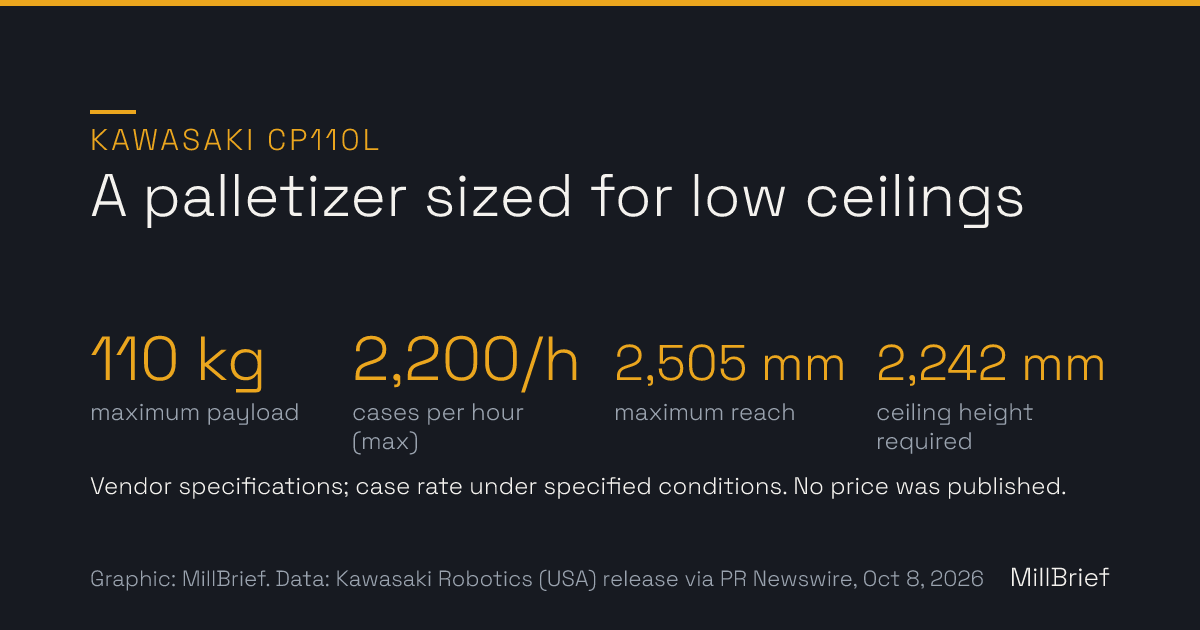
Kawasaki Robotics (USA) will launch its CP110L palletizing robot in North America at PACK EXPO International, October 18 to 21 at McCormick Place in Chicago, the company said in a news release on October 8. The pitch is a 110 kg payload in a package meant for end-of-line areas where floor space and ceiling height are limited. Kawasaki’s figures: up to 2,200 cases per hour “under specified operating conditions” (about 37 a minute, our arithmetic: 2,200 ÷ 60 = 36.7), a maximum reach of 2,505 mm, a required ceiling height of 2,242 mm (about 7 ft 4 in) and a revolute-axis interference radius of 453 mm. It has four axes, a robot mass of 820 kg and a hollow wrist that routes cables and hoses inside the arm. Power regeneration, which recovers energy as the arm decelerates, is standard. With the CP110L, Kawasaki’s CP palletizing series now spans payloads from 110 to 700 kg. No price was given.
Kawasaki’s booth (N-5933) will also have two smaller packaging cells built with partners: a case packer from Design For Making around an RS013N robot (13 kg payload, 1,460 mm reach), and IRIS Factory Automation’s RPZ-U palletizing system with an RS025N robot (25 kg, 1,885 mm). The release cites PMMI’s 2026 Robotics in Packaging & Processing report, in which 61% of end users surveyed expect to increase their robotics investment over the next 12 months.
Kawasaki Robotics EMEA’s official channel has a video from the robot’s European premiere at Interpack earlier this year:
At the same show, CMES Robotics will give its AI-vision mixed-case palletizer its first public U.S. showing at booth N-5772, according to a company news release dated October 6. The system launched internationally in the first quarter of 2026. CMES says it identifies, orients and stacks cases of different sizes and shapes onto one pallet, is aimed at third-party logistics providers and large distribution centers, and is designed to fit into existing lines without redesigning the surrounding facility. The release gives no throughput, payload or price figures.
Why it matters: Palletizing is often a good first robot project because the work is heavy and repetitive. The CP110L’s selling point is the ceiling height, so measure yours, including sprinklers, lights and ducts, before you talk to a dealer. Treat 2,200 cases an hour as a ceiling, not a plan: ask what case weight, pattern and gripper that figure assumes, and what rate your own mix gives. For mixed-case systems like CMES’s, bring your real SKU list and ask for a measured rate and error rate on it, since the release gives neither. Our industrial robot cost guide covers what sits around the arm, and the RFQ generator helps put those questions into a quote request.
Sources: Kawasaki Robotics (USA) release via PR Newswire, October 8, 2026; CMES Robotics release via Robotics Tomorrow, October 8, 2026; Kawasaki Robotics EMEA on YouTube.
Eight washdown SCARA cells pick out bad peach halves at a Greek plant
At Agrophoenix, a fruit processor founded in 2018 in Greece’s Imathia region, eight inspection cells now remove defective peach halves from the line, Robotics & Automation News reported on October 8. The cells use STAQ, an AI vision system from Dutch startup QING, with a Stäubli TS2-80 SCARA robot in its HE (humid environment) washdown version mounted over each conveyor. The main job is finding halves that still contain pit pieces. After washing, steam peeling, halving, pitting and a colour pre-check, each half is photographed in the cell, and the robot lifts the rejects onto side belts. Rejects with larger pits go to automatic re-pitting, the smaller ones to manual inspection, and both then go back through the cells. Because QING uses AI to train the vision system, the article says, the plant can teach the system what counts as acceptable and change the settings itself.
The figures come from the people involved. Partner and project manager Lazaros Ioannidis says the plant counts by weight: 15 tons an hour, which at about 150 g a peach is roughly 100,000 peaches, or 200,000 halves (our check: 15,000,000 g ÷ 150 g = 100,000). He adds that 3,600 of them can be rejected in that time. QING commercial director Will Uijting says the robots can pick one peach half per second. The article explains that because the fruit has already been graded, few halves are rejects, which is what lets 15 tons an hour pass through the eight cells. The lines stop every four hours for a 20-minute automatic cleaning cycle, with a deeper clean with food-grade detergent each Sunday. QING chose H1 oil for the robots because they are mounted above the conveyors carrying the fruit.
It took two seasons, not one, to make the cells production-ready, and the holdup was not the AI, the software or the robots. Peeled peaches are slippery, so the team had to find a conveyor material that kept them in place, and a vacuum gripper and contact material that could pick and release halves lying cup-down. The system has now completed its first harvest season. Next, the plant and QING want to try removing pit fragments automatically.
Why it matters: This is a useful template for any food or consumer-goods plant thinking about vision-based reject picking. Two points carry over. First, the reject rate decides how many robots you need: this works because upstream grading keeps rejects low, so get your own defect rate measured before you size a cell. Second, the gripper and the surface the product sits on took a whole extra season; budget time and money for handling trials with your real product, and for washdown-rated equipment and cleaning downtime if you run wet. Our list of hidden costs of automation covers trials and downtime, and what to automate first helps pick a starting point.
Source: Robotics & Automation News, October 8, 2026.
A building-supply distributor’s first year with Exotec Skypods
Exotec has deployed its Skypod storage and picking system at First Supply’s warehouse in West Salem, Wisconsin, Robotics & Automation News reported on October 8. First Supply is a wholesale supplier of HVAC, plumbing, building, lighting, waterworks and other industrial products, and the article describes it as a fifth-generation business in the region. According to the article, it can now offer next-morning delivery at scale for orders placed by 5 p.m., and that next-day orders can make up as much as 20% of the distribution center’s daily volume.
The headline numbers are listed as “expected” impacts rather than measured results: 4x growth in storage capacity without expanding the existing racking footprint, with 30% additional capacity kept for future hardware, picking 10 times faster than manual processes, more than 14,000 SKUs in the system, and less walking for operators. The system has been running for just over a year. First Supply chief logistics officer Steve Baer said the system lets the company meet peak season and peak daily demand, and Exotec North America managing director Stanislas Normand called the results a sign of what the right automation strategy can deliver. The article does not give the system’s size or cost.
Why it matters: Plenty of mid-size manufacturers run a parts or finished-goods store that looks like this one: thousands of SKUs and a same-day cutoff. A year in is a good point to ask for measured figures, and this story mostly gives expected ones. If you are quoting goods-to-person storage, ask the vendor for an existing site you can visit and for measured picks per hour and uptime after year one, not projections. Also ask how much spare capacity is built in and what adding more robots or picking stations would cost. Our automation ROI and payback guide and the TCO calculator help test a proposal on your own numbers.
Source: Robotics & Automation News, October 8, 2026.
Sources
- Kawasaki Robotics to Launch CP110L Palletizer in North America at PACK EXPO (PR Newswire (Kawasaki Robotics (USA) news release), 2026-10-08)
- CMES Robotics Brings AI-Powered Mixed Case Palletizer to the U.S. for the First Time at PACK EXPO International 2026 (Robotics Tomorrow (CMES Robotics news release), 2026-10-08)
- Kawasaki Robotics CP110L: European Premiere at Interpack 2026 (Kawasaki Robotics EMEA (official YouTube channel), 2026-10-09)
- Stäubli robots and AI inspect 100,000 peaches an hour at Greek processing plant (Robotics & Automation News, 2026-10-08)
- First Supply deploys Exotec robots to increase warehouse picking speeds tenfold (Robotics & Automation News, 2026-10-08)