Industry Brief, October 10, 2026: UK robot adoption hubs, Danu, Cyngn, AWS toolchain
Four stories today, and most of them come back to one question: whose numbers are you looking at? The UK is setting up regional hubs that offer businesses advice, demonstrations and, in the waste sector, independent testing of robots. A Scottish recycling-robot startup has put a striking payback pitch on the record. Cyngn has published nine months of fleet data for its autonomous tuggers. And AWS has released an open-source toolchain for training and deploying robot AI models. As always, the writing is ours, each item links to the original source, and vendor claims are labelled as vendor claims.
The UK’s robotics adoption hubs take shape: one-to-one advice in the South West, a waste-sector testbed in the South East
Businesses in the UK’s Greater South West will get one-to-one help deciding whether and how to adopt robots through a new £9.8 million regional programme, Robotics & Automation News reported on October 9. The Greater South West Robotics Adoption Hub is led by Bristol Robotics Laboratory through the University of Bristol, with UWE Bristol and the National Composites Centre (NCC), and has 23 partners from industry, academia and local government. The money is £7.2 million from Innovate UK plus £2.6 million from project partners (our check: £7.2m + £2.6m = £9.8m). The NCC will run the advisory service: advisers will help companies spot automation opportunities, assess possible solutions, build investment cases and connect with expertise and finance. The hub will also offer industrial site visits, demonstration facilities and proof-of-concept work. Sectors named include maritime, energy, food and drink, aerospace manufacturing and healthcare. It is expected to be fully operational by January 2027.
It is one of eight Robotics Adoption Hubs funded across the UK. In a second report the same day, the outlet said Kingston University will lead the National Waste and Recycling Robotics Adoption Hub (NORAH), a £3.6 million project (£1.5 million of it for Kingston) within what it describes as a £40 million government scheme. The article says fewer than 5% of UK waste facilities have adopted automation, which it puts down to some robotic systems struggling to work reliably on contaminated, mixed and deformable material, leaving operators unable to predict performance or quantify the return. NORAH plans to test robots on live waste streams and promises independent benchmarking on operators’ own waste samples, “generating measured performance data rather than vendor-derived metrics”, plus site-specific payback modelling. Project lead Professor Vasilis Argyriou said the aim is to support more than 150 organisations and deliver operational deployments by 2030.
Why it matters: If you run a small or mid-size plant in the Greater South West, this is largely publicly funded help with the hardest early step: deciding what to automate and whether the numbers stack up. The South West hub is not fully open until January 2027, so now is the time to get your own data ready (cycle times, labour hours, scrap rates) so an adviser can work with real figures. NORAH’s promise of measured results on your own material is worth asking for from any vendor, hub or no hub. Our piece on why good paybacks go unbuilt covers what tends to stall projects after the business case is written, and what to automate first helps pick a candidate.
Sources: Robotics & Automation News on the Greater South West hub, October 9, 2026; Robotics & Automation News on NORAH, October 9, 2026.
Danu Robotics’ recycling robot comes with a payback pitch to test
Edinburgh-based Danu Robotics is bringing its H.E.R.O. sorting robot to market after six years of development, TechCrunch reported on October 9. The robot picks recyclables with a pincer claw rather than the suction used by competitors such as Glacier, and the company uses AI to keep improving the robot’s software. According to the article, Danu has raised $5 million in late-seed funding, has $500,000 of signed contracts and letters of interest from two large customers, and counts more than 200 customers in its sales pipeline.
The numbers buyers will notice are founder Amy Ma’s own estimates: a site would earn $485,000 in additional revenue from having the robot on the sorting line, against a $160,000 initial investment and $24,000 a year in maintenance fees. The article does not say over what period the $485,000 is earned. If it were per year, the payback would be about four months (our arithmetic: $160,000 ÷ ($485,000 − $24,000) = 0.35 years, or about 4.2 months). Ma’s next goal is a sturdier, smaller and more versatile robot that could sort waste at the source, for example at shopping centres, hospitals or airports. Danu is in TechCrunch’s Startup Battlefield 200 at Disrupt in San Francisco, October 13 to 15.
Why it matters: Today these robots are sold to recycling sites, and Danu wants smaller units that sort waste where it is created. Either way, a payback measured in months is a claim to test, not a plan. Ask what period the revenue figure covers, what material mix, prices and pick rate it assumes, and whether a site you can visit has measured it. Contaminated, mixed material is where, according to the NORAH item above, some systems struggle to work reliably. Our automation ROI and payback guide shows how to rebuild a vendor’s payback on your own inputs.
Source: TechCrunch, October 9, 2026.
Cyngn publishes nine months of autonomous tugger fleet data
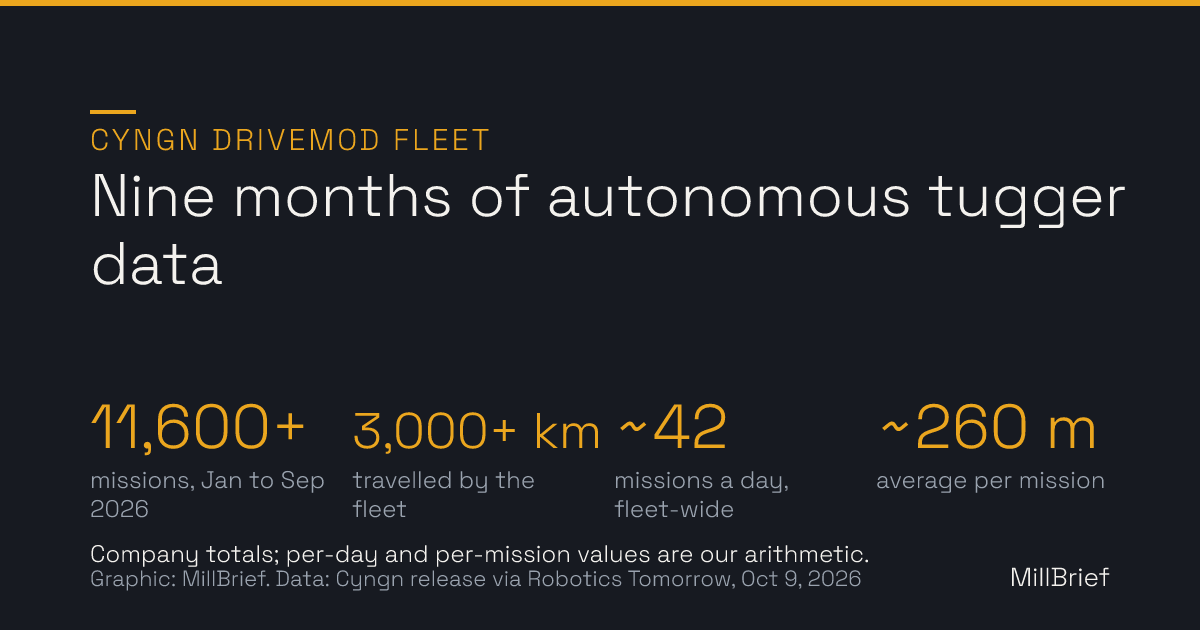
Cyngn, the Nasdaq-listed maker of autonomous DriveMod tuggers, says its fleet completed more than 11,600 missions and travelled over 3,000 km across customer operations in the first nine months of 2026, in a company release published by Robotics Tomorrow on October 9. It says fleet activity reached a monthly high in September and that the number of industrial locations using its vehicles grew during the year. The release does not say how many vehicles or sites the figures cover.
Some context from our own arithmetic: January to September is 273 days, so 11,600 missions works out to about 42 a day for the whole fleet (11,600 ÷ 273 = 42.5), and 3,000 km over 11,600 missions is about 260 m a mission (3,000,000 m ÷ 11,600 = 259). The daily figure is a floor, since the company says “more than” 11,600; the distance per mission is only a rough average, because both totals are given as minimums. Cyngn says its tugger targets a typical payback of under two years, needs no infrastructure installation, and lets customers start with one defined material-movement workflow; it says its EasyLaunch program lowers the upfront commitment.
Why it matters: Fleet totals without a fleet size cannot tell you how hard each vehicle works, and that is what drives payback. If you are quoting autonomous tuggers, ask for missions per vehicle per shift, route length and uptime at a site like yours, and check them against the manual moves you would replace. Short routes like a 260 m average can still pay if they are frequent; count your trips before the demo. Our TCO calculator helps put the answers into numbers.
Source: Cyngn release via Robotics Tomorrow, October 9, 2026.
AWS releases an open-source toolchain for building robot AI
Amazon Web Services has released the Physical AI Toolchain on AWS, an open-source set of reference architectures, infrastructure-as-code and deployment automation for developing robot AI models, Engineering.com reported on October 9. It covers synthetic data generation, model training, simulation and validation, edge deployment, and improvement using data from deployed machines. It combines AWS services (SageMaker for training, EC2 GPU instances for simulation, S3 for storage and IoT Greengrass for edge deployment) with NVIDIA software including Isaac Sim, Isaac Lab, Isaac GR00T, Cosmos and OSMO, and supports formats such as ROS 2, URDF and ONNX. One AWS example uses 27 episodes of pick-and-place teleoperation data from a UR3 robot.
Prerequisites listed in AWS’s technical blog, as reported, include an AWS account with approved GPU capacity, an NVIDIA NGC API key and a Hugging Face token. Amazon says the toolchain can help manufacturers launch physical AI capabilities in weeks rather than years; the article notes that this is the company’s stated expectation, not an independently verified result. NEURA Robotics, RLWRLD and Config are named as companies working on physical AI in Amazon’s announcement.
Why it matters: This is a toolkit for robot developers and integrators, not something most plants will run themselves. What it signals is that cloud and chip vendors are competing to cut the cost of training robots for new tasks, which over time could mean cheaper changeovers on cells you buy. For now, if a supplier pitches an AI-trained cell, ask where the model is trained and hosted, what cloud or GPU costs you would carry, and who retrains it when your parts change. Our questions to ask a system integrator cover the support side of that conversation.
Source: Engineering.com, October 9, 2026.
Sources
- UK's National Composites Centre to lead business support for new £9.8 million Greater South West robotics hub (Robotics & Automation News, 2026-10-09)
- Kingston University chosen to lead UK's first waste and recycling robotics hub (Robotics & Automation News, 2026-10-09)
- Danu Robotics' fight to build a better recycling robot (TechCrunch, 2026-10-09)
- Cyngn Autonomous Fleet Expands Operational Footprint Across Industrial Facilities in 2026 (Robotics Tomorrow (Cyngn news release), 2026-10-09)
- AWS launches open-source toolchain for physical AI development (Engineering.com, 2026-10-09)