Industry Brief, October 13, 2026: Fork palletizing gripper, CIIF launches, robot pace
The China International Industry Fair (CIIF) opened in Shanghai on Monday, and ABB and JAKA used it to launch hardware in size classes small and mid-size plants buy. First, a gripper for a palletizing job that often stays manual: open and flimsy boxes. Last, an Ars Technica report on Amazon gathers the evidence on what happens to people when robots set the pace of work. Most figures today are vendor figures, and we say so where they appear.
An off-the-shelf electric gripper for boxes that vacuum cannot lift
OnRobot announced the 2FGP20 Fork on October 12, according to a release carried by Robotics Tomorrow. It is an all-electric palletizing gripper for open boxes, display boxes and other low-rigidity packaging: it lifts the box from underneath with forks and steadies it from above with an adjustable top clamp. OnRobot calls it the first globally available out-of-the-box tool for this type of packaging. It says feedback from its integration partners suggests packaging that cannot be lifted by vacuum or side gripping is “a significant share” of potential palletizing projects, and that such jobs have needed custom pneumatic tooling or stayed manual.
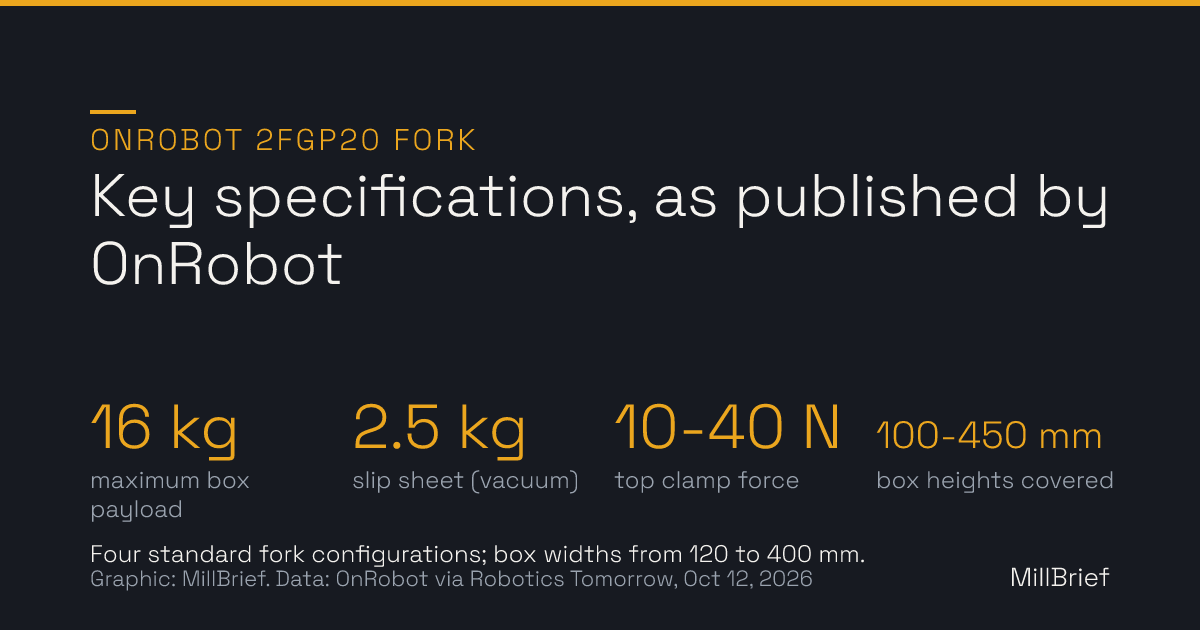
The published specifications: up to 16 kg box payload, a 260 mm fork stroke, a 218 mm top clamp stroke, 10 to 40 N of adjustable clamping force, and four standard fork configurations covering box heights from 100 to 450 mm and widths from 120 to 400 mm. A built-in electric vacuum pump handles interlayer slip sheets up to 2.5 kg without a tool change, and no compressed air is needed. Plugins and scripts are listed for ABB, Doosan, Fanuc, JAKA, Omron TM, Techman, Universal Robots and Kawasaki, with digital signals for other brands. Global shipments began September 25. No price was given.
The release quotes Javier Tena, director of operations at integrator PowerBots, who says programming patterns for hundreds of box references “used to take months”, and that with the gripper and OnRobot’s D:PLOY software someone without advanced programming experience can set up the next one. That is a partner’s testimonial in a vendor release.
Why it matters: If your end-of-line palletizing is still manual because the cartons are open or soft, this is a catalogue part rather than a custom tool, which usually means a shorter quote and spares you can reorder. Check the limits against your heaviest SKU (16 kg), your tallest and widest box, and your robot brand before asking for a quote, and ask for a trial on your own packaging, since the “hundreds of references” claim comes from one integrator. Our cobot price comparison and TCO calculator help size the rest of the cell.
Source: Robotics Tomorrow, October 12, 2026 (company release).
ABB launches a compact arm family and a vision training tool for integrators
ABB Robotics used CIIF, which runs October 12 to 16, to debut the IRB 1700 and IRB 1700ID, according to a release on Robotics Tomorrow. The family has five variants with payloads from 6 to 12 kg, runs on ABB’s OmniCore controllers, and is aimed at material handling, arc welding, deburring, sanding and machine tending. ABB’s figures: path repeatability down to 0.03 mm, joint speeds up to 700 degrees per second, a footprint 50% smaller than its predecessor, up to 15% lower power consumption and up to 20,000 hours between oil changes. It also claims cycle times up to 20% shorter than comparable robots on the market, without naming them. The ID version routes cables and hoses inside the arm. No prices or ship dates were given.
In a second release, ABB added AI Robot Trainer to its OmniCore EyeMotion vision software. It is designed for system integrators and automation partners: it turns shop-floor images, mixed with synthetic data, into trained vision models, deploys them to the robot, and keeps improving them, with a guided workflow and an AI chatbot. ABB says it works with any brand of camera and sensor and covers jobs from 2D pick and place to 3D bin picking, inspection, sorting and assembly. Its headline claims, commissioning time cut by up to 90% and cycle time by up to 50% when combined with automatic collision-free path planning, are ABB’s own, with no baseline stated.
Why it matters: A 6 to 12 kg arm with long service intervals is squarely the size class for machine tending and small welding cells, so the IRB 1700 is worth adding to a shortlist once prices appear. The vision tool matters more indirectly: it is sold to your integrator, so the questions belong in the RFQ. Ask whether your integrator uses it, who owns and retrains the vision model when your parts or lighting change, and what that costs after handover. Our questions to ask a system integrator cover the rest.
Sources: Robotics Tomorrow and Robotics Tomorrow, October 12, 2026 (company releases).
JAKA adds a 50 kg cobot and reports deployment times for its wheeled humanoid
Also at CIIF, Chinese robotics firm JAKA unveiled the Zu50, a collaborative arm with a 50 kg payload, and the Kargo50, a heavy-duty wheeled humanoid for moving totes and materials between workstations, Interesting Engineering reported on October 12. Citing JAKA’s product listing, the outlet says the Zu50 reaches up to 2,100 mm and offers up to 50% higher axis speeds; the article does not say compared with what. JAKA has not released payload or other specifications for the Kargo50.
The more useful numbers concern the smaller Kargo10, which JAKA says is in large-scale commercial use at automotive parts and electronics factories. According to the company, on-site engineering support cut its time to handle one tote from 105 seconds to 28 seconds, and deploying it in a new operating scenario now takes 57 days. These are JAKA’s figures, reported without independent data.
Why it matters: A 50 kg payload with 2.1 m reach puts the Zu50 in the range for case palletizing and heavier machine loading, where the alternative is often a fenced industrial robot; whether it can run collaboratively at useful speed with that load depends on your risk assessment, not the brochure. The Kargo10 figures are a reminder that the first cycle time a mobile robot achieves on site may be far from the one it settles at, and that “deployment” can mean about two months of engineering. Ask any vendor for both numbers, and who pays for the weeks in between. Our cobot vs industrial robot comparison sets out the trade-offs.
Source: Interesting Engineering, October 12, 2026.
When the robot sets the pace: what Amazon’s injury data shows
A long report by Jeremy Hsu in Ars Technica, published October 12, walks through Amazon’s fleet of more than 1 million robots, most of them still wheeled mobile robots, and what it means for its human workers.
The part most relevant to smaller plants is a study published in the journal ILR Review in April 2025. As Ars reports it, Amazon’s robotic warehouses had a 40% decrease in severe injuries compared with legacy fulfillment centers, but a 77% increase in less severe injuries linked to strain from repetitive motions. Co-author Brian Greenwood, a business professor at George Mason University, told Ars that pick rates at the robotic sites are much higher and that “the robot is dictating the pace of work”, which appears to be driving the strains and sprains. The study drew partly on weekly data from more than 150 Amazon warehouses from 2016 to 2019; Greenwood said he has not seen much evidence that the dynamics have changed.
Amazon has called earlier critical reports, by a union coalition and a US Senate committee, flawed and reliant on data that predates its newest robots. A spokesperson told Ars that since 2019 its recordable incident rate has improved 43% and its lost-time incident rate 70%, without breaking out robotic and non-robotic sites. Amazon also says its advanced robotic sites typically need 30% more staff in reliability, maintenance and engineering roles.
Why it matters: The finding is not specific to Amazon’s scale. If a cobot or a goods-to-person system feeds a person at a fixed rate, the robot removes the heavy lifts but can raise the number of small repetitive motions that person makes each shift. Set the pace from the human station, not the robot’s maximum, design that station for repetition, and track minor strain reports as well as lost-time injuries after go-live. Budget for maintenance skills too. Our guide to the hidden costs of automation covers staffing after installation.
Source: Ars Technica, October 12, 2026.
Sources
- OnRobot Launches 2FGP20 Fork, a Ready-to-Deploy Electric Gripper for Challenging Palletizing Applications (Robotics Tomorrow, 2026-10-12)
- ABB Robotics introduces two new high-performance robots for precision manufacturing (Robotics Tomorrow, 2026-10-12)
- ABB Robotics enables anyone to train, deploy and optimize AI-powered robotics applications (Robotics Tomorrow, 2026-10-12)
- China's tote-moving wheeled humanoid, 110-pound robot arm target factory automation (Interesting Engineering, 2026-10-12)
- Amazon has over 1 million robot workers. What's next for human employees? (Ars Technica, 2026-10-12)