Industry Brief, October 22, 2026: A humanoid for AGCO, a gripper that feels, AI line setup
Four items today, and none of them comes with a price. AGCO signed up to pilot Agility’s Digit humanoid at a Kansas plant from 2027, Robotiq put tactile sensing and onboard compute into its widely used 2F gripper, Siemens described AI tools it is testing in its own electronics factory, and a startup founded by OpenAI’s former research chief raised $230 million on the promise of faster line changes. Each is worth knowing about; the useful part for a smaller buyer is the question each one raises.
AGCO plans a humanoid pilot at its Hesston, Kansas plant
AGCO, the agricultural machinery maker behind the Fendt, Massey Ferguson, PTx and Valtra brands, has signed a commercial agreement with Agility Robotics to deploy the Digit humanoid in its manufacturing operations, The Robot Report reported on October 21. The US pilot is expected to begin in 2027 at AGCO’s production site in Hesston, Kansas.
According to Agility, Digit will first support assembly and production operations, including sorting and stacking parts and placing totes for storage. Agility says the robot, managed through its cloud-based Arc fleet platform, can be added without extensive infrastructure changes or costly facility upgrades; that is the company’s claim. The report names Toyota, GXO Logistics and Schaeffler as other Digit customers. It gives no number of robots, price or contract value.
The deal lands during a busy stretch for Agility, which unveiled Digit 5 last month and is due to go public through a merger with Churchill Capital Corp XI. That deal is expected to close in the fourth quarter of 2026, with trading on Nasdaq under the ticker AGLT.
Why it matters: The first jobs named here, moving totes and sorting and stacking parts, are ones that conveyors, mobile robots and fixed cells already handle in many plants. The humanoid pitch is that one machine can work in spaces built for people without changing the layout. A pilot that starts in 2027 will not tell anyone much until it has run for a while, so if a vendor offers you a humanoid for similar work, ask for measured uptime and parts handled per hour from a running site, and price the same task with conventional equipment. Our guide to what to automate first covers how to pick that first task.
Source: The Robot Report, October 21, 2026.
Robotiq adds touch and onboard compute to its 2F gripper
Robotiq launched the 2FC, an adaptive gripper with tactile sensing and built-in computing, in a release published on RoboticsTomorrow on October 21. Pre-orders are open now in 85 mm (2FC-85) and 140 mm (2FC-140) stroke versions, and shipping begins in the first quarter of 2027. The release gives no price.
The 2FC is built on Robotiq’s 2F adaptive gripper, of which the company says more than 30,000 are deployed. It adds tactile sensors, compute at the wrist (Robotiq calls it the AI Hub) and Contact Core software. The gripper records pressure, vibration, proprioception, force, position and current, synchronized at millisecond level, and Robotiq says a ROS 2 package and C++ SDK will be on its GitHub. On the gripper itself it currently runs grasp quality assessment, incipient slip detection, object pose estimation, object centering and an advanced grip check, and reports labelled events rather than only raw signals. Robotiq rates it for 2 million cycles.
Owners of existing 2F grippers can add the TSF tactile sensors and the AI Hub instead of replacing the gripper, the company says. Robotiq will present the 2FC in a webinar on October 28 at 11 a.m. ET.
Why it matters: The release is pitched at teams training AI models, but slip detection and grip checks address a plain shop floor problem: a part that shifts or drops in a machine tending or packing cell stops the cell. The upgrade path is the detail to note if you already run 2F grippers. Before paying for it, ask what the sensor and AI Hub kit costs per gripper, which robot brands and controllers can act on its events without custom code, and whether a slip alarm can stop the cycle. The arm prices in our cobot price guide exclude grippers and other tooling, so budget for them separately.
Source: Robotiq release via RoboticsTomorrow, October 21, 2026.
Siemens reports AI tools that set up inspection before the first prototype
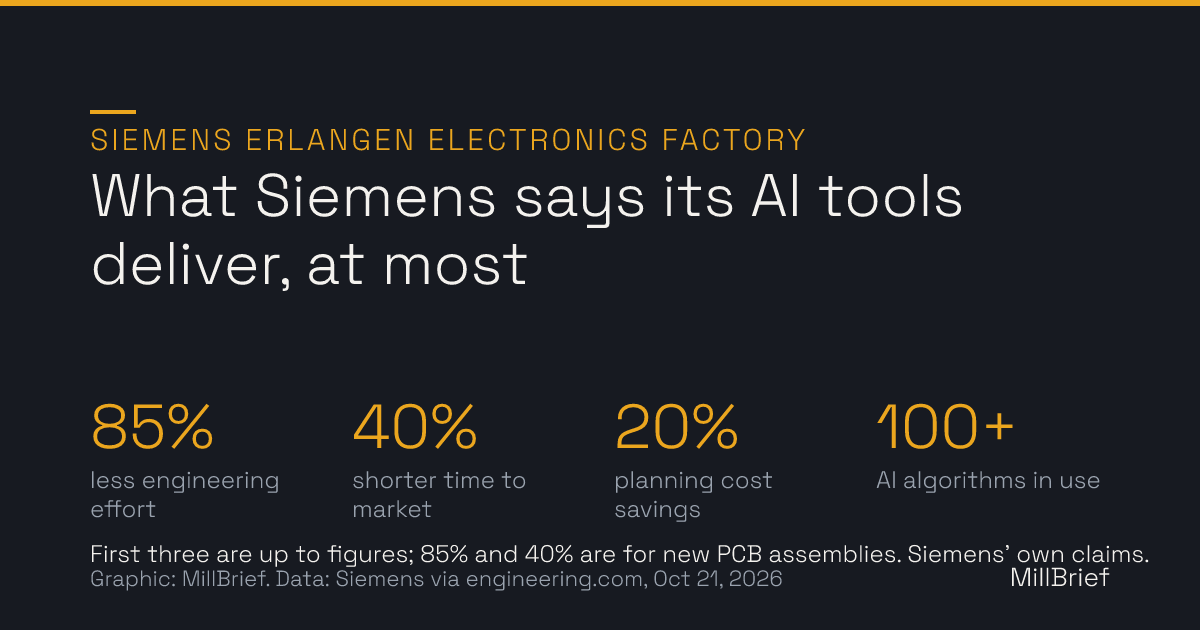
Siemens has put AI applications into use at its Electronics Factory in Erlangen, Germany, as part of its work with Nvidia on AI-supported manufacturing, engineering.com reported on October 21. The plant, established in 1971, employs about 1,000 people making power electronics and automation technology, and already uses more than 100 AI algorithms in production, logistics, quality inspection and maintenance. The two companies built the first applications in less than ten months.
The first tool tackles inspection setup. Preparing quality inspection for a new printed circuit board assembly could take several weeks, because teams needed physical prototypes to train vision systems and configure inspection equipment. The new workflow uses AI to generate photorealistic images of the board from its digital twin, so inspection can be prepared before prototypes exist. For boards used in drives and frequency converters, the report puts the gain from this virtual production preparation at up to 85% less engineering effort and up to 40% shorter time to market.
The second tool is an AI agent for production planning. When orders arrive, it generates scenarios that account for capacity, material availability, delivery dates and line constraints, shows planners the effect of each option; proposed plans are then tested on a digital twin of the plant before they go live. Siemens says this can support cost savings of up to 20%. All of these figures are Siemens’ own, from its own plant; the article cites no independent measurement.
Why it matters: Most small plants will not build digital twins of their boards or factories, but the bottleneck Siemens names is a common one: a vision inspection system cannot be trained until real parts exist, so inspection setup ends up on the critical path of a launch. When you buy a vision system or a cell with inspection, ask how many good and bad sample parts the supplier needs, whether it can start training from CAD models or synthetic images, and how many days of tuning on site are in the quote. Setup time that is not in the quote is one of the hidden costs of automation.
Source: engineering.com, October 21, 2026.
Arda raises $230 million to make automation keep up with design changes
Arda, a startup led by Bob McGrew, OpenAI’s former research chief, has raised $230 million at a $1.5 billion valuation, the company told CNBC in an interview published October 20. Altimeter Capital, Accel and Khosla Ventures led the round. Arda makes AI software to help automate manufacturing, and McGrew said its models are already deployed with the military technology company Anduril.
McGrew described the product as a user interface and an AI agent for manufacturing engineers, comparable to what coding assistants do for programmers, and said it lets them build assembly lines much faster. His case rests on changeover: after a design change, he said, a person can be retrained in a day, but changing the automation takes three to six months. He said robotics is next on the product roadmap. The article does not say what the software costs or when it will be available to other manufacturers.
Why it matters: McGrew’s three to six months is his own figure, but the problem is familiar to any high-mix shop: automation that cannot keep up with frequent design changes is why many short-run jobs stay manual. Nothing here is on sale to small manufacturers yet. The practical step today is to put changeover in the quote: ask an integrator what it costs, in hours and money, to adapt a cell to a new part or a revised drawing, and who does the work. Our piece on why short paybacks go unbuilt looks at what keeps projects off the shop floor.
Source: CNBC, October 20, 2026.
Sources
- AGCO to deploy Agility Digit humanoid in Kansas factory (The Robot Report, 2026-10-21)
- Robotiq Launches the 2FC Physical AI Gripper (RoboticsTomorrow (Robotiq release), 2026-10-21)
- Siemens tests AI manufacturing tools at Erlangen plant (engineering.com, 2026-10-21)
- Former OpenAI exec has quietly built $1.5 billion startup, betting AI can revive U.S. manufacturing (CNBC, 2026-10-20)