Industry Brief, October 23, 2026: Formic's $50M, an AI welding cobot, pallet AMRs
Four company announcements today, all from October 22, and all of them about the part of automation that sits around the robot rather than the robot itself. Formic raised $50 million to grow its robots-for-a-monthly-fee business, ESAB launched a welding cobot that works out its own weld path, Signode added mobile robots that carry pallets away from the end of the line, and Schaeffler set a target of cutting automation costs by up to 40% with a software platform built on Wandelbots NOVA. None of the four gives a price. The figures below are the companies’ own, and we say so each time.
Formic raises $50 million for robots paid by the month
Formic, which supplies factory robots on a monthly fee rather than a sale, has raised $50 million in growth capital, according to a company release on Business Wire dated October 22. The money combines a Series B led by Mercato Partners, with Light Ray Ventures, Lightscape Partners, Citi and other new and existing investors taking part, and debt financing from S2G Investments. The release does not say how the $50 million splits between equity and debt.
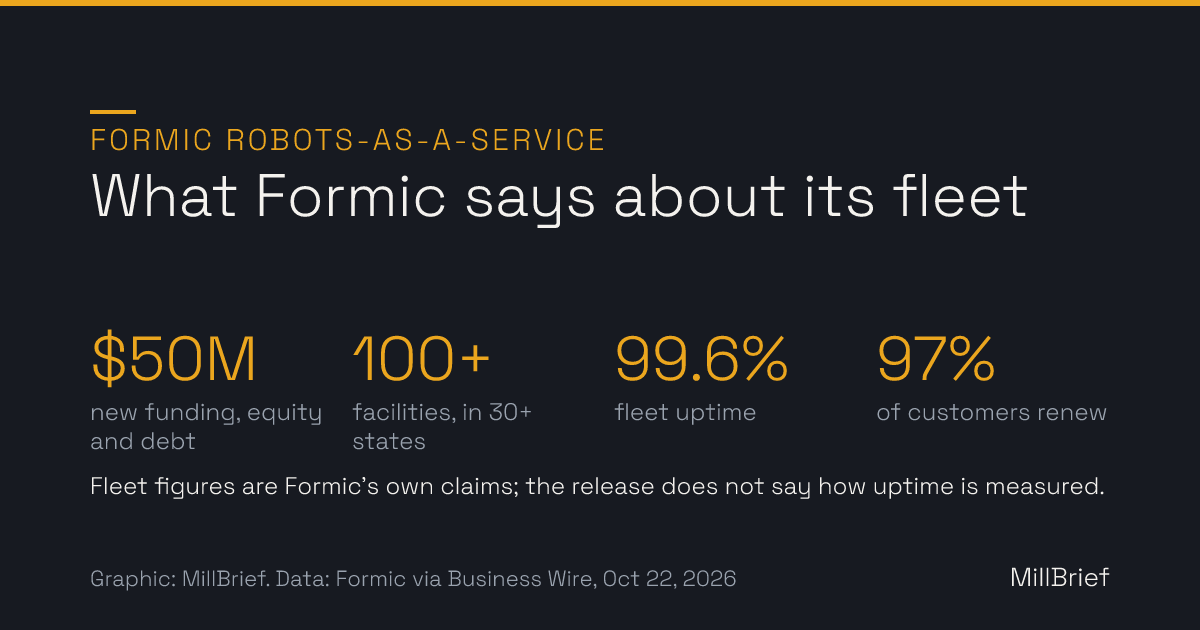
Formic’s model bundles the equipment, deployment software, field operations, maintenance, financing and performance monitoring into one recurring monthly payment, with no upfront capital from the customer. The company says it runs hundreds of robots across more than 100 facilities in over 30 states, that its fleet runs at 99.6% uptime and that 97% of customers renew; those are Formic’s own figures. Its applications include palletizing, case packing, machine tending and kitting. Formic says the new money will move it from task-specific automation towards general-purpose robots, working with Physical Intelligence on AI models, and into new work such as metal fabrication. It assembles and tests robots at a new facility in Bolingbrook, Illinois.
Why it matters: Paying by the month turns a capital purchase into an operating cost and puts uptime on the supplier, which suits a plant that cannot tie up cash or does not have robot maintenance skills in house. It also makes the supplier’s health part of your production plan, so new funding is relevant to existing and prospective customers. Before signing any robots-as-a-service deal, ask for the monthly rate in writing, the minimum term, the cost of ending early, what happens to the equipment at the end, and how uptime is measured in your contract rather than across the fleet. Then use our TCO calculator to itemize what buying the same cell outright would cost, and set that against the monthly fee.
Source: Formic release via Business Wire, October 22, 2026.
ESAB’s ROBBI AI welding cobot plans its own weld path
ESAB has launched ROBBI AI, a cobot welding system for MIG and TIG that uses camera and laser sensing to find the joint and generate its own weld path, according to a release published on RoboticsTomorrow on October 22. The operator places the cobot at or near the joint, enters the parameters from the welding procedure specification (consumables, material, weld type) and starts the weld. ESAB says the system can change travel motion, oscillation or welding parameters if the joint gap opens or closes, within the set procedure, and can stop a weld when it detects a condition that could cause a defect.
The system records weld data and video for operators to review, and its AI runs on a computer inside the customer’s facility rather than in the cloud. ESAB says its InduSuite software keeps the AI’s decisions inside the welding procedure specification and qualification requirements. Users can switch off the full AI mode and run it as a conventional cobot. The arm is a Universal Robots unit (the release lists the UR10e and UR 20e), offered with a seventh axis or on a wheeled cart, paired with EWM Titan XQ, EWM Tetrix XQ or Aristo Edge 500R power sources. ESAB aims it at low-volume, high-mix work, joints whose fit-up varies, pipe fabrication and TIG. The release gives no price or ship date.
Why it matters: Teaching every path and coping with poor fit-up are two of the main reasons small fabrication shops keep welding manual, and this release goes after both. The claims are ESAB’s, and the test is your own parts: ask for a trial on your worst-fitting assemblies, the range of gap it can handle, how often it stops a weld and what that costs in rework, and whether its adjustments stay inside procedures your customers or code body have already approved. The arm is only part of a cell’s price; our cobot cost guide shows what else to budget for.
Source: ESAB release via RoboticsTomorrow, October 22, 2026.
Signode adds mobile robots to move pallets off the end of the line
Signode, the transit packaging equipment and materials maker, has expanded its range of autonomous mobile robots for moving palletized loads through plants and warehouses, the company said in a release on RoboticsTomorrow on October 22. The range covers lifting robots, pallet trucks, counter-balanced forklifts, reach trucks and stacker forklifts. They navigate without fixed lines or magnetic strips and reroute around obstructions, and are designed to work with warehouse and fleet management software.
The robots are meant to connect Signode’s palletizing and packaging equipment with its StorFast automated storage and retrieval system, for example by delivering finished pallets into storage. Signode says StorFast and its wider warehouse automation range have more than 800 vehicles deployed at over 80 locations worldwide. “One customer has integrated more than 17 robots within a single warehouse,” said Shawn Semer, Signode’s vice president of global automation. The release does not name the robots’ maker or give payloads, lift heights or prices.
Why it matters: Once a palletizer is running, the next manual job is often the forklift trip that takes the pallet away, and buying that move from the company that supplied the line gives one point of contact. Ask who builds the vehicles and who services them, the payload and lift height for your heaviest load, which safety standard they meet (ISO 3691-4 or ANSI/ITSDF B56.5 for driverless trucks), and how they share aisles with your manual forklifts. Our questions to ask a system integrator apply to an equipment maker selling integration as well.
Source: Signode release via RoboticsTomorrow, October 22, 2026.
Schaeffler targets up to 40% lower automation costs with Wandelbots
Schaeffler, which calls itself The Motion Technology Company, has formed a technology partnership with the German deep-tech company Wandelbots to build a physical AI platform for its plants on Wandelbots’ NOVA software, according to a release on RoboticsTomorrow dated October 22. The goal is to cut the cost of automation solutions by up to 40% over their whole lifecycle, in new and existing production. That is a target, not a measured result. The platform is set to become available to all Schaeffler plants worldwide.
NOVA separates the application logic from the robot hardware, so the same program can in principle run on industrial robots, mobile robots or humanoids from different makers. Processes are first simulated and checked in Nvidia’s Omniverse and Isaac Sim, then sent to the shop floor through the same software layer, and Schaeffler plans a library of reusable robot skills. In earlier joint projects, the release says, development time for a robot-assisted packaging cell fell by around two weeks per application. Schaeffler’s production network has several thousand robotic systems. Wandelbots’ chief executive, Christian Piechnick, said NOVA is not an off-the-shelf product but a foundation that companies build their own platforms on.
Why it matters: A manufacturer with several thousand robots can build its own software platform; a shop with three cells cannot. The idea that carries over is portability: programs that are tied to one robot brand and one integrator’s code are expensive to move, change or hand to a new supplier. When you buy a cell, ask whether you receive the full program and simulation files, whether the cycle was proven offline before installation, and what commissioning time is in the quote. Engineering change orders, billed at the integrator’s hourly rate, are among the hidden costs of automation.
Source: Wandelbots release via RoboticsTomorrow, October 22, 2026.
Sources
- Formic Raises $50 Million to Scale Physical AI Across American Manufacturing (Business Wire via FinancialContent (Formic release), 2026-10-22)
- ESAB ROBBI AI Cobot for MIG and TIG Welding Automation Brings Physical AI to the Shop Floor (RoboticsTomorrow (ESAB release), 2026-10-22)
- Signode Expands Autonomous Mobile Robot Portfolio to Advance End-of-Line and Warehouse Automation (RoboticsTomorrow (Signode release), 2026-10-22)
- Schaeffler Leverages Wandelbots NOVA as Its Physical AI Platform (RoboticsTomorrow (Wandelbots release), 2026-10-22)