Industry Brief, October 30, 2026: Robot import finding, robotic milling, AI inspection
Four items today. The White House has formally found that imports of robots and industrial machinery threaten US national security, but has chosen negotiations over tariffs, for now. Fives is pitching robots as a cheaper alternative to big CNC machines for large parts that do not need tight tolerances. Siemens and P&G are rolling out an AI inspection system across P&G’s plants. And a contributed column makes the case for looking after the Windows PCs that run your machines. Vendor numbers are labelled as vendor numbers, and any arithmetic marked as ours is ours.
Washington calls robot imports a security risk, but sets no tariff yet
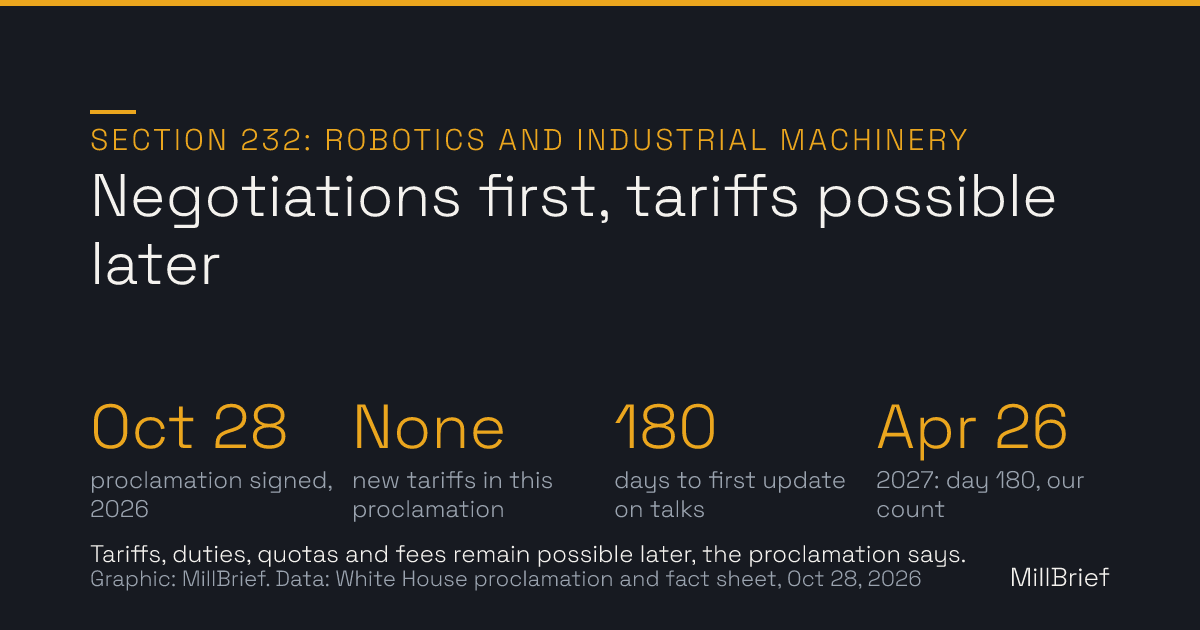
On October 28, President Trump signed a proclamation under Section 232 of the Trade Expansion Act of 1962 covering imports of robotics, industrial machinery and their parts and components. It accepts the Commerce Secretary’s finding that these imports arrive “in such quantities and under such circumstances as to threaten to impair the national security of the United States.” It does not impose tariffs. Instead, it directs the Commerce Secretary and the US Trade Representative to negotiate agreements with trading partners and to report on progress within 180 days. By our count, day 180 falls on April 26, 2027.
The proclamation says that, depending on how the talks go, the president may later consider tariffs, duties, quotas and fees, and a programme to encourage new US production of robots, machinery and components. Under Section 232 he may also take other action if no agreement is reached within 180 days, or if one is not carried out or proves ineffective. The White House fact sheet says the negotiations cover imports “from any country.” Among the Secretary’s findings: the US relies on imports for most types of robots, industrial machinery and their components, produces less than it consumes, and some equipment from “certain foreign entities” carries cybersecurity risks.
The Robot Report gathered early reactions. Ash Sharma of Interact Analysis said the decision “shouldn’t be read as a new robotics tariff today” but shows the direction of travel, and that any later measures could affect components as well as finished robots. Robert Little, a former robotics strategy chief at Novanta, said his biggest concern was the thin US supply of components such as sensors, actuators, precision gears and encoders. Ars Technica notes that the four biggest industrial robot makers (FANUC, ABB, Yaskawa and KUKA) are headquartered in Japan, Switzerland and Germany, that no US company offers comparable heavy-duty arms, and that any tariff would be paid by the US companies importing the robots.
Why it matters: Nothing changes on your invoice today. But the proclamation covers parts and components as well as finished robots and machines, so a later duty could reach spare parts and the reducers, motors and controllers inside a cell built in the US. If you are quoting imported equipment for delivery around or after next spring, ask the supplier three things in writing: the country of origin of the main components, whether the price is fixed at order or at delivery, and who pays if a duty is added in between. Our RFQ generator has room for those terms, and our page on hidden costs of automation covers what else to pin down before you sign.
Sources: White House proclamation and fact sheet, October 28, 2026; The Robot Report and Ars Technica, October 29, 2026.
Fives pitches robots instead of big CNC machines for large, looser-tolerance parts
Fives High Precision Machines has set out the case for its Liné Machines RoboTDM, an industrial robot fitted with a spindle, toolholder and cutter that machines large workpieces in place, in a company article published by RoboticsTomorrow on October 29. Fives aims it at jobs where a tolerance of about 0.1 mm is good enough: face milling and deburring castings, trimming weld beads, drilling pilot holes in large panels, and trimming and routing composite or thermoplastic parts.
Fives says conventional robots typically hold about 0.3 mm, and that calibration and motion-planning software bring RoboTDM’s machining deviation down to 0.1 mm, which it calls a threefold improvement (0.3 / 0.1 = 3). The company says its development trials showed cycle-time reductions of up to 70% in trimming and milling. Spindles are available with up to 125 kW, up to 80 Nm of torque and up to 30,000 rpm, and options include tool changing, tool measurement, breakage detection, part probing and vision for drilling. Fives also says the system needs lighter foundations than a large machine tool, and that where tolerances tighter than 0.1 mm are needed, a CNC machine is still the right choice. It is built in Granby, Quebec. No prices were given.
Why it matters: If you deburr large castings or trim welds by hand, or tie up a big machining centre on work that does not need its accuracy, robotic machining is worth pricing. Treat the 70% figure as a best case from the vendor’s own trials, and ask for a test cut on your part with the accuracy measured on your material. Compare the quote with our industrial robot cost ranges, and remember that dust or chip extraction, guarding and fixturing come on top.
Source: RoboticsTomorrow (Fives release), October 29, 2026.
Siemens and P&G expand an AI inspection system across P&G plants
Siemens and Procter & Gamble are extending an AI-based quality inspection system, the Visual Inspection Cockpit (VIC), across P&G’s manufacturing operations worldwide, Engineering.com reported on October 29. The two companies developed it together for high-speed consumer goods lines, where soft, textured materials can shift, stretch or wrinkle and traditional vision systems often need reconfiguring when materials or packaging change. It combines P&G’s deep-learning models with Siemens’ Industrial Edge platform and industrial PCs with Nvidia GPUs.
The system inspects at full line speed, processes results next to the line, and can trigger alerts or reject defective products automatically. According to the article, scrap fell by 10% to 20% depending on the product, and new deployments can be commissioned five to ten times faster than traditional custom vision systems. The article does not say who measured these figures or how, so treat them as the companies’ claims. It also does not say whether VIC is offered to other manufacturers, or at what price.
Why it matters: The interesting claim for smaller plants is the commissioning time, since retuning vision for each new product is often where inspection projects stall. When a vendor offers you AI inspection, ask how many good and bad samples it needs to train on a new product, who retrains it, and what the reject rate is on good parts. Then put the scrap saving through our ROI and payback page using your own scrap cost, not the vendor’s percentage.
Source: Engineering.com, October 29, 2026.
The Windows PCs behind your machines may be the weakest link
In a contributed column for Robotics & Automation News, Nathan Spitalny, chief executive of RDE Technologies (a managed IT and cybersecurity provider, so a firm that sells this kind of service), argues that the HMI and SCADA PCs in small and mid-size plants are often the least watched computers in the building. He gives three reasons: old operating systems (standard editions of Windows 10 lost support on October 14, 2025, unless enrolled in Extended Security Updates, though some industrial LTSC editions are supported longer), no visibility of failing disks or disabled antivirus, and plant networks shared with the office.
His fix is remote monitoring and management (RMM) software on the Windows machines, with patches approved and timed for maintenance windows rather than pushed automatically. He also warns that attackers abuse these tools, citing a 2023 CISA advisory (AA23-025A), so the console needs multi-factor authentication, limited remote access and logged sessions, and the agent should be kept off PLCs and safety systems.
Why it matters: His starting point costs nothing: list every Windows machine that touches production, what operating system it runs and who supports it. If your integrator set those PCs up, their support terms may decide who is allowed to patch them, so check before anyone installs an agent. On new projects, write operating system support dates and patch responsibility into the quote; our questions to ask an integrator are a good place to add them.
Source: Robotics & Automation News, October 28, 2026 (contributed column).
Sources
- Adjusting Imports of Robotics, Industrial Machinery, and Their Parts and Components into the United States (The White House, 2026-10-28)
- Fact Sheet: President Donald J. Trump Adjusts Imports of Robotics, Industrial Machinery, and their Parts and Components into the United States (The White House, 2026-10-28)
- White House makes Section 232 determination regarding foreign-made robots (The Robot Report, 2026-10-29)
- Trump declares robot imports a national security threat (Ars Technica, 2026-10-29)
- Large-Part Machining Transformed with High-Precision Robotics (RoboticsTomorrow (Fives release), 2026-10-29)
- Siemens and P&G expand AI quality inspection deployment (Engineering.com, 2026-10-29)
- The Factory PCs Nobody Patches: Why Automation Needs Remote Monitoring (Robotics & Automation News, 2026-10-28)