Industry Brief, November 7, 2026: Rockwell tariff refunds, peak support, a safer humanoid
Three items today. The first one could put money back in your pocket: Rockwell Automation says it will refund customers who paid its tariff-related price increases, now that it has received refunds of the duties itself. The second is a look at how a robot vendor gets its customers through the busiest weeks of the year, which is a fair test of any vendor’s support. The third is a new humanoid from a Swiss start-up that was designed to be safe around people. Company claims are labelled as such, and arithmetic marked as ours is ours.
Rockwell will refund customers who paid its tariff price increases
Rockwell Automation reported its fiscal 2026 fourth quarter and full year results on November 5, in a release filed with the SEC. In the quarter, which ended September 30, Rockwell received $103 million of refunds of tariffs it had paid under the International Emergency Economic Powers Act (IEEPA), plus $5 million of interest. It also approved and communicated a refund program for customers that paid price increases on products affected by IEEPA tariffs, and booked an accrual of $85 million for the refunds it expects to issue. The release calls the $85 million an estimate and does not say when or how customers will be paid.
The customer refunds were booked as a reduction of sales, which cut both reported and organic growth in the quarter by about 4 percentage points, Rockwell says. Fourth quarter sales were $2,332 million, up 1 percent, and up 3 percent organically. Full year sales were $8,989 million, up 8 percent, and adjusted earnings per share were $13.42, up 27 percent. Software and Control was the strongest segment, with fourth quarter sales up 15 percent; Intelligent Devices grew 5 percent, and Lifecycle Services fell 9 percent, mostly because of businesses sold (organic sales there grew 2 percent).
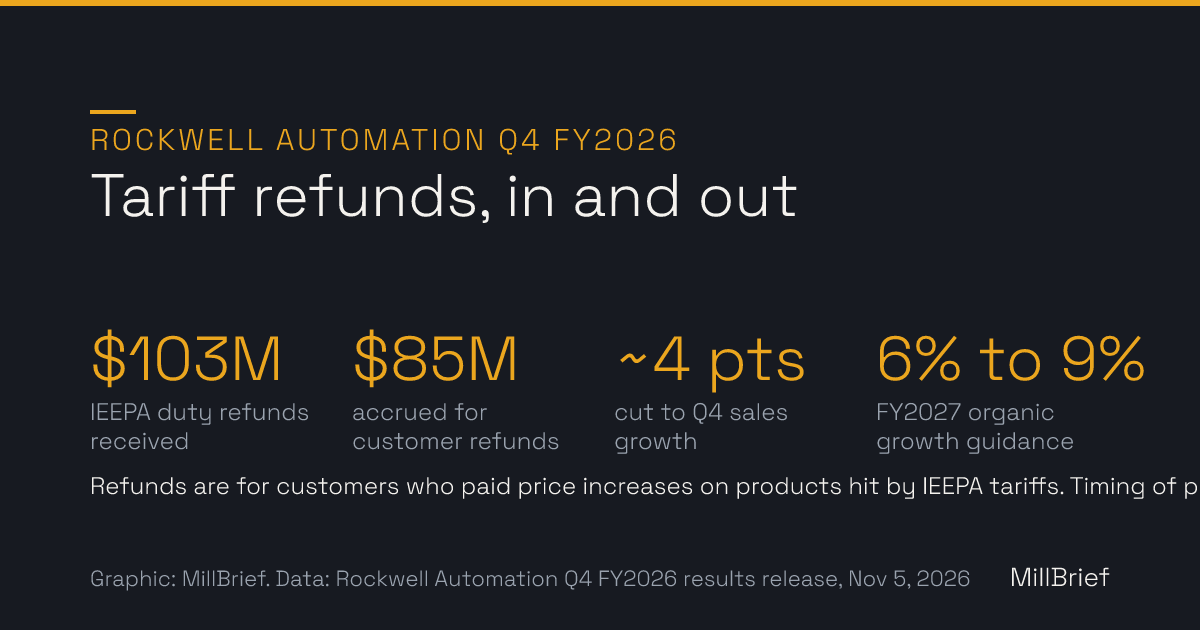
For fiscal 2027, Rockwell guides to reported sales growth of 4.5 to 7.5 percent, organic growth of 6 to 9 percent and adjusted earnings per share of $14.50 to $15.50. About 1 point of that growth is a benefit from the 2026 refund program, Rockwell says; our reading is that the refunds lowered the 2026 base. Chairman and CEO Blake Moret said the company enters 2027 “with healthy customer demand and significant new product releases.” By our arithmetic, the $85 million set aside for customers is about 83 percent of the $103 million in duty refunds received (85 / 103 = 0.825). There is no reason for the two to match: what customers paid in price increases and what Rockwell paid in duties are different amounts.
Why it matters: If you bought Rockwell Automation products in the past year and saw a tariff surcharge or a price increase blamed on tariffs, ask your distributor now whether those purchases qualify, what records you need and when refunds will be paid. Keep the invoices that show the increase. Then ask your other automation suppliers the same question. Rockwell’s program gives you a public reference point if a supplier says it has no plans to pass refunds on. For future quotes, a tariff clause that works in both directions (price up if duties rise, refund if they are struck down) is worth asking for; our RFQ guide shows where it fits. On vendor health, Rockwell’s numbers point to a stable supplier with growing control and software sales.
Source: Rockwell Automation results release (Form 8-K, Exhibit 99), November 5, 2026.
What a robot vendor does to get customers through peak season
Ambi Robotics, whose AmbiSort systems automate induction, scanning and sorting in final-mile delivery operations, told The Robot Report on November 5 how it prepares for the year-end shipping peak. Co-founder and COO Stephen McKinley said the company expects its customers to see a 9 to 10 percent increase compared with last year’s peak, and that it is installing new systems at eight facilities before peak starts. Customers often meet extra demand by adding shifts or people to work alongside the systems they already have.
The preparation is mostly about people and parts. Ambi gives customers extra training just before peak, because McKinley says performance depends partly on how well trained the operators are. During peak, about half of its team travels to check in on sites while the other half stays ready to fix problems as they come up. Spare parts normally kept at its Berkeley, California headquarters are increased and sent out to East Coast locations that are hubs of customer activity, and spare computers and other critical items are placed at each site. The people on its support hotline are the same people who do training and repairs.
McKinley also said Ambi’s systems do not improve themselves over time on site. The company retrains its models on new data and tests the changes in a controlled environment before rolling them out.
Why it matters: Most small and mid-size plants have their own peak, whether it is a seasonal product, a big customer’s year-end order or a model changeover. Ambi’s routine is a useful checklist for any automation vendor: which critical spares will be on your site or within a day’s drive, who answers the phone and whether they have seen your cell, what refresher training is included before your busy season, and how software or AI updates are tested before they reach your line. Get the answers into the service agreement, not just the sales conversation. Our questions to ask a system integrator and hidden costs of automation cover spares and support lines that are easy to leave out of a quote.
Source: The Robot Report, November 5, 2026.
Embodied AI shows AIR, a wheeled humanoid built to give way on contact
Embodied AI, a robotics company spun out of EPFL and based in Lausanne, Switzerland, unveiled a humanoid called AIR at Humanoid Europe 2026 on November 6, according to a company release on Robotics Tomorrow. AIR is aimed at repetitive manual tasks that change too often for conventional robots. Its motors, gearboxes and electronics sit in the torso, and its light arms are moved by tendons, so they carry almost no mass and give way on contact. It runs on wheels rather than legs, because, the company says, factory floors are flat and wheels are more stable.
The company says AIR is designed under ISO/TS 15066:2016, the technical specification for collaborative robot operation, with CE marking planned for 2027. Each new job starts under the control of a human operator, so the robot is productive from its first shift; every run is recorded, and the company says its software learns from those demonstrations until AIR can do the task alone, typically within a month. The operator stays on hand for anything the robot has not seen before.
The performance claims are the company’s own. It says a consumer electronics manufacturer tested five funded start-ups on a cable handling task, none met its targets, and Embodied AI reached 98 percent reliability against a 90 percent goal. The release presents that result alongside its paid deployments of a two-arm industrial cell and does not say AIR was used. AIR is now being tested with global manufacturers, and the company says it is starting plans for scaled production. The release names no customers and gives no price.
Why it matters: The design choices are the right questions to ask of any humanoid pitch: wheels instead of legs on a flat floor, and safety that comes from light, compliant arms rather than only from software limits. But this is a new product with no CE mark yet, which in the EU a machine generally needs before it is placed on the market or put into service, and a month of operator-guided learning per task is labour you pay for. If you are offered a pilot, ask who supplies the operator during that month, what counts as reliable enough to hand over, and how the safety assessment for your cell will be done. For most small plants a proven cobot is still the lower-risk route; our cobot vs industrial robot page and cobot price data are a starting point.
Source: Robotics Tomorrow (Embodied AI release), November 6, 2026.
Sources
- Rockwell Automation Reports Fourth Quarter and Full Year 2026 Results; Introduces Fiscal 2027 Guidance (Form 8-K, Exhibit 99) (Rockwell Automation via SEC EDGAR, 2026-11-05)
- How Ambi Robotics helps its customers prepare for peak season (The Robot Report, 2026-11-05)
- Embodied AI Unveils AIR, a Physically Safe Humanoid Robot That Learns on the Job (Robotics Tomorrow, 2026-11-06)