Industry Brief, November 13, 2026: DIY bin-picking setup, NVIDIA CEO exit, Siemens orders
Three items today. A vision company wants your own staff, not an integrator, to set up each new part in a bin-picking cell, and we list what to check before believing that. NVIDIA, whose simulation and other technology is used in industrial and mobile robots, has lost its founding CEO, and its board says nothing changes for customers. And Siemens reports that orders at its factory automation business rose in the last quarter, with the U.S. particularly strong. Vendor claims are labelled as such.
Bin-picking setup software aimed at the people who run the line
Eureka Robotics, in an announcement datelined Atlanta, has launched StereoPick, the setup and training software for its AI Vision System, according to a company announcement published by Robotics Tomorrow on November 12. It takes an application through six guided steps: choose the robot, upload CAD files of the gripper and the part, define where the part is picked and placed, and check the cell on a digital twin. The software then trains the vision model on synthetic images rendered from the CAD file and, once the hardware is installed, calibrates the camera to the robot. The company says simple, rigid parts typically train within a few hours, and that everything, including training, runs on hardware in the plant with no cloud connection.
The product page adds that a new part needs zero to ten real images and that a cell can be simulated before any hardware is ordered. A separate mode that needs no training is offered for simple pick and place, which Eureka says suits boxes, bottles and gears laid out in trays but is not a good fit for overlapping industrial parts. A footnote on the same page says that training the AI model on site (the privacy option) is a paid add-on, and an optional training server is offered for faster training. No prices are published; the page directs buyers to sales.
According to the announcement, the system (camera, controller and software) works with any robot arm, carries no subscription fees, is in production at Pratt & Whitney, Subaru and Coherent, and has completed more than 30 million picks. Those are Eureka’s claims.
Why it matters: In many bin-picking cells the vision setup is the slow and costly part, and each new part number can mean another round of integrator time. Software that lets your own team add parts would lower the lifetime cost of a cell, if it works on your parts. Before buying, ask for a trial on your own parts in your own bins, especially shiny or tangled ones; get a written list of what is priced separately (camera, controller, on-site training, the training server); and put a pick rate, cycle time and an agreed response for when picking degrades into the purchase terms. Our RFQ guide shows where, and hidden costs of automation covers the integrator hours this is meant to replace. We covered Shelley Automation taking on Eureka’s system on September 25.
Sources: Robotics Tomorrow (company announcement), November 12, 2026; Eureka Robotics product page.
NVIDIA’s CEO resigns; the board says the roadmap continues
NVIDIA’s board announced on November 12 that Jensen Huang had resigned as president, chief executive and board member, effective immediately, according to the company’s release filed with the SEC. Colette Kress, chief financial officer since 2013, is interim CEO and keeps the CFO role; the board is searching for a permanent CEO and will consider internal and external candidates. Harvey C. Jones, a former CEO and executive chairman of Synopsys, becomes the board’s first chair. Jones said the board expects the company’s “operations, customer commitments and product roadmap to continue without interruption.” Quarterly results are still due on November 17.
The Robot Report says the change follows a week in which NVIDIA’s stock fell about 18.5%. On November 8, it reports, Huang issued a statement apologising over his personal conduct and saying the board had started an independent investigation into national security concerns raised in news reports. The outlet notes that NVIDIA’s simulation and other technologies are used in industrial arms, autonomous mobile robots and humanoids, that the company released new versions of its GR00T robot model and Isaac Lab learning framework this week, and that its planned $12.9 billion purchase of Hugging Face’s AI platform, announced in September, will receive more scrutiny, in the outlet’s view.
Why it matters: Few small manufacturers buy from NVIDIA directly, but The Robot Report notes that its technology is used in industrial arms and mobile robots, so some AI-based equipment offered to you may depend on it. Nothing in the announcement changes a product or a support commitment, and there is no reason to pause a purchase over it. It is a reminder of a question worth asking about any AI-based equipment: which computing hardware and software does it depend on, and for how many years will the vendor support that platform and supply spares? Put the answer in the purchase terms. The November 17 results are the next point where the company will speak publicly.
Sources: NVIDIA release via SEC EDGAR, November 12, 2026; The Robot Report, November 12, 2026.
Siemens’ factory automation orders rise and it raises its targets
Siemens reported results for its fiscal 2026, which ended on September 30, in a press release on November 12. Group orders rose 25% on a comparable basis (excluding currency and portfolio effects) to a record €108.2 billion, and comparable revenue rose 8% to €83.4 billion, a book-to-bill ratio of 1.30 (108.2 / 83.4 = 1.297, by our check). The order backlog reached €143 billion. Siemens raised its mid-term target for comparable revenue growth to 7 to 11% a year, from 6 to 9%, and expects 9 to 11% for fiscal 2027. Much of the strength came from Smart Infrastructure, whose fourth-quarter orders rose 39% on a comparable basis and included numerous larger contracts from data centre customers, mainly in the U.S. and Europe.
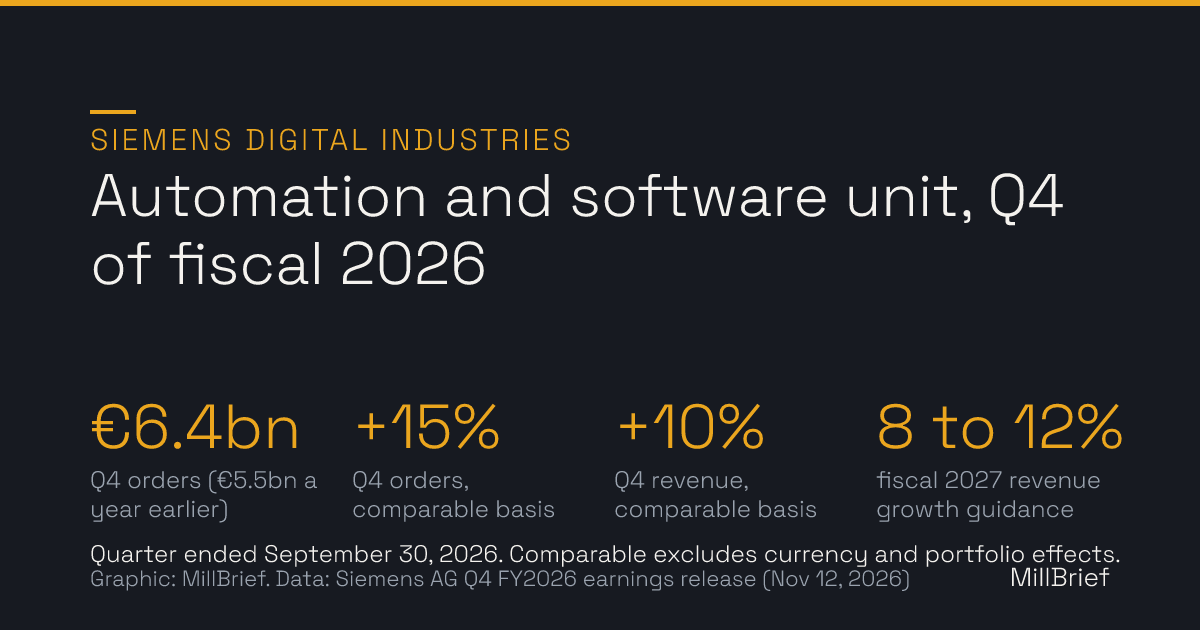
The figures closer to a factory buyer are in the earnings release for Digital Industries, the unit that covers Siemens’ automation and industrial software businesses. Its fourth-quarter orders were €6,414 million against €5,511 million a year earlier, up 16% (15% comparable), and revenue rose 10% on a comparable basis to €5,594 million. Siemens says order growth in automation came mainly from short-cycle businesses (by which it means, in our words, products ordered and delivered quickly rather than large projects), that volume rose in all reporting regions, and that the U.S. contribution was particularly strong. For the full year, the unit’s orders were €20,880 million, up 12% on a comparable basis. Siemens expects Digital Industries to grow comparable revenue by 8 to 12% in fiscal 2027, with a profit margin of 20 to 22%.
Why it matters: Rising short-cycle orders at a major automation supplier suggest that demand for standard automation products is growing, and Siemens singles out the U.S. Its release says nothing about prices or lead times, so it offers no evidence either way on shortages. Still, if you are quoting a project that will be built in 2027, ask your integrator how long component prices and delivery dates in the quote are valid, and get both in writing. Our RFQ guide and production line automation cost pages cover how to structure that.
Sources: Siemens AG press release, November 12, 2026; Siemens AG Earnings Release Q4 FY 2026, November 12, 2026.
Sources
- Eureka Robotics launches StereoPick, allowing anyone to set up 3D picking systems (Robotics Tomorrow, 2026-11-12)
- Bin picking software (StereoPick product page) (Eureka Robotics)
- NVIDIA Announces CEO Transition (Exhibit 99.1 to Form 8-K) (NVIDIA via SEC EDGAR, 2026-11-12)
- NVIDIA replaces CEO amid China AI and robotics concerns (The Robot Report, 2026-11-12)
- Outstanding fiscal 2026 performance: Industrial AI to drive future growth (press release) (Siemens AG, 2026-11-12)
- Earnings Release Q4 FY 2026 (Siemens AG, 2026-11-12)