Industry Brief, July 19, 2026: Japan's physical-AI pact, Doosan's AI ally, open tools
Four items today, and three of them are the same story wearing different logos: the AI software layer moving into industrial robotics: via Japan’s incumbent robot makers, via a cobot vendor’s integration partner, and via open-source tooling. The fourth is a high-payload inspection quadruped entering pilots. As always, we summarize in our own words and link to the original outlet; we report only what each source’s own reporting supports.
Fujitsu, Fanuc, Yaskawa and Kawasaki plan a shared physical-AI platform
Robotics & Automation News reports that Fujitsu is partnering with Fanuc, Yaskawa Electric, and Kawasaki Heavy Industries (with Nvidia providing technology) to develop what the companies describe as an open, sovereign collaborative control platform connecting digital systems with robots and other physical equipment, integrating AI, robotics, simulation, and data analysis. The Nvidia components named are Cosmos foundation models, Omniverse libraries, the Isaac robotics platform, and the Newton physics engine. Stated deployment targets span manufacturing (production planning optimization, autonomous adaptation to changing factory conditions), logistics and retail (material handling tied to real-time sales and inventory data), and healthcare (specimen transport, patient reception). Nvidia CEO Jensen Huang is quoted calling physical AI “the next industrial revolution” and saying “it will be made in Japan.” The partners say they will now develop a roadmap for technology development and commercialization; no budget, timeline, or production targets were given.
Why it matters: Ignore the announcement’s size and look at the names: Fanuc, Yaskawa, and Kawasaki are the robots already bolted to your floor. Startups demo physical AI, but if it reaches an ordinary plant it will most likely arrive through the incumbent vendors’ controllers and service networks, which is why three rivals agreeing on a shared platform is worth noting even at roadmap stage. And roadmap stage is what this is: no product, no dates, no numbers, so nothing here changes a purchasing decision in 2026. The practical move is a diary note, not a budget line: when your next robot refresh comes around, ask the vendor what of this platform actually shipped, with the same show-me-the-spec discipline as our integrator questions.
Source: Robotics & Automation News, July 18, 2026.
Grid Dynamics pairs its physical-AI platform with Doosan’s cobots
Engineering.com reports a partnership between Grid Dynamics and cobot maker Doosan Robotics: Grid Dynamics’ GAIN platform for physical AI will be paired with Doosan’s collaborative robots, with the companies aiming to offer what they call turnkey physical AI solutions to industrial users and to extend joint R&D around robotics policy control. The use cases they name are telling: processing and inspection of complex-geometry objects, assembly with variability, and packaging of unseen and deformable items, tasks the announcement describes as “not tractable for traditional robotics software.” Doosan is described as operating in 45 countries. No customers, pricing, figures, or timelines were disclosed.
Why it matters: The named use cases are precisely the jobs that get “no-quoted” today: if your parts vary, deform, or arrive unsorted, conventional automation vendors walk away or quote you a fixture-heavy cell that dies on the next product change. AI-driven manipulation is the credible route to those jobs, and it arriving as an integrator offering on top of a mainstream cobot line is more buyable than a research demo. But with no named customers or pricing, treat it as a capability claim: if you have one of these no-quote tasks, it costs little to ask for a paid feasibility trial on your actual parts, priced against the integrator rates and cobot cost baselines you would apply to any cell, with scrap rate and cycle time as the acceptance numbers.
Source: Engineering.com, July 17, 2026.
Nvidia and Hugging Face grow LeRobot, the open robotics AI stack
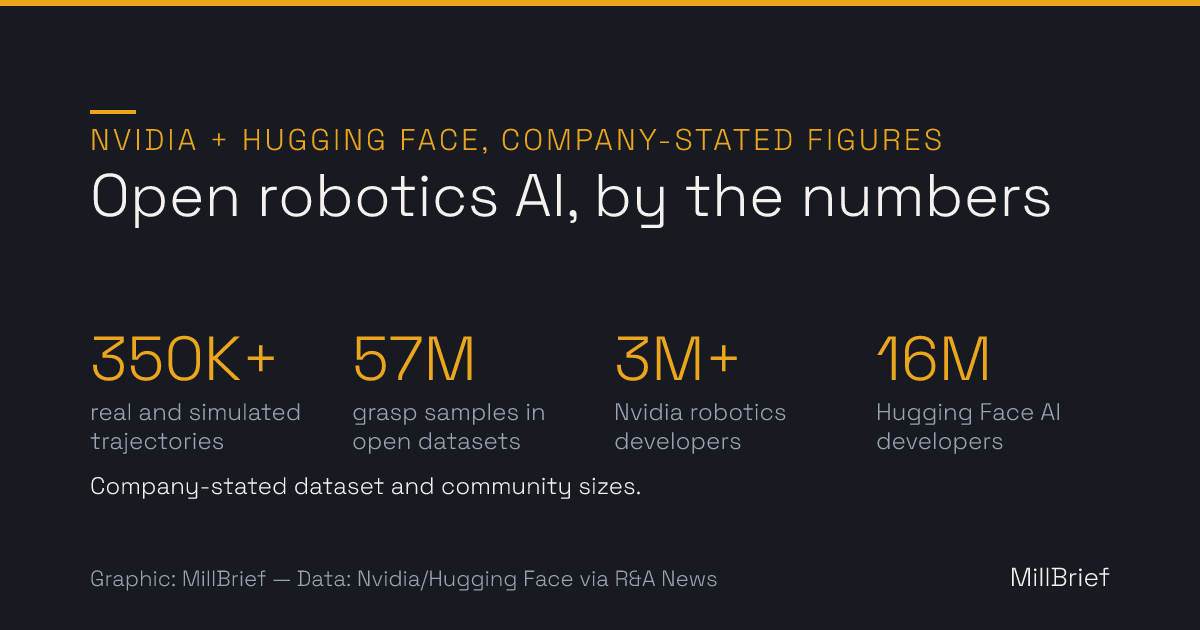
Robotics & Automation News reports that Nvidia and Hugging Face are expanding the open-source LeRobot project. New integrations include Nvidia Isaac GR00T 1.7, an open vision-language-action foundation model for humanoid robots, and the Isaac Teleop framework for collecting human demonstrations from external devices in standardized formats; an integration of Cosmos 3, Nvidia’s world foundation model for physical AI, is described as planned rather than live. Already available through the ecosystem, per the companies: open physical-AI datasets of more than 350,000 real and simulated robot trajectories and 57 million grasp samples, simulation environments built on Isaac Sim and Isaac Lab, and Jetson Thor support on Hugging Face’s Reachy 2 robot. The companies cite communities of more than three million robotics developers (Nvidia) and 16 million AI developers (Hugging Face). No release dates for Cosmos 3, licensing terms, or performance benchmarks were stated.
Why it matters: You will never install LeRobot on your line, but open tooling shapes your market anyway: it is where the next generation of automation engineers learns, it lowers the cost floor for the small integrators and startups who quote your odd jobs, and it makes vendor AI claims easier to benchmark against a public baseline. The dataset and community numbers above are the companies’ own; dataset size is also not capability, and “planned” integrations are not shipped ones. The buyer-side takeaway is a hiring and vetting signal: an integrator whose engineers can point to work in the open ecosystem is easier to evaluate than one whose AI story is entirely proprietary slides.
Source: Robotics & Automation News, July 18, 2026.
Strider Robotics starts pilots with a 40 kg payload quadruped
Robotics & Automation News reports that Bengaluru-based Strider Robotics has demonstrated a quadruped robot with a company-stated 40 kg payload (described as one of India’s highest-payload quadrupeds) and begun commercial pilots with a major oil and gas company and an automotive manufacturer, neither named. The company, whose founders have researched legged robotics since 2015 through IISc and IIT Madras and which was incubated at ARTPARK, positions itself as a full-stack platform: autonomous quadrupeds plus hardware-agnostic AI software that can run on third-party robots. Strider says the robot has more than 80 percent indigenous content by component cost. Target applications are industrial inspection, oil and gas facilities, mining, power plants, infrastructure monitoring, security patrols, and disaster response. Speed, battery life, IP rating, pricing, and availability were not stated.
Why it matters: The pattern from yesterday’s brief repeats: walk-look-measure inspection is the entry job for legged robots, and pilots with unnamed customers are the stage before evidence. What is distinctive here is the payload claim: 40 kg is well beyond the familiar inspection quadrupeds, enough to carry serious sensor packages or tooling, though it is the vendor’s own number from a demonstration. Equally instructive is what the spec sheet omits: for an inspection robot, runtime, ingress protection, and speed decide whether it survives your site, so those absences are the first questions to ask. If a quadruped pitch reaches your plant, scope it like any first automation project: one route, one measurable inspection output, and acceptance criteria before purchase.
Source: Robotics & Automation News, July 18, 2026.
Sources
- Fujitsu partners with Fanuc, Yaskawa and Kawasaki to advance physical AI using Nvidia technology (Robotics & Automation News, 2026-07-18)
- Grid Dynamics partners with Doosan Robotics (Engineering.com, 2026-07-17)
- Nvidia and Hugging Face expand LeRobot with new open robotics AI tools (Robotics & Automation News, 2026-07-18)
- Strider Robotics demonstrates 40 kg payload quadruped robot as commercial pilots begin (Robotics & Automation News, 2026-07-18)