Industry Brief, July 20, 2026: robot blacksmiths, Toyota's AI factories, the teleop trap
Four items today: robots forming aerospace metal to defense qualification standards, Toyota widening its Nvidia partnership into the factory, a pointed argument about what teleoperated robot demos actually prove, and a Chinese humanoid launch with a very quotable order number that deserves its caveats. As always, we summarize in our own words and link to the original outlet; we report only what each source’s own reporting supports.
Lockheed Martin qualifies Machina’s robot-formed parts for a missile program
The Robot Report covers a qualification contract under which Lockheed Martin will use parts from Machina Labs on the Joint Air-to-Surface Standoff Missile (JASSM) program: the first component made with Machina’s RoboForming process to advance to qualification for a US defense missile system. RoboForming pairs two industrial robots on opposite sides of vertical sheet metal, coordinating (the company’s phrase) “just like a blacksmith would” to form complex parts from exotic materials such as titanium, in lot sizes as small as one, with newer workcells adding drilling, laser cutting, and engraving. Machina operates as a contract manufacturer rather than an equipment seller, and is building Factory 3, a 200,000 sq ft facility designed for up to 50 RoboCraftsman cells with forming, machining, welding, and assembly under one roof. The company claims the approach compresses production timelines “from months to days.” CEO Edward Mehr’s framing: “Missile programs are not constrained by design. They are constrained by production.” No contract value, part specifications, quantities, or Factory 3 completion date were disclosed.
Why it matters: Two things here travel beyond defense. First, robotic incremental sheet forming passing a defense qualification gate is a maturity signal; that is the most paperwork-heavy, tolerance-unforgiving regime a forming process can enter, and lot-size-one titanium is exactly the low-volume/high-mix niche where conventional tooling (dies, presses, months of lead time) hurts most. Second, note the business model: Machina sells parts, not robots. For a small or mid-size shop, “robotic capability as a purchase order” is often the rational first step before owning the robot cell yourself: you get the capability without the capex, integration risk, or utilization problem. The timeline-compression claim is the vendor’s own; if you send anyone lot-size-one work, quote it against your current die-and-press lead times and let the dates argue.
Source: The Robot Report, July 16, 2026.
Toyota and Nvidia expand their partnership into factory operations
Robotics & Automation News reports an expanded Toyota-Nvidia partnership spanning vehicle development, software engineering, factory operations, and intelligent transportation. The factory piece: Toyota is creating digital twins of production environments using Nvidia Omniverse libraries and the Isaac Sim robotics simulation framework to simulate robot movements, optimize workflows, and reduce downtime before deploying changes on the floor. Elsewhere in the stack, future vehicles get Nvidia DRIVE AGX with the safety-certified DriveOS (targeting what the companies call Level 2++ driving), Toyota built a MISRA-compliant AI coding assistant on Megatron-LM and Nemotron for safety-critical automotive software, and Woven by Toyota developed a traffic-analysis vision-language model on H100 GPUs. No launch dates, financial figures, or quantified performance improvements were stated.
Why it matters: Strip the automotive parts away and the factory sentence is the transferable one: the world’s benchmark manufacturer thinks changes should be simulated before they touch the line. That logic is not scale-dependent: a digital twin of one cell can be as simple as an offline simulation of the robot program before you commit a weekend changeover, and most integrators now offer exactly that. The honest caveat is that this announcement contains no measured downtime reduction: “reduce downtime” is the goal, not a result, and Toyota’s internal tooling does not tell you what a bolt-on digital-twin product will do for a 20-person shop. Ask for the simulation deliverable in your next cell quote; do not buy a twin as a product until someone shows you the delta it produced somewhere your size.
Source: Robotics & Automation News, July 18, 2026.
The “teleoperation trap”: an argument about what robot demos prove
The Robot Report published an opinion piece by Nikita Rudin, co-founder and CEO of Flexion, previously of ETH Zurich’s Robotic Systems Lab and Nvidia, where he led development of the Isaac Gym and Isaac Lab simulation tools. His argument: humanoid companies raising billions are “quietly funding hiring humans to operate robots,” and learning from teleoperated demonstrations has structural problems: operators lack tactile feedback and reliable depth judgment, a commercial ecosystem of teleoperation-data labor has emerged across several countries, and teleoperation datasets are, by his estimate, over 100,000 times smaller than the datasets behind current language and vision models. His prescription is reinforcement learning in simulation (which scales with compute rather than labor), and his accountability test: demand evidence that “dependency on humans reduces over time.” Worth stating plainly: Rudin runs a company built on the approach he recommends, so this is an interested party’s argument, and the piece offers no cost comparison or sim-to-real success metrics.
Why it matters: You do not need to adjudicate the RL-versus- teleoperation debate to use the test at the end. Whenever a robot demo (humanoid or otherwise) impresses you, the first question is the one this piece sharpens: how much of that was the robot? Ask what fraction of the demonstration ran autonomously, how often a human intervenes per shift in current deployments, and whether that intervention rate is falling. Then write the answer into your acceptance criteria as a measured number, not a promise. A robot that needs a hidden human is a labor cost wearing a robot costume; the trend line of human intervention, not the demo reel, is the spec that matters.
Source: The Robot Report, July 19, 2026.
Ubtech launches the U1, claiming the first mass-produced humanoid
New Atlas covers the launch of Ubtech’s Uworld U1, described as the world’s first full-size, mass-produced “ultrabionic” companion robot (a claim from the company’s own marketing, with no independent verification offered). Vendor-stated specifications: 183 cm/42 kg (male version) or 163 cm/35 kg (female version), 88 servo joints, 300 facial micro-expressions, replication of “up to 90% of human movements,” sub-20-millisecond lip-sync latency, and two to four hours of battery per charge. Three models (U1 Lite, Pro, and Ultra) span 119,800 to 990,000 RMB (about US$17,655 to $145,717). Ubtech reports more than 13,000 orders on launch day; New Atlas notes many came from demonstration halls and government procurement programs rather than private consumers, observes response times of tens of seconds in demonstrations, and calls the interaction technology “pretty rusty.” No production targets, delivery dates, or international availability were stated.
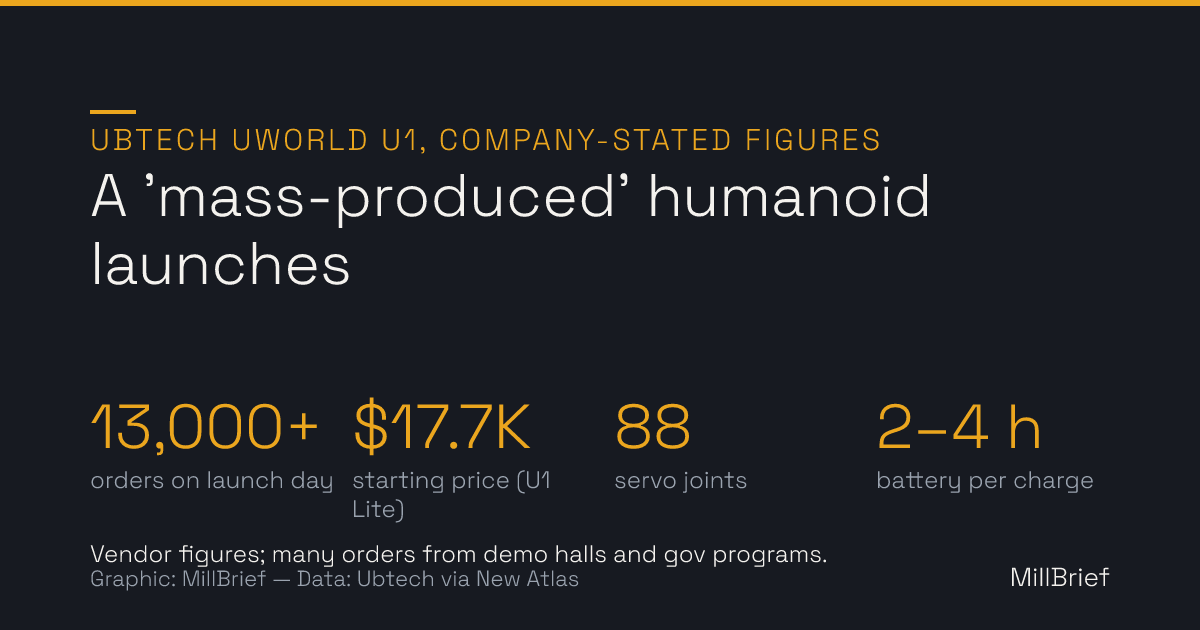
Why it matters: This is a companion robot, not a factory machine; we include it because “mass-produced humanoid” is a milestone claim your leadership will read about, and the caveats here are a template for reading every humanoid headline. A 13,000-unit day-one order book sounds like product-market fit until you read who ordered: demo halls and government programs are not end-users voting with their own money. The same order-book skepticism applies directly to industrial humanoids; recall that even the best-evidenced vendor in the category qualifies its order figures as milestone-contingent, as we covered in Saturday’s brief. Battery life of two to four hours and tens-of-seconds response times are also a useful reality anchor: if that is the state of a shipping flagship, plan factory-floor humanoid pilots (if you run one at all) around first-project discipline, not around the launch video.
Source: New Atlas, July 19, 2026.
Sources
- Lockheed Martin taps Machina's robots for mission-critical missile parts (The Robot Report, 2026-07-16)
- Toyota and Nvidia expand partnership to develop AI for vehicles, factories and cities (Robotics & Automation News, 2026-07-18)
- How to avoid the teleoperation trap in robotics development (The Robot Report, 2026-07-19)
- 'World's 1st mass-produced humanoid robot' motors to market in China (New Atlas, 2026-07-19)