Industry Brief, July 31, 2026: China threatens countermeasures, cobots rebound, Gemini 2
Day three of the robot-ban story and it has gone bilateral: Beijing’s commerce ministry is now threatening countermeasures. Around that we have three useful non-ban readings: the cobot market’s bellwether posted its fifth straight growth quarter with hard numbers attached, the BBC went inside the Chinese warehouse-robot fleet already running UK retail, and Google DeepMind moved humanoid control software a visible step forward. As always: our own words, links to the original outlet, and vendor numbers labelled as vendor numbers.
Beijing threatens countermeasures over the robot ban
CNBC reports from Beijing that China’s commerce ministry said Thursday the FCC has “repeatedly ignored Beijing’s restrained stance” on product bans, that the escalating restrictions “severely damage China-U.S. economic and trade stability” (CNBC’s translation of the Mandarin statement), and that China will take countermeasures if the US doesn’t withdraw the decision. The report adds market and timing context: Hong Kong-listed UBTech briefly fell more than 6% Thursday morning; Unitree and Agibot (which with UBTech held the top three spots in humanoid installation share last year, per Counterpoint Research, with Tesla’s Optimus fifth) have both filed to go public. Counterpoint’s Marc Einstein calls the ban “bad news for Chinese humanoid producers planning their IPOs” and names the “two major cards” Beijing can play: further restricting rare-earth sales to American companies, and further restricting Chinese market access for American companies like Tesla and Nvidia. The timing is delicate: President Trump is scheduled to host Xi Jinping in September.
Why it matters: Yesterday’s expert warnings are now an official threat: the rare-earth card STM’s Stieler flagged in our previous brief is one of the two levers China’s own analysts expect. For buyers the practical read is supply-chain, not geopolitics: rare-earth magnets sit inside the motors of robots from every country, so a countermeasure aimed at the US ban could touch lead times and pricing on equipment that has nothing Chinese on the nameplate. If you have automation purchases planned for the next 12 months, this is the week to ask vendors about magnet and component sourcing exposure and to get quoted lead times in writing; the hidden-costs discipline now includes a trade-policy line.
Source: CNBC, July 30, 2026.
The cobot bellwether is growing again, with a US tilt
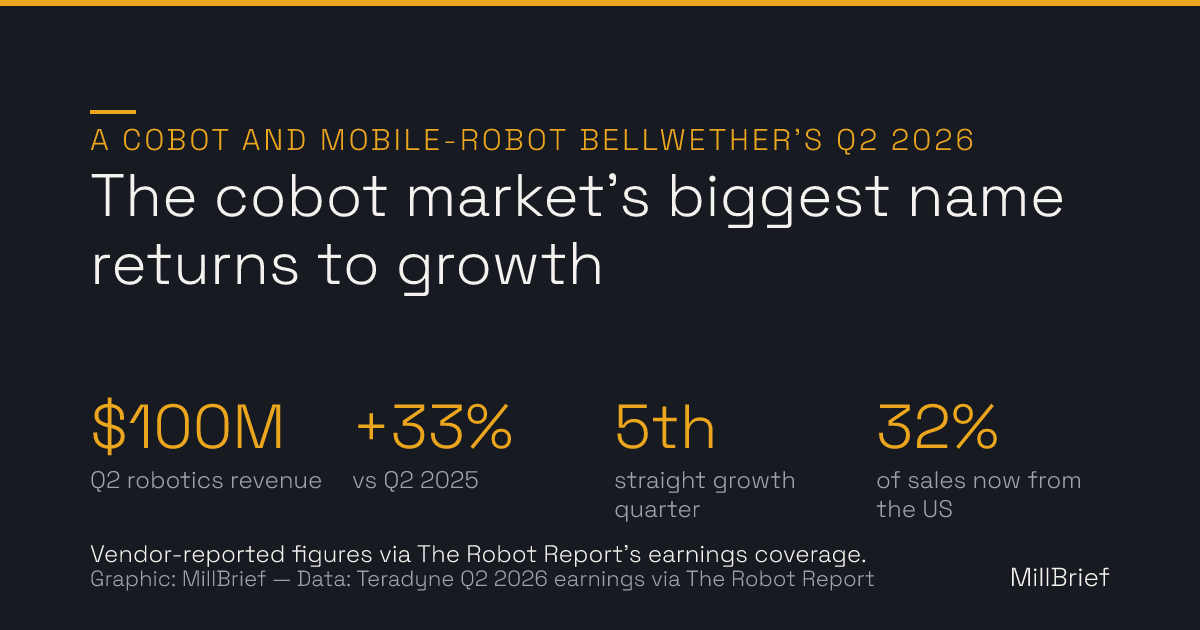
The Robot Report covers Teradyne’s Q2 earnings: Teradyne Robotics, the unit housing Universal Robots (cobots) and MiR (mobile robots), both Odense-based, posted $100 million in quarterly revenue, up 33% from $75 million a year earlier and up from $91 million in Q1, its fifth consecutive quarter of growth. Two structural details matter more than the headline. First, geography: US sales rose to 32% of the unit’s revenue, and Teradyne plans a Michigan manufacturing center later this year. Second, the driver: CEO Greg Smith says AI is doing the pulling: the fastest-growing robotics segments are electronics manufacturing and semiconductors, tied to data-center buildout. The piece is candid about the road here: revenue peaked at $326 million in 2022, declined through 2024, and the company ran two rounds of layoffs in 2025 (10% in January, another 14% in November) before this recovery.
Why it matters: This is the closest thing the cobot market has to a public health check, and it says demand is real again, but concentrated. If your application is electronics assembly, test, or anything data-center-adjacent, you’re in the segment vendors are chasing hardest, which is when competitive quotes get sharp. If you’re a general machine shop, note the flip side: a supplier growing on AI demand allocates engineering and inventory toward AI customers. The US-manufacturing move is worth watching against this week’s ban news: a domestic production base is suddenly a sales feature. Either way the numbers are the company’s own; what they tell you is where the vendor’s attention will be, and our cobot cost and price comparison pages remain the place to sanity-check what that attention costs.
Source: The Robot Report, July 30, 2026.
The BBC counts the Chinese robots already inside UK retail
While Washington debates imports, BBC News visited Geek+’s factory in Hefei and counted what’s already deployed in Britain: more than 2,000 Geek+ autonomous mobile robots across 10 UK warehouse sites via local partner MotionTech, serving retailers including Tesco, Asda, and Next. The UK is now Geek+’s biggest European market; the company listed in Hong Kong last year and, per the BBC, is the world’s largest AMR supplier. The piece is useful on the why: AMRs deploy with QR-code floor markers and safety fencing rather than fixed conveyors and permanent infrastructure, which suits retrofits. And the OECD’s 2026 SME technology report calls UK robotics adoption surprisingly low for its manufacturing heritage, i.e., the headroom is the story. MotionTech’s account director is blunt about the drivers: labour shortage, high storage on a smaller footprint, reduced headcount. On humanoids the same practitioner is skeptical: “definitely going to be complementary,” not a replacement for wheeled AMRs and fixed arms that already move goods cheaply.
Why it matters: This is the ground truth under both the ban debate and the humanoid hype. First: the installed base moves on economics, and goods-to-person AMRs win retrofits precisely because they don’t demand the building be rebuilt (the same what-to-automate-first logic that applies on a factory floor). Second: the practitioner quote is the most grounded humanoid take we’ve seen from someone who deploys robots for a living: wheeled platforms and arms already solve the solved problems; humanoids must find the unsolved ones. Third, for UK readers specifically: your warehouse fleet is now a geopolitically exposed supply chain; the US just showed how fast import rules can change, so the service, spares, and software-update continuity questions in our integrator checklist apply with extra force when the vendor is in the crosshairs of someone’s trade policy.
Source: BBC News, July 29, 2026.
Gemini Robotics 2: from upper-body demos to whole-body control
The Verge reports Google DeepMind’s Gemini Robotics 2 can control “entire humanoid robots”: whole-body motion from feet to fingertips, where the previous model handled only the upper body. Demo videos show Apptronik’s Apollo 2 walking, crouching, bending to pick up a watering can, and retrieving specific items from shelves; the model also drives five-fingered hands through tasks like sealing a Ziploc bag and unscrewing a lightbulb. The companion embodied-reasoning model, ER 2, handles longer tasks, “understands when tasks begin and end,” and coordinates multiple different robots (one demo has Apollo 2 instructing a dual-arm robot during a garage cleanup). DeepMind itself flags the caveats: robots “have more to advance in movement speed,” and the safety framing (detecting nearby humans and triggering a safe stop) is presented as the release’s core progress. An on-device variant runs without an internet connection and adapts faster to new robot shapes and sensor sets.
Why it matters: File under capability watch, not procurement. The pattern to track is that control software is improving faster than the hardware economics: whole-body coordination and cross-embodiment transfer are exactly the bottlenecks that kept humanoids in demo reels, and DeepMind’s own “movement speed” caveat tells you cycle-time parity with a human (let alone a dedicated machine) isn’t close yet. The on-device variant is the quietly practical bit: local control without cloud dependency is a real requirement on production floors. The item above has a working deployer calling humanoids “complementary”; this one shows the software stack advancing anyway. Both are true, which is why our advice stays: watch the demos, buy against measured cycle times.
Source: The Verge, July 30, 2026.
Sources
- China threatens retaliation against U.S. humanoid robot ban (CNBC, 2026-07-30)
- Teradyne Robotics revenue rises 33% year over year in Q2 (The Robot Report, 2026-07-30)
- The Chinese robot army transforming the UK's retail industry (BBC News, 2026-07-29)
- Google DeepMind's new AI model can control a robot's entire body (The Verge, 2026-07-30)