Industry Brief, August 12, 2026: Q2 robot orders, 50,000-robot fleets, solar automation
Wednesday’s three items are about scale you can count: the industry association’s Q2 order statistics showing who is actually buying robots, a fleet operator claiming its 50,000th deployed robot, and an energy company whose solar-installation robots have placed 180,000 modules on live construction sites. Our own words, links to the original outlet, vendor numbers labelled as vendor numbers.
Q2 orders: buyers paid 21% more money for 4% more robots
The Association for Advancing Automation (A3) released its second-quarter data: North American companies ordered 8,940 robots valued at $622 million, up 4.3% in units and 21.3% in revenue versus Q2 2025 (comparisons are cohort-based, per A3’s own methodology note). First-half totals reached 17,995 units and $1.166 billion, up 2.0% and 6.6% respectively. The distribution matters more than the headline: Automotive OEM orders fell 25% against the first half of 2025, and the growth came from everywhere else: Semiconductors & Electronics/Photonics +35% units, Life Sciences/Pharma/Biomed +32%, Automotive Component +24%, Food & Consumer Goods +17%. Non-automotive customers took 56% of Q2 units. Collaborative robots held a steady slice: 2,774 cobots at $114 million in the first half (15.4% of units but only 9.8% of revenue), with cobot share highest in Life Sciences (43.7% of that sector’s orders) and Semi/Electronics (36.5%).
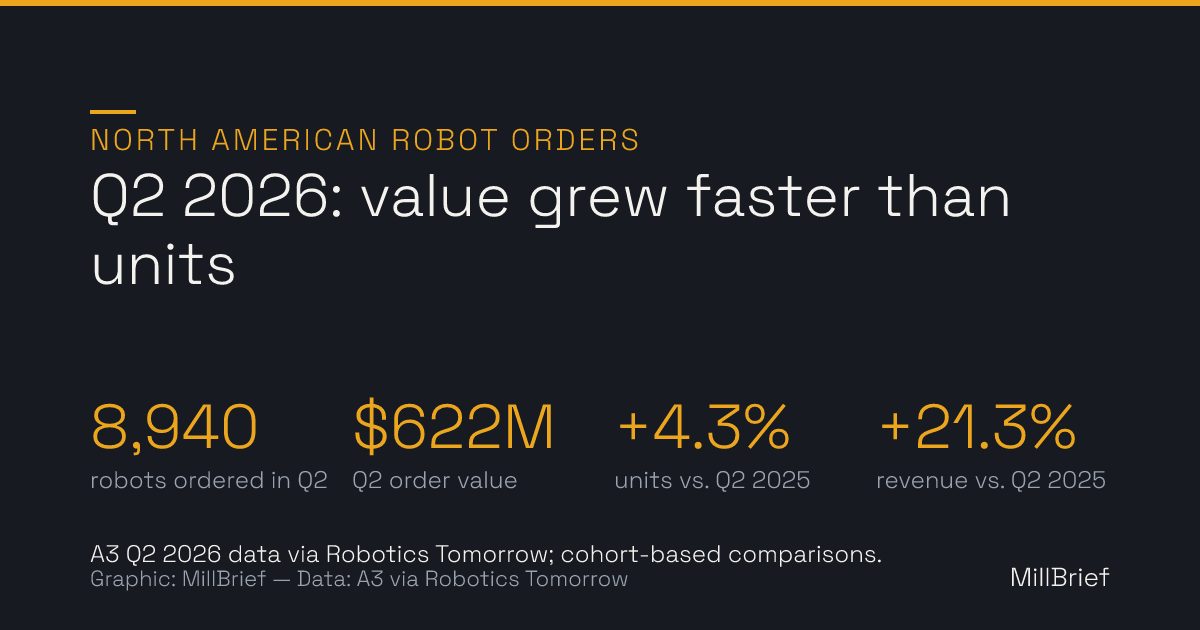
Why it matters: Revenue growing five times faster than units means the average order got more expensive, consistent with buyers specifying larger systems, more integration, or higher-payload machines rather than more of the same. And the 25%-down automotive OEM number against double-digit growth in food, life sciences, and electronics is the cleanest quantitative evidence yet for what vendors keep asserting: robot demand is now a general-industry phenomenon. If you’re in one of those growth sectors, your peers are buying, which affects both integrator availability and delivery lead times. The cobot revenue share (9.8% of dollars for 15.4% of units) is also a useful sanity check on cobot price expectations: the average cobot order runs well below the average industrial-robot order, which is much of their appeal and some of their limitation.
Source: Robotics Tomorrow (A3 release), August 11, 2026.
Brain Corp claims 50,000 deployed robots and 5.3M autonomous hours in H1
Brain Corp, whose BrainOS platform drives autonomous floor scrubbers and inventory robots in retail, logistics, airports, and commercial cleaning, announced it has passed 50,000 deployed robots worldwide, Robotics & Automation News reports. The company’s H1 2026 figures, all self-reported: deployments up 68% year over year, more than 5.3 million autonomous operating hours (up 24%), coverage up 400 million square feet versus the same period last year, and more than 3.7 billion square feet covered in the half. The announcement also leans on trust signals rather than capability claims: SOC 2 Type II compliance for security and data handling, partnerships with ShelfOptix and an expanded one with Tennant Company, and an argument that enterprise buyers now evaluate autonomy platforms on predictable fleet-wide performance and data governance across hundreds of sites, not on whether one robot can do one task.
Why it matters: Vendor milestone announcements are marketing, but the shape of this one tells you where the procurement conversation has moved: the pitch is uptime, fleet management, and audited data controls (the concerns of someone operating hundreds of robots) rather than demos. That’s a useful template for RFQ requirements even at small scale: ask how a fleet is monitored, where operational data lives, and who can access it, questions that got sharper for public-facing robots after the foreign-robot import ban put supply-chain and data provenance on every checklist. The growth-rate gap in Brain Corp’s own numbers is worth noting too: deployments up 68% but hours up only 24% suggests the fleet’s newest robots are younger and not yet working full schedules; treat all of it as unverified vendor reporting until third parties can count.
Source: Robotics & Automation News, August 7, 2026.
180,000 solar modules in: what field-proven construction robotics looks like
Robotics & Automation News interviews Nick Hegeman, chief commercial officer of Maximo, the solar-installation robot developed inside energy company AES through its AES Next incubator. The company’s deployment numbers, per the interview: more than 180,000 photovoltaic modules installed representing over 100 MW of capacity, peak rates above 500 installations per day, up to 24 modules per person per shift-hour for crews using the system, and a sustained pace of 20 MW per month across December 2025 and January 2026. The modules involved weigh up to 75 pounds each: work crews would otherwise lift hundreds of times a day in open desert heat. Hegeman’s commercial claims: installation rates more than double the industry average and up to two months shaved off utility-scale timelines. The structural advantage he describes is candid: because AES owns a pipeline of live solar projects, Maximo skipped the startup phase of chasing a first pilot site and iterated on real construction sites from day one. Next automation targets, per Hegeman: site logistics and material handling, plus module makers starting to design panels with robotic installation in mind.
Why it matters: Two things transfer beyond solar. First, the adoption trigger wasn’t a spec sheet: Hegeman says the large engineering contractors fast-tracked evaluations only after watching the system hold a 20 MW/month pace on a live site, which is the construction-industry version of insisting on proof under your own conditions before committing. Second, the design constraint that made adoption easy (slot into existing workflows, change nothing about the customer’s process) is the same property that separates smooth deployments from hidden-cost quagmires in factories. The economics driver is familiar too: heavy payloads, labor scarcity, and schedule risk converging, with speed-to-power (time-to-revenue) on top, the same payback logic that governs a production line, at utility scale. All performance figures are the company’s own, given in an interview.
Source: Robotics & Automation News (interview), August 10, 2026.
Sources
- Robot Orders Increase in Q2 as Automation Demand Broadens Across Industries (Robotics Tomorrow (A3 release), 2026-08-11)
- Brain Corp reports 68 percent growth and surpasses 50,000 autonomous robots worldwide (Robotics & Automation News, 2026-08-07)
- Interview with Maximo's Nick Hegeman: 180,000 robotic installations of solar panels and counting (Robotics & Automation News (interview), 2026-08-10)