Industry Brief, August 21, 2026: Unitree's US dealer pivots, Prime Air's 500 cities, CACI
Friday’s three items: the FCC robot ban produces its first full business pivot as Unitree’s main U.S. distributor becomes a manufacturer, Amazon puts a year-end number on drone delivery, and a defense contractor’s new Rochester plant shows how reshoring demand reaches small job shops. Our own words, links to the original outlet, vendor numbers labelled as vendor numbers.
Unitree’s main US distributor pivots to making robots on Long Island
RoboStore (the main North American distributor of Unitree’s humanoids and robot dogs, whose buyers included Harvard, MIT, Amazon, and Nvidia) is pivoting to manufacturing its own robots, Ars Technica reports. Under a new company, Robo Inc., it plans to fully open a 66,000-square-foot facility on Long Island by the first fiscal quarter of 2027. Founder Teddy Haggerty says the company has sold over 1,500 robots to customers including Cisco, OpenAI, and more than 150 universities, a distribution business it has already shut down (parts and repair support continues) after the FCC’s July ban on imports of new foreign-made robots, which we covered in July. Initial products: a wheeled humanoid torso for healthcare and concierge work that can take vitals like temperature and blood oxygen, a security quadruped, and a U.S.-compliant humanoid platform for the education and research market Unitree used to own. The company is raising its first outside funding after years bootstrapped. The candid line comes from Haggerty himself, a man who built the largest humanoid sales channel in the country: robotic arms from companies like Universal Robots are “better suited for most businesses, for what they want to achieve, than a humanoid robot.”
Why it matters: This is the FCC ban working exactly as designed (a distribution business converted into domestic manufacturing and integration capacity inside seven months), and it’s also the clearest independent confirmation of the demand mix behind yesterday’s Unitree IPO numbers: the biggest U.S. sales channel was overwhelmingly universities, and its founder says plainly that a purpose-built arm beats a humanoid for most business problems. When the person whose margin depended on humanoid sales tells you that, it’s worth more than any analyst note, and it’s the same conclusion as our what to automate first guidance. Watch whether the education-platform bet survives: “U.S.-compliant” is now a sellable feature, and 150 universities needing a Unitree replacement is a real, ban-created market.
Source: Ars Technica, August 20, 2026.
Amazon: Prime Air to nearly 500 cities by year-end
Amazon announced plans to expand Prime Air drone delivery to nearly 500 U.S. cities and towns by the end of 2026 (a sixfold increase over its current footprint, by the company’s own description), The Robot Report covers. Prime Air currently operates in cities across seven states (Arizona, Florida, Kansas, Louisiana, Michigan, Nebraska, and Texas), with Chicago, Syracuse, Cleveland, Atlanta, and Boise named next, and a first international site live in Darlington, U.K. The operating envelope, per Amazon: items up to 5 pounds that fit a large shoebox (which it claims covers more than 60 percent of its most frequently purchased items), delivered in as fast as 30 minutes, most around 60. Prime Air VP David Carbon says the service has delivered “hundreds of thousands of packages” this year. The regulatory substance: Prime Air holds FAA Part 135 certification, the framework used for commercial air carriers, and Amazon says its Detect-and-Avoid system lets drones make real-time airspace decisions without a human monitoring a live camera feed.
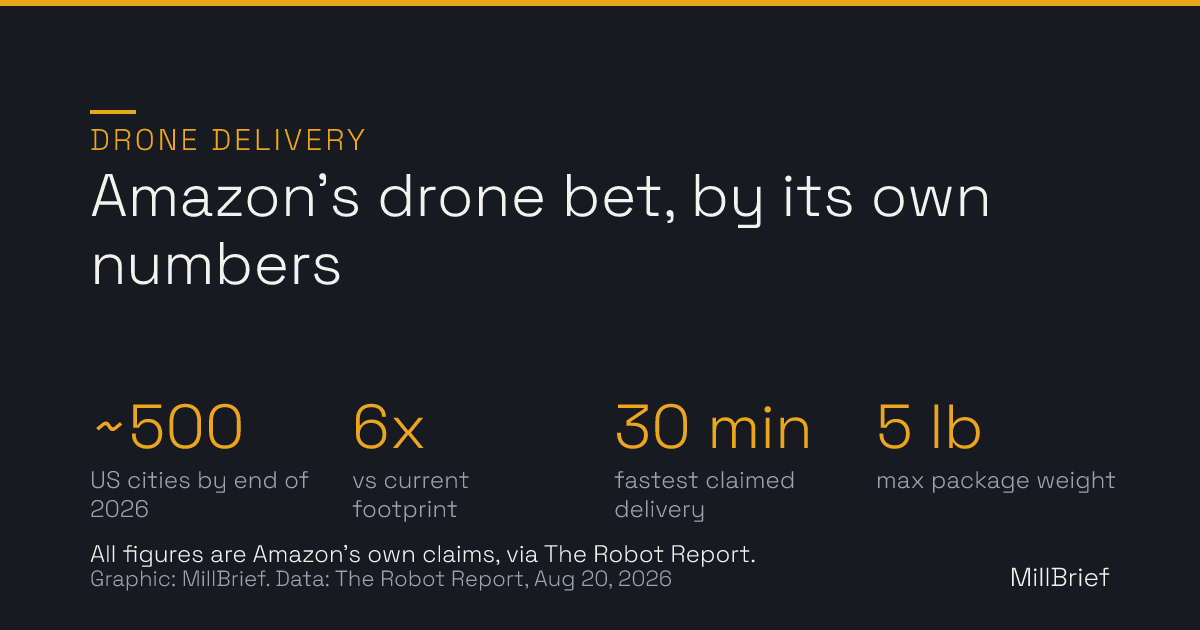
Why it matters: Every number here is Amazon’s own, and year-end expansion targets from any vendor deserve the usual discount, but the Part 135 certification isn’t marketing, and a sixfold scale-up attempt will stress-test whether autonomous-drone operations hold up outside pilot regions. For the industrial reader the second-order story is fleet production: hundreds of cities means thousands of aircraft, batteries, sensors, and ground stations, landing on the same U.S. drone supply chain that tariffs are squeezing and venture capital is flooding. Amazon scaling domestic drone manufacturing while imports get expensive is one more demand signal for the machine shops and contract manufacturers feeding that ecosystem.
Source: The Robot Report, August 20, 2026.
CACI opens a Rochester plant, and the demand reaches job shops
Defense contractor CACI International opened a 61,000-square-foot manufacturing center in the Greater Rochester, New York area to build software-defined electronic warfare systems, Interesting Engineering reports, increasing the company’s manufacturing footprint in the region by more than 300 percent. (The headline number is regional, not national.) The plant starts with the TLS BCT Manpack, a soldier-carried electronic warfare system whose capabilities update through software rather than hardware swaps, and the facility handles development, testing, assembly, customer acceptance, and on-site storage in one location. The line relevant to this audience: CACI says TLS Manpack production is expected to support dozens of small manufacturing and fabrication businesses across Upstate New York.
Why it matters: The pattern from the Neros raise repeats at a bigger prime: defense production scaling doesn’t just build big plants, it pushes machined parts, cable assemblies, enclosures, and board work down into regional supplier networks, and “software-defined” hardware means volumes concentrate in fewer, longer-running physical designs, which is exactly the kind of demand a small shop can tool up for. For a small manufacturer within reach of one of these hubs, a defense-prime supplier qualification is slow and bureaucratic, but it buys multi-year volume stability that commercial work rarely matches, and that stability is what makes an automation payback calculation actually bankable.
Source: Interesting Engineering, August 20, 2026.
Sources
- US distributor of China's most popular humanoid robots pivots after US ban (Ars Technica, 2026-08-20)
- Amazon plans to expand Prime Air to nearly 500 cities by the end of 2026 (The Robot Report, 2026-08-20)
- New 61,000 sq ft manufacturing hub powers 300% surge in US electronic warfare capacity (Interesting Engineering, 2026-08-20)