Industry Brief, August 22, 2026: Humanoid gearboxes, printed reactor vessels, MIT's WSI
Saturday’s three items: the component supplier behind Thursday’s humanoid-training story shows its manufacturing hand, two national labs print a pressure vessel with welding robots, and MIT builds an excavator interface that erases the novice-expert gap in one session. Our own words, links to the original outlet, vendor numbers labelled as vendor numbers.
Schaeffler will mass-produce humanoid gearboxes in 2027: by forming, not machining
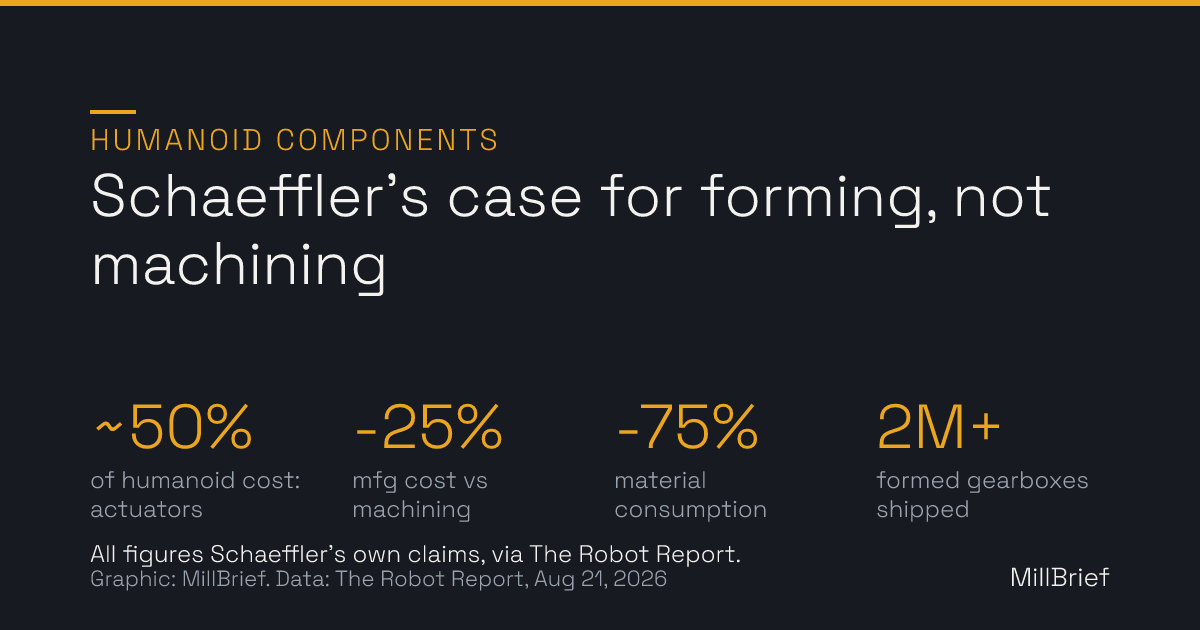
Schaeffler says it has finished validation testing of its formed strain wave gearboxes for humanoid robots and will be ready to manufacture them at scale in 2027, starting in Germany, The Robot Report covers. The numbers are the company’s own, and they aim at the biggest line in the humanoid bill of materials: actuators, which Schaeffler says account for around half the cost of manufacturing a humanoid, with strain wave gearboxes as their key component. The pitch is process, not product: conventional strain wave gears are precision-machined (slow and capital-intensive, which Schaeffler argues will bottleneck humanoid scaling), while its forming process presses the gear geometry into shape in seconds, cutting manufacturing costs by more than 25 percent and material consumption by more than 75 percent, with torque and efficiency it claims are comparable to machined parts. The credibility anchor: the company says it has shipped more than 2 million formed strain wave gearboxes into automotive markets over the past decade.
Why it matters: Put this next to Thursday’s item, Schaeffler training AEON humanoids in its own factories while supplying actuator technology into them, and the strategy is legible: use the deployment side to learn the requirements, then sell the picks and shovels to everyone. For buyers the interesting spillover isn’t humanoids at all: strain wave gears are the same component class that sets the price of cobot joints, and a forming process that cuts gear cost by a quarter at automotive volumes is the kind of upstream change that eventually shows up in cell quotes. That’s the mechanism behind the price-collapse curve in Monday’s humanoid economics, and a reminder that the most bankable winners of the humanoid wave so far are component suppliers with automotive DNA, not the robot makers.
Source: The Robot Report, August 21, 2026.
Three robot arms print a nuclear pressure vessel at Oak Ridge
Oak Ridge and Idaho National Laboratories demonstrated wire arc additive manufacturing of a nuclear-relevant pressure vessel (roughly three feet by five feet, in a steel alloy relevant to nuclear service) using MedUSA, a platform that coordinates three robotic arms melting steel wire with electric arcs, Interesting Engineering reports. The driver is a real industrial constraint: domestic forging capacity for large high-integrity components is limited, and new reactor programs are queueing behind it. The more consequential idea is what ORNL calls “born-qualified” components: instrumenting the build to track shape and material properties in real time, so qualification evidence accumulates during production instead of in lengthy testing afterward. The same platform and material system already produced neutron sensor brackets for Antares Nuclear’s R1 Mark-0 microreactor, which reached criticality at INL in June. The labs name aerospace, defense, chemical processing, and oil and gas as follow-on sectors.
Why it matters: Wire arc additive is, mechanically, robotic arc welding building a part layer by layer, the same robot-plus-arc toolchain whose economics we covered Tuesday, pointed at a different problem: not labor cost but a forging queue measured in years. For manufacturers the “born-qualified” concept is the part worth stealing regardless of sector: in-process monitoring as the qualification record is the same logic quality engineers apply when they trust machine data over end-of-line inspection, scaled up to safety-critical hardware. National-lab demonstrations are years from ASME-stamped production parts, and the article is clear the qualification question is still open, but when the bottleneck is a handful of forges, a printed alternative doesn’t have to be cheaper, only available.
Source: Interesting Engineering, August 21, 2026.
MIT’s excavator interface erases the rookie gap in one session
MIT engineers built a controller that lets novice excavator operators match experts from their first session, New Atlas reports. The World-Space Interface (WSI) is a miniature excavator arm the operator grips and moves like their own arm (extend, rotate, close a fist over virtual dirt), with a six-panel display mirroring every gesture, replacing the joystick mappings that normally take years to internalize. In the study (Journal of Computing and Civil Engineering), expert and novice volunteers trained an hour a day for seven days across 15 virtual scenarios: trenching, grading, debris clearing, rock breaking. With joysticks, novices stayed consistently behind experts all week; with the WSI, the gap vanished from session one. The team is adding haptic force feedback next, and envisions the same arm mounted in a real cab or in an off-site trailer for teleoperation of machines in unsafe environments. Caterpillar, Hyundai, and Komatsu all have training simulators, the piece notes, but built around the joysticks that are the problem.
Why it matters: The binding constraint across every equipment-heavy trade right now is experienced operators, the same shortage math driving welding automation. This result points at a third option between “train humans for years” and “remove the human entirely”: re-map the interface so the skill transfers from the body the operator already has. It’s one simulator study on task-progress metrics, not a jobsite deployment, but the teleoperation vision is the practical endgame, because an intuitive remote interface turns one experienced supervisor plus several low-training operators into a viable crew model. Watch whether an OEM licenses it; the incumbents’ joystick simulators are exactly the incumbency this design attacks.
Source: New Atlas, August 21, 2026.
Sources
- Schaeffler plans to mass produce gearboxes for humanoid robots in 2027 (The Robot Report, 2026-08-21)
- Three robotic arms 3D print nuclear vessel for America's expanding reactor fleet (Interesting Engineering, 2026-08-21)
- New excavator interface lets rookies match veteran operators on day one (New Atlas, 2026-08-21)