Industry Brief, August 28, 2026: Copycats in court, pizza bots in the graveyard
Two of today’s items are about what happens after the purchase order: the market leader in cobots going to court over lookalike arms, and pizza restaurateurs stuck with six-figure machines whose maker vanished. The other two are the pipeline (public research money and commodity compute) that feeds the next generation. Our own words, links to the original outlet, vendor numbers labelled as vendor numbers.
Universal Robots’ parent takes a second cobot copycat to court
Teradyne Robotics, parent of Universal Robots, has filed a patent-infringement suit against the German subsidiary of Chinese cobot maker JAKA at the Unified Patent Court’s Copenhagen division, covering both hardware and software in its collaborative arms, The Robot Report writes. It’s the company’s second European case against a Chinese competitor this year: in February it sued Elite Robots’ German unit over copyright, and in April the Regional Court of Hamburg issued a preliminary injunction barring the disputed software from the German market; that case is ongoing. Universal Robots’ CTO says the JAKA case began after the company bought one of the lookalike arms and examined it. A UPC ruling could reach 17 of the 18 participating EU states plus, per Teradyne, certain non-UPC countries including the UK and Spain. The backdrop, from Teradyne’s own reporting: $100 million in Q2 2026 robotics revenue, up 33 percent year over year, most of it from Universal Robots, while Chinese entrants keep undercutting on price.
Why it matters: If a budget cobot on your shortlist is priced dramatically under the established brands, this is one of the reasons to ask why. See our cobot cost breakdown for the honest gap. The Elite precedent shows an injunction can pull a product (and its software) off a national market mid-lifecycle, which would leave an installed base without updates or parts. Teradyne also raises the safety-compliance angle; that’s a self-interested argument, but risk assessments on force-limited arms are genuinely only as good as the vendor’s certification discipline.
Source: The Robot Report, August 27, 2026.
The pizza-robot graveyard is a vendor-risk case study
The BBC’s technology-of-business desk surveys the wreckage of robotic pizza making, and it reads like a due-diligence checklist written in hindsight. When supplier Picnic shut down abruptly in May, Seattle’s Moto Pizza was left with $160,000 of cabinet-sized pizza machines rendered “basically useless”; technical support evaporated the day the vendor did. Picnic joins Zume, Pazzi, and Basil Street on the list of defunct pizza-automation firms; Zume’s 300-plus patents were bought by Miso Robotics, whose CEO argues the vision was right but “a beat too early.” A Bank of America restaurants analyst is blunter: none of the success stories materialized, the bots still drop ingredients, and “humans are very efficient at making pizza.” One counterpoint on labor from Moto’s own stadium operation: robots cut the pizza-making crew from ten to two, and the other eight moved to customer-facing roles rather than out the door.
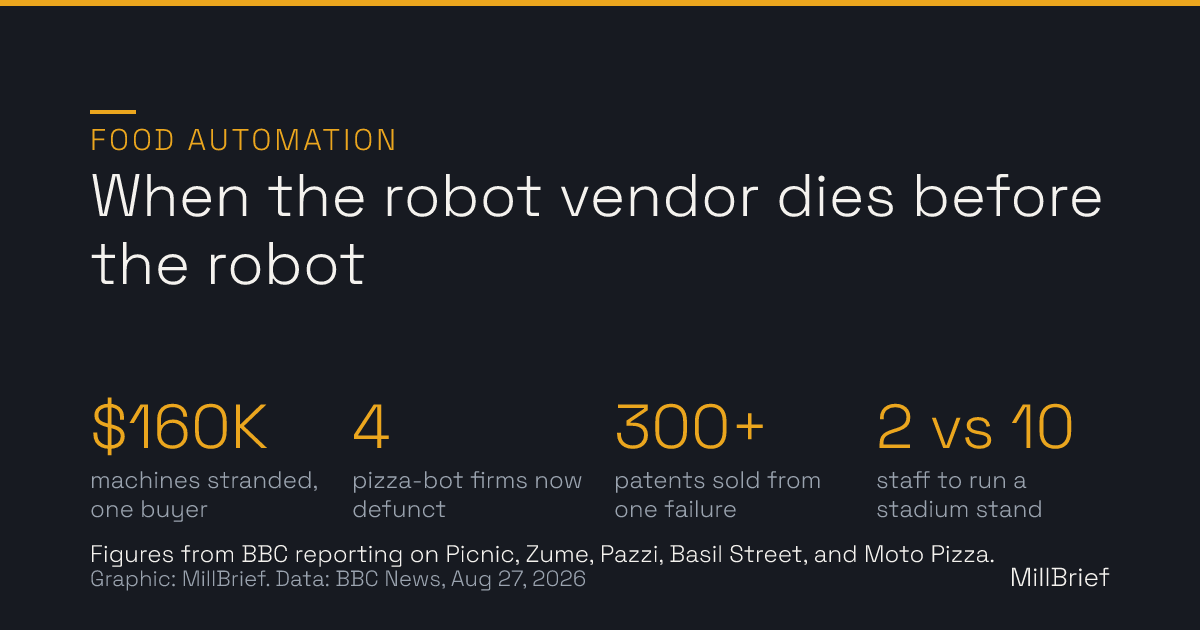
Why it matters: Vendor viability is the most underweighted line in automation procurement: a machine that works perfectly is still a write-off if nobody can service it, a failure mode we cover in why automation projects fail. Before signing, ask what happens to support, spares, and control software if the vendor folds: source-code escrow, open interfaces, and second-source parts are cheap insurance against exactly the hidden cost that hit Moto. The redeployment detail is worth filing too: the labor story on the ground was reallocation, not headcount.
Source: BBC News, August 27, 2026.
NSF puts $90M into new science centers: one is all about humans and robots
The U.S. National Science Foundation is investing $90 million over five years in three new Science and Technology Centers ($6 million per center per year, with a shot at five more years after that). The robotics entry is the Center for Human and Robot Co-Adaptation, led by the University of Texas at Austin, studying how people and robots adapt to each other as service and assistive robots spread through homes, hospitals, and workplaces, combining robotics, AI, and human-factors research so machines learn individual needs and adjust physically and cognitively. The other two centers cover turbulence engineering (Michigan State) and genome engineering (Northwestern).
Why it matters: Human-robot co-adaptation is the research-grant name for the thing every cobot deployment struggles with in practice: the robot is fixed, and the humans do all the adapting. Federally funded, publishable work on the other direction tends to surface in commercial HRI features five to ten years out. Slow-burn, but this is the pipeline.
Source: The Robot Report, August 27, 2026.
Kodiak puts server-class AMD chips in its driverless trucks
Robotics & Automation News reports that Kodiak AI will use AMD EPYC server processors in its seventh-generation Kodiak Driver platform, the first deployment of EPYC in a driverless-trucking hardware stack, per the companies. The CPUs handle the latency-sensitive workloads that don’t parallelize well onto GPUs: aggregating and preprocessing lidar, camera, and radar data, localization, and path planning. Kodiak’s stated rationale is telling: buying leading commercial hardware lets it spend its engineering on the autonomy software rather than custom silicon. The company already runs trucks with no human in the cab in the Permian Basin and says it is working toward driverless operation on public highways later this year.
Why it matters: Between yesterday’s Gatik raise and NVIDIA’s edge module and today’s item, a pattern: the autonomy firms actually shipping are standardizing on commodity compute (server CPUs, catalog modules) instead of bespoke boards. That’s the same make-versus-buy discipline that applies to a factory cell: custom hardware is a maintenance liability you fund forever. Note the claims split: the EPYC design win is announced fact; the public-highway timeline is a company target.
Source: Robotics & Automation News, August 27, 2026.
Sources
- Teradyne Robotics ramps up fight against cobot copycats (The Robot Report, 2026-08-27)
- Overcooked? Why robotic pizza makers are failing (BBC News, 2026-08-27)
- NSF to invest $90M into three new technology centers, including one focused on robotics (The Robot Report, 2026-08-27)
- Kodiak AI and AMD collaborate to advance computing power for driverless trucking (Robotics & Automation News, 2026-08-27)