Industry Brief, August 31, 2026: Robot games, the edge wall, and a $399 duck
A Sunday triple: what Beijing’s humanoid spectacle actually tells a buyer, a researcher’s argument that embodied AI is about to hit a computational wall no bigger GPU can fix, and the cheapest legitimate robot-learning platform yet to ship. Our own words, links to the original outlet, vendor numbers labelled as vendor numbers.
Beijing’s humanoid games: records fell, and so did the robots
The Verge recaps the second World Humanoid Robot Games, a five-day event at Beijing’s National Speed Skating Oval, and the year-over-year numbers are the story. Last year’s winning 100-meter sprint was a glacial 21.50 seconds and the best standing high jump 0.95 meters; this year a humanoid ran the 100 meters in 9.39 seconds (faster than Usain Bolt’s 2009 world record) and another cleared 2.88 meters in a standing high jump. The drama was equally real: a robot from smartphone maker Honor lost a leg mid-sprint, others tripped in showers of sparks or caught fire, and one toppled into the judges’ table under a modest barbell. Alongside the track events sat the telling ones: bed-making, parcel delivery, shelf stacking, clothes folding, and hammering nails. Some events required full autonomy; others allowed teleoperation with a scoring penalty.
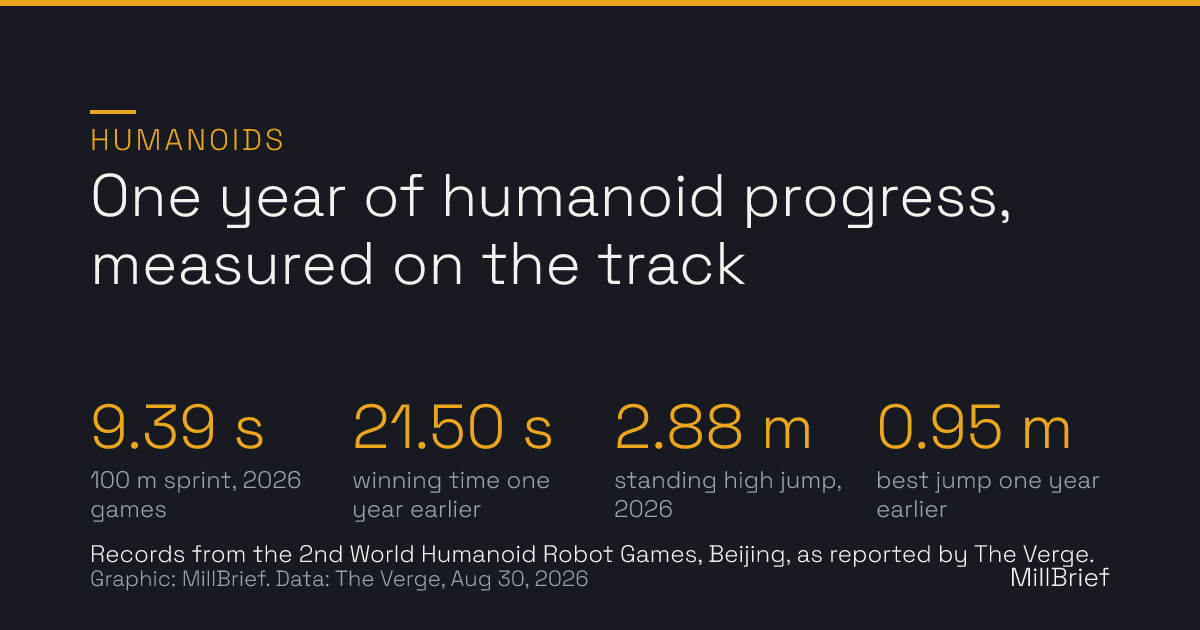
Why it matters: Read the event list, not the sprint times. Racing shows actuator and balance progress: a 21.50-to-9.39 jump in one year is a genuine hardware signal. But the games’ own organizers put bed-making and shelf stacking on the program because that’s the work these machines are being built for, and The Verge’s read is that the mundane events remain unimpressive, with teleoperation still propping up much of the dexterity on display. That matches the deployment test we keep applying to humanoid announcements: a named factory, a named task, a dated rollout beats a highlight reel every time.
Source: The Verge, August 30, 2026.
The “edge AI wall”: why a bigger GPU may not save your robot
A contributed essay in The Robot Report by Zhengis Tileubay, an independent researcher from Kazakhstan, argues that embodied AI faces a systemic barrier he calls the edge AI wall. The chain is physical: every extra watt of onboard compute demands more battery capacity and weight plus more cooling, which eats payload and uptime, so the cloud-AI habit of throwing more hardware at the problem stops scaling. Offloading to the cloud doesn’t rescue it either: a 500-millisecond delay is fine for a chatbot, but for a robot in motion even 50 milliseconds means the command arrives to act on a world that no longer exists. His diagnosis is that behavioral degradation in autonomous mobile robots often comes not from hardware failure but from planner overload: too many alternative trajectories evaluated in real time. His proposed answer is a regulator that compresses the search space as conditions change; in his simulations (his own figures, from a published test harness), it cut the planning space by a factor of 8 to 11 and near-collision events by over 90 percent in a high-chaos scenario.
Why it matters: Treat the specific algorithm as one researcher’s simulated claim, but the framing is a good procurement question today: ask your AMR vendor what the robot does when its planner saturates: does it slow down, narrow its options, and fail safe, or does it freeze and twitch in front of an obstacle? Erratic behavior in busy aisles is exactly the kind of failure that kills automation projects after the pilot, and it’s worth knowing whether your vendor’s answer is “bigger compute” or an actual degraded mode.
Source: The Robot Report, August 30, 2026.
Hugging Face’s $399 duck is a serious training rig in a silly suit
TechCrunch covers Microduck, a 25-centimeter open-source duck robot from Hugging Face and its Pollen Robotics unit (acquired April 2025), selling for $399 and shipping before Christmas, per the announcement. It waddles, picks things up with its beak, self-rights after falls, crouches, and roller skates, sensing the world through a camera, lidar, and two inertial measurement units. The substance is the workflow: behaviors are trained in simulation with reinforcement learning, deployed straight to the robot, then fine-tuned and redeployed, and the SDK, simulator, and full RL training stack are on GitHub. It joins the $499 Reachy Mini and $399 Reachy Mini Lite in Hugging Face’s push to, in CEO Clément Delangue’s words, “democratize physical AI.” TechCrunch adds the sober caveat: open-source auditability doesn’t guarantee privacy once third-party apps get access to the robot’s camera and microphone.
Why it matters: For a manufacturer curious about robot learning, a $399 sim-to-real pipeline is the cheapest hands-on education available, the same open-source robotics wave we flagged when Hugging Face opened its robot-learning stack this summer. An engineer who has trained, broken, and retrained a toy duck understands vendor claims about “learned behaviors” far better than one who has only watched demos. The privacy caveat transfers to industrial gear too: auditability of the base platform means little if application software can ship your camera feeds elsewhere. Put data egress in the RFQ.
Source: TechCrunch, August 27, 2026.
Sources
- China's robots race ahead (The Verge, 2026-08-30)
- The edge AI wall: Why embodied AI requires new mathematics (The Robot Report, 2026-08-30)
- Hugging Face is selling a cute $399 open source duck robot, Microduck (TechCrunch, 2026-08-27)