Industry Brief, October 4, 2026: Michigan LIFT, training grants, 10GigE vision, humanoids
Four stories today. Ford and JPMorganChase have opened a supplier platform in Michigan whose first Open Calls include automated assembly and getting more out of old equipment. Two training grants aim at the electricians and robot technicians that every automation project needs. Basler is selling a matched 10GigE camera kit for inspection cells. And a second analyst count of humanoid robot shipments is out, which tells you where those robots are actually going. As always, the writing is ours, each item links to the original source, and vendor numbers are labelled as vendor numbers.
Michigan LIFT: Ford and JPMorganChase want suppliers who can automate
Ford, JPMorganChase, the State of Michigan (through the Michigan Economic Development Corporation, MEDC), Michigan Central and Newlab have launched Michigan LIFT, short for Michigan Launchpad for Industrial Innovation & Transformation, according to a JPMorganChase news release dated September 29. Industrial buyers post manufacturing problems as “Open Calls”; suppliers respond, are referred to the buyer, and if a solution moves forward the platform helps line up financing, state resources, workforce support and help with scaling production.
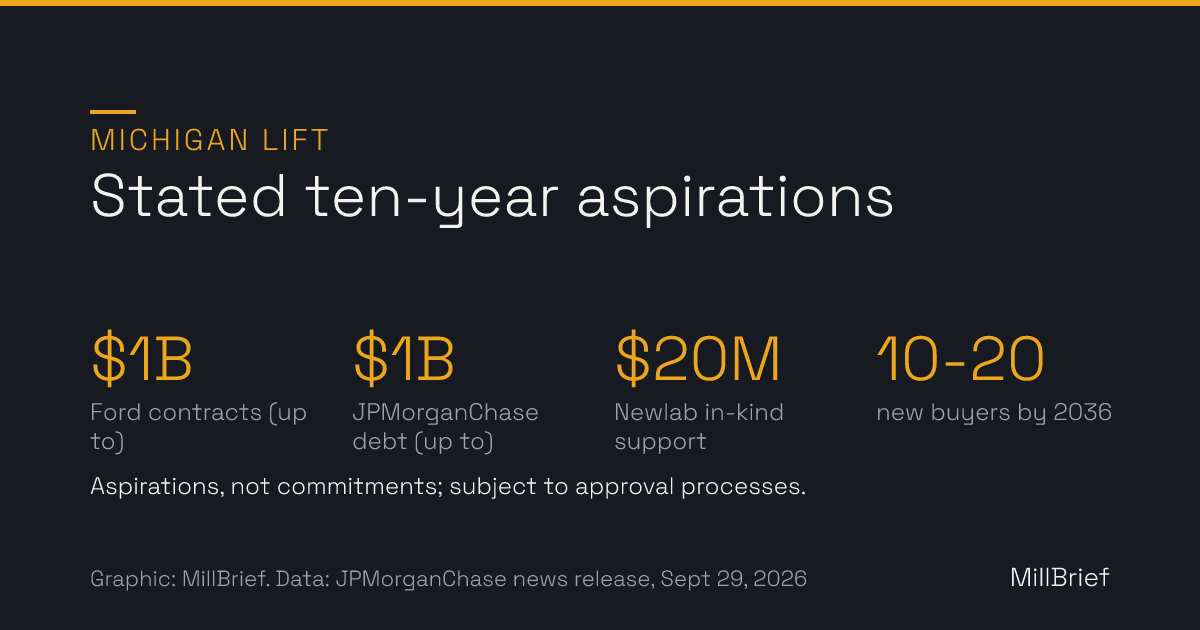
The numbers are aspirations over the next decade, and the release says each is subject to the participants’ normal qualification, sourcing and approval processes. Ford, as anchor buyer, aspires to award up to $1 billion of business to suppliers through the platform. JPMorganChase aspires to provide up to $1 billion of debt financing to suppliers on it. Newlab aspires to contribute $20 million of in-kind support, and Michigan Central, Newlab and MEDC hope to attract 10 to 20 more industrial buyers with over $1 billion in annual demand by the end of 2036. Spread evenly over ten years, Ford’s figure would be up to about $100 million a year (our arithmetic: $1 billion / 10).
Robotics and advanced manufacturing automation is the first of the initial focus areas listed in the release. The four Open Calls on michiganlift.org include scalable, automated and cost-competitive U.S. assembly of flexible and non-rigid materials, and improving the reliability, quality and capacity of existing “brownfield” equipment without costly wholesale line replacement. Suppliers that can address the calls, including companies setting up or expanding production in Michigan, can respond through the site, and the release says industrial buyers do not need to be based in Michigan.
Why it matters: For a small Michigan supplier, the attraction is a named buyer and a lender in the same conversation, which is often the hard part of financing new equipment. Keep the wording in mind: “aspires” and “up to” are not purchase orders, and every opportunity still goes through Ford’s normal supplier qualification. The brownfield call is the one most shops can answer, because it asks for better output from machines they already own. If you respond, bring numbers: current OEE (our OEE calculator gives you a baseline), scrap and downtime, and a costed plan. Our payback by project type analysis shows which kinds of projects tend to pay back fastest.
Sources: JPMorganChase news release, September 29, 2026; Michigan LIFT Open Calls page.
Two grants for the people who wire and run the robots
The same release says Ford Philanthropy and JPMorganChase are giving $550,000 in total to Focus: HOPE, a Detroit nonprofit, to strengthen its industrial manufacturing training programme, which teaches manufacturing skills, robotics and welding. The money also covers employer connections, job placement support and transport help for trainees.
Separately, Engineering.com reports that the North Carolina Business Committee for Education (NCBCE), a partner in the Careers Electric coalition, was selected in BlackRock Future Builders’ first national request for proposals and received a grant of more than $999,000, as announced by the Siemens Foundation. NCBCE was one of 15 workforce initiatives picked from more than 1,000 applications, so fewer than 1.5% were funded (our arithmetic: 15 / 1,000 = 1.5%). The money extends Careers Electric Summer Academies into eastern North Carolina, where the report says demand for electrical workers is significant. Students on the academies are paid, registered as pre-apprentices, and can earn industry-recognised credentials and college credit. The coalition aims to help develop 25,000 skilled electrical workers in the U.S. in its first 10 years, an average of 2,500 a year (our arithmetic: 25,000 / 10).
Why it matters: A robot cell needs an electrician to install it and a technician to keep it running long after the integrator leaves, and a shortage of either delays start-up or stretches downtime. Neither grant is large, but both run through local community colleges and nonprofits that small manufacturers can actually work with: offering a summer placement or joining an advisory group is a cheap way to get first look at trained people. Budget for training and in-house support from the start; skipping it is one of the reasons in why automation projects fail.
Sources: JPMorganChase news release, September 29, 2026; Engineering.com, October 2, 2026.
Basler packages a 10GigE camera kit for multi-camera inspection
Basler is offering a 10GigE vision system made of matched parts: its compact ace 2 10GigE cameras, its own 10GigE network interface cards that support RDMA (a way of moving image data with less work for the PC’s processor), pylon software with GigE Vision 3.0 support, and lenses, lighting and cables, according to a company release on Robotics Tomorrow dated September 29. Basler says the system carries the full 10 Gbps data rate from camera to PC with low latency and reduced CPU load.
The company’s figures: the cameras measure 29 mm x 29 mm x 61.5 mm, take power over the Ethernet cable (PoE), use Sony Pregius S sensors in the visible and UV range with resolutions of up to 24.4 MP and frame rates of up to 232 fps, and draw less than 7 W. The resolution and frame rate are “up to” figures; the release does not say which model reaches which, and gives no prices. Basler names quality inspection, robot control, logistics and semiconductor work among the uses.
Why it matters: Multi-camera inspection cells often struggle with the PC and network rather than the camera: dropped frames and an overloaded processor show up as missed defects. Buying the cameras, cards and software from one supplier puts one company on the hook if the chain does not keep up, which is the point of the offer. Before you choose, ask your integrator for the resolution and frame rate the inspection actually needs; 10GigE is worth paying for only if a 1 or 5 GigE setup cannot carry it. Put the data rate and acceptance test in writing with our RFQ generator.
Source: Robotics Tomorrow, October 2, 2026 (Basler press release dated September 29).
Two analyst counts of humanoid shipments, and where those robots went
Global humanoid robot shipments approached 25,000 units in the first half of 2026, up 432.1% on a year earlier, according to IDC data reported by Robotics & Automation News. The outlet notes the data was supplied to it by Agibot, which IDC ranks first with more than 8,600 units, about 35% of the total. That growth rate implies roughly 4,700 units in the first half of 2025 (our arithmetic: 25,000 / 5.321 = 4,698). IDC expects global shipments to exceed 750,000 units by 2030. For scale, if the second half of 2026 matches the first, this year would end near 50,000 units (our arithmetic: 25,000 x 2).
IDC’s count is a second estimate for the same period. In August, TechCrunch reported Counterpoint Research’s figure of 22,000 units, with the five largest makers (AgiBot, Unitree, Galbot, UBTECH and Leju Robotics, all Chinese) taking 86%. The two firms are about 3,000 units apart. The deployments Agibot highlighted were more than 300 robots at Chimelong Spaceship Park in Hengqin and 100 X2 humanoids in ASD stores, doing guiding, greeting and service work rather than factory jobs.
Why it matters: The growth is real, but from a small base, and the headline deployments are in public-facing service roles, not on production lines. For a small or mid-size plant, a humanoid is still an application-development project. If one is pitched to you, ask for reference sites doing your kind of task in a factory, and compare its cost and cycle time with a conventional arm, using our industrial robot cost guide as the benchmark.
Sources: Robotics & Automation News, October 2, 2026 (IDC data supplied by Agibot); TechCrunch, August 30, 2026.
Sources
- Michigan LIFT launches to accelerate industrial innovation, scale manufacturing growth and strengthen U.S. competitiveness (JPMorganChase (news release), 2026-09-29)
- Michigan LIFT: Open Calls (Michigan LIFT, 2026-09-29)
- Careers Electric receives grant to expand North Carolina training (Engineering.com, 2026-10-02)
- Basler Introduces Compact 10GigE Cameras (Robotics Tomorrow, 2026-10-02)
- IDC data shows Agibot led global humanoid robot shipments in H1 2026 (Robotics & Automation News, 2026-10-02)
- The U.S. is building barriers around drones and robots. China still has scale. (TechCrunch, 2026-08-30)