Industry Brief, November 10, 2026: A fab robot charging standard, AMR Wi-Fi, exceptions
Three items today, and all three are about what happens around a robot rather than the robot itself. Samsung, SK hynix and Micron, which between them hold more than 70% of the global memory market, are reported to be working on a common way to charge mobile robots in their fabs, so that one dock can serve several brands. A chip supplier explains why Wi-Fi handovers matter to mobile robots, and gives targets worth asking a vendor about. And a column argues that the human side of a robot cell, who answers when it gets stuck, has to be designed before go-live. Vendor claims are labelled as such.
Chipmakers move to standardise how mobile robots charge
Samsung Electronics, SK hynix and Micron are working on a common charging standard for mobile robots in semiconductor fabs, the Seoul Economic Daily reported on November 8. Working-level staff from the three have formed an early-stage consultative body, and industry associations including SEMI are taking part. Items under consideration include battery specifications for different mobile robots, communications and equipment for charging stations, charger connection parts and battery management systems. The scope is limited to mobile robots deployed in chip plants: humanoids, autonomous mobile robots and mobile manipulators. The companies and SEMI are not quoted, and no standard name or timetable has been reported.
A companion article explains the motive. Older fabs have relatively few overhead transport systems, so workers still often move wafer containers on manual carts, and mobile robots are meant to take over that work. But most mobile robots have no standard specifications, and if each model needs its own charging equipment, the number of charging station types grows with every robot type, in older plants that lack the spare floor space. The first goal is for robots from different makers to share the same charging equipment; the next is to feed charging data into the manufacturing execution system (MES) so that work and charging times can be scheduled against production. How the work is split between the chip and robot industries has not been decided, the paper says. It notes that Germany’s automotive association, the VDA, published a standard communications interface for robots in April, but that standards covering components and equipment as well are hard to find.
Why it matters: You will not be setting standards with Samsung, but the problem is the same in a plant with two AMR brands: each vendor can bring its own dock, battery and fleet software, and a second brand then costs floor space and spares as well as its price. This effort is early and limited to chip fabs, so do not expect products soon. In the meantime, ask any mobile robot vendor whether its chargers, batteries and charging data are proprietary, and whether its fleet manager supports ISO 21423, the mixed-fleet communication standard we covered on November 3. Our RFQ guide shows where to put the question.
Sources: Seoul Economic Daily (main report, analysis), November 8, 2026 (English versions are AI-translated from Korean, per the paper).
Wi-Fi roaming is part of your AMR’s performance, says a chip vendor
An autonomous mobile robot may cross dozens of Wi-Fi coverage zones in a shift, and a warehouse robot may hand over between access points dozens or even hundreds of times, writes Mikko Niemi of Synaptics in a piece published by The Robot Report on November 9. Each handover runs through discovery, evaluation, authentication, key exchange and reassociation, and each step adds delay. In a conventional design the robot’s main radio also has to stop carrying application traffic (video, telemetry, fleet management data) periodically while it scans for the next access point.
The article gives “common performance targets” for robot deployments, without citing a source for them: roaming latency under 80 ms, sustained throughput of 20 Mbps and packet loss under 2% during roaming. Its answer is Synaptics’ own: a separate low-power scanning subsystem, Scan Core, that watches neighbouring access points while the main radio keeps carrying traffic. The figures for it are the company’s: in its own platform characterisation, scan time up to 65% faster, overall scan duration about 40% shorter and scan power up to 75% lower, with no baseline stated, and roaming times below the 80 ms target in three test scenarios while carrying a continuous 20 Mbps stream. Synaptics adds that results depend on the platform, network, traffic and radio environment.
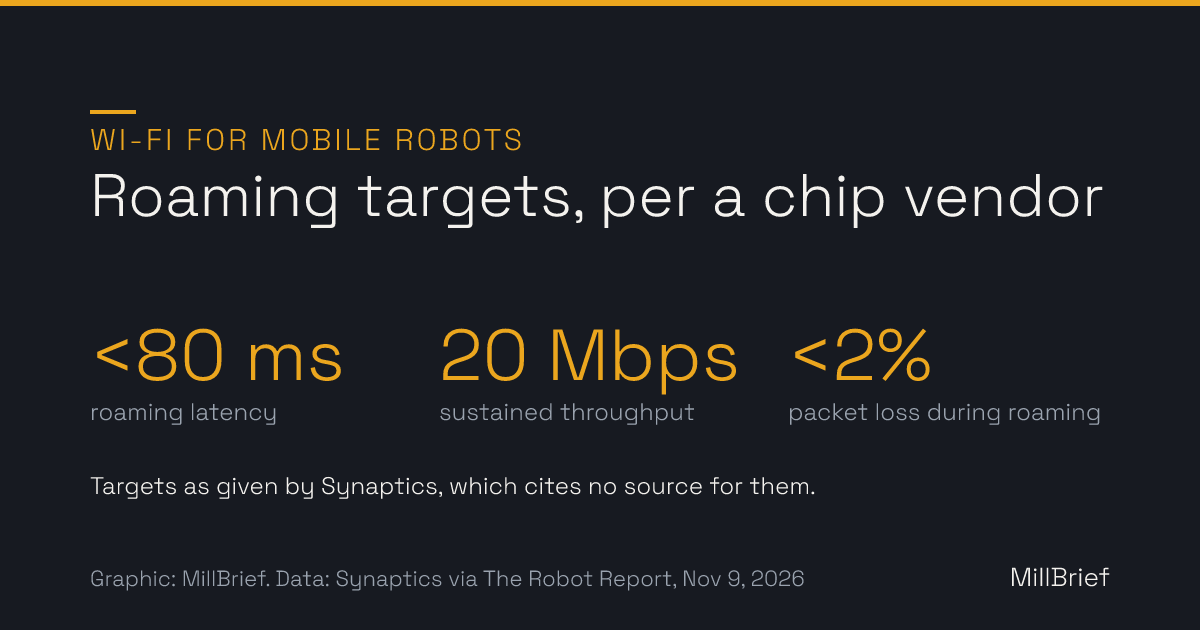
Why it matters: You will not choose the Wi-Fi chip in an AMR, but you will own the network it runs on. The article lists what slow roaming costs: higher latency, lost packets, broken video, delayed control responses and lower productivity. Before a mobile robot pilot, ask the vendor what roaming time, throughput and packet loss its fleet needs, whether its robots support fast roaming on your access points, and who pays for the site survey and any extra access points. Write those numbers into the acceptance test, and test them along the busiest route at the busiest time, not in an empty aisle. The piece is written by a supplier promoting its own product, so treat its targets as a starting point for that conversation rather than a standard.
Source: The Robot Report (article by Synaptics), November 9, 2026.
Who answers the robot when it gets stuck at 3 a.m.?
In an opinion column for Robotics & Automation News on November 9, Rafael Patron, president of the scientific-technical committee of AIPIA, the Italian Association of Artificial Intelligence Professionals, argues that “supervised autonomy” is usually described from the robot’s side, while many projects leave the harder human question, who answers the robot when it gets stuck, until commissioning. His example: a depalletising cell on a night shift meets a pallet in reflective film its vision system has never seen, the gripper fails twice and the line backs up. What happens next, he writes, depends less on the AI model than on decisions taken months earlier.
The column builds on the outlet’s October interview with Plus One Robotics chief executive Erik Nieves, who argued that a robot should be judged on its worst day. Patron’s proposals are practical. List the exceptions that disrupt the manual process today (damaged cartons, items stuck together, a changed pallet pattern, a person in the wrong zone) and decide before go-live which ones the robot may resolve alone and which must always reach a person; anything touching safety, product damage above a threshold or a customer-specific rule usually belongs in the second group. Log every exception, including those the robot solved, and review the list every few months. A request for help should carry an image or clip, what the robot tried and how many times, and how long the supervisor has before the cell stops or diverts the item.
On staffing, the column says there is no reliable industry benchmark for how many robots one supervisor can cover, and that a figure borrowed from another site will mislead. Instead, measure during the pilot how many help requests each cell raises per hour, how long each type takes to resolve and how that changes across shifts. The column closes with a test: before signing, ask the operations manager, the automation engineer, the AI specialist and the shift supervisor to each describe the robot’s worst day. If their answers differ, the design is not finished. (The column also points to AIPIA’s training paths and to UNI 11621-8:2026, an Italian standard describing twelve AI role profiles.)
Why it matters: For a small plant, the cost of exceptions is often the part of the business case nobody wrote down. If a vision-guided cell needs someone to walk over every time a carton is crushed, that time is a running cost, and on a night shift it may fall on whoever is nearest. Ask the vendor for exception rates from the pilot, by type and by shift, and put the escalation list and response times into the acceptance test. It pairs with the column on rehearsing operator challenges we covered on November 4, and our hidden costs of automation page covers where these costs hide.
Source: Robotics & Automation News, November 9, 2026.
Sources
- Samsung, SK hynix, Micron Move to Set Robot Charging Standard (Seoul Economic Daily, 2026-11-08)
- Memory Giants Push Robot Charging Standards for Older Fabs (Seoul Economic Daily, 2026-11-08)
- How to minimize Wi-Fi roaming interruptions for autonomous mobile robots (The Robot Report, 2026-11-09)
- Opinion: Supervised autonomy in robotics starts with the robot's worst day (Robotics & Automation News, 2026-11-09)