Industry Brief, July 27, 2026: $1.7B for specialized robots, AMD's controls play
Four items today: the biggest robotics check of the season goes to specialized machines rather than humanoids, a Seoul startup raises $105 million for a wheeled humanoid with an unusually sober view of factory reality, AMD mounts a full-stack challenge to NVIDIA for the robot’s control computer, and a foundation-model lab teaches one AI model to run 9,000 different grippers. As always, we summarize in our own words and link to the original outlet; we report only what each source’s own reporting supports, and vendor performance numbers are labelled as exactly that.
Kalanick’s ATOMS raises $1.7 billion, for specialized robots, not humanoids
The Robot Report covers a $1.7 billion equity raise for ATOMS, the robotics company led by Uber co-founder and former CEO Travis Kalanick (essentially a rebranded holding structure built on top of his CloudKitchens business, now merged into a single equity entity). Details on the actual robots are thin: ATOMS says it will act as an OEM building “atoms-based” computers for major industrial sectors, starting with food infrastructure, mining productivity, and a wheelbase for mobile robots. a16z led the round with Ben Horowitz joining the board; other equity participants include Bain Capital, Uber itself, Fifth Wall, and SV Angel, with Bank of America, Goldman Sachs, Wells Fargo, JP Morgan, and Barclays as debt partners. The most quotable part is Kalanick’s positioning: humanoids will be good at low-scale tasks in human-designed spaces, but “if you need an industrial kitchen to make 1,000 pancakes an hour, you’ll need a more customized approach.”
Why it matters: Strip away the branding and this is a check more than ten times the size of the week’s humanoid rounds, placed on the other side of the bet: purpose-built machines for high-volume work, which is the same conclusion plant engineers reach when they price a cell honestly. There is nothing here you can put on a purchase order: no product, no specs, no deployment record. But it is a useful calibration when a vendor pitches you a general-purpose robot for a specialized job: throughput work rewards picking the right first target and machinery shaped to it, and the cost structure of a dedicated line is still the benchmark any flexible alternative has to beat.
Source: The Robot Report, July 23, 2026.
Holiday Robotics raises $105M for FRIDAY, a wheeled humanoid built around its hands
The Robot Report reports a $105 million Series A for Holiday Robotics of Seoul, South Korea, building FRIDAY, a “semi-humanoid” with a wheeled mobile base, a dexterous upper body, and hot-swappable batteries sized for a full shift. The company’s framing is notably un-hyped: a real factory imposes constraints that never show up in a controlled demo (contact, timing, repeatability, safety, recovery), and the robot “has to work inside the environment as it already exists.” Holiday says it put its engineering weight where the value is: by the company’s own count FRIDAY has 64 degrees of freedom, 40 of them in its tactile-sensing, force-aware hands, with back-drivable joints and 360° camera-plus-lidar perception for safe operation around people. On the software side it takes a “vision-language-skill” approach (individual skills validated separately, then composed) rather than one end-to-end model. Current status: private proofs of concept with industrial partners in automotive, semiconductor, and logistics settings.
Why it matters: This is the second wheeled-base, hands-first humanoid round in a week (after London-based Humanoid’s $152M we covered on July 22). The category is converging on wheels plus dexterous hands, quietly conceding that legs are not where factory value is. Holiday’s own constraint list is the right checklist to turn back on any humanoid vendor: ask for evidence on contact, repeatability, recovery, and safety in your environment, not a demo reel. And note what stage “private proofs of concept” is: nothing here changes what is purchasable today, where cobots and conventional robots remain the options with published prices and installed bases.
Source: The Robot Report, July 23, 2026.
AMD challenges NVIDIA for the robot’s control computer
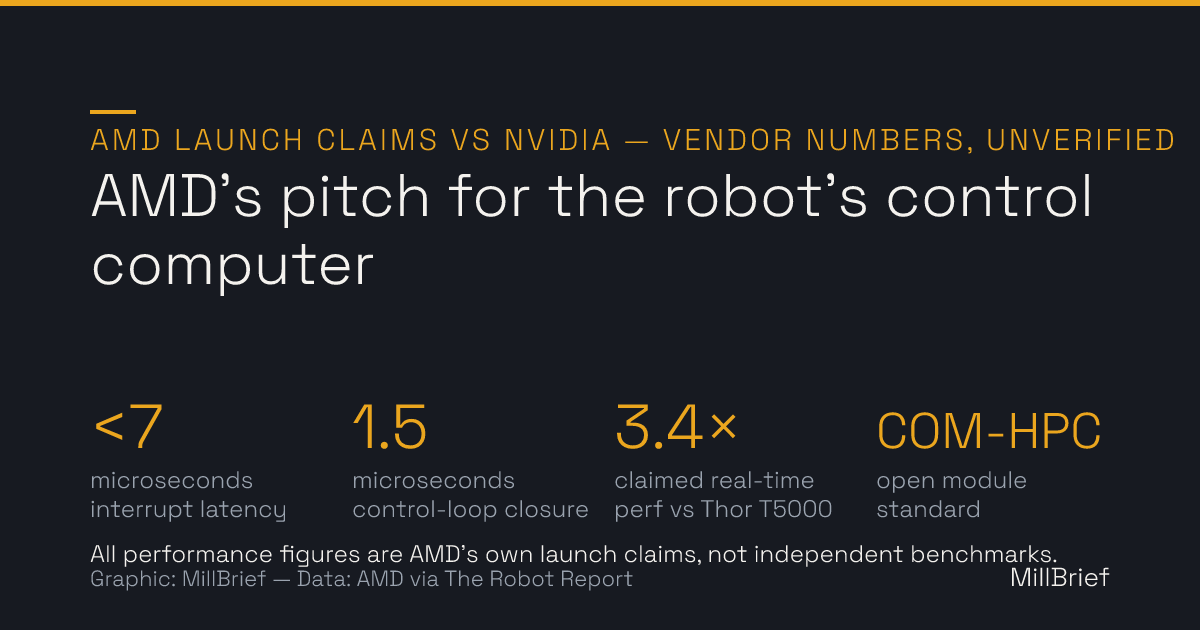
The Robot Report details AMD’s full-stack robotics play: the Ryzen AI Embedded X100 system-on-chip line plus a Kria AI system-on-module, development kit, open-source “Sophie Suite” software stack, and a robotics partner network (Open Robotics, Open Navigation, OpenCV among them). The technical pitch is unified CPU-GPU-NPU memory that cuts data copies for perception and planning, plus deterministic control: a sub-7-microsecond interrupt-latency target for “firm” real-time under optimized Linux, hypervisor isolation for hard real-time, and a claimed 1.5 μs control-loop closure on the module. The comparative numbers are AMD’s own launch claims and should be read that way: 3× the FP32 compute of NVIDIA Thor in signal- processing workloads, and 3.4× better real-time performance than Thor T5000 for the Kria module. Two structural choices matter more than the benchmark claims: the module uses the open COM-HPC standard rather than a proprietary form factor (any manufacturer can build compatible modules), and the dev kit’s baseboard schematics are open-source. Early customers named: Castec International’s semiconductor-fab AMR and Foundation Robotics, which is migrating off Intel and NVIDIA.
Why it matters: Most plants will never buy a robotics SoC, but the compute inside your next AMR or vision cell decides who controls its spare parts, software updates, and second source, the same vendor-viability exposure we flag for integrator and vendor selection. A credible second supplier plus an open module standard is good news for buyers regardless of whose benchmark you believe: it pressures pricing and gives machine builders an exit ramp from single-vendor lock-in. If you are speccing AI-heavy equipment with a 10-year life, it is now a fair RFQ question to ask what compute platform the product roadmap rides on and what happens if that platform’s pricing or availability changes (another entry for the hidden costs checklist).
Source: The Robot Report, July 23, 2026.
Generalist trains one model across 9,000 gripper variations
The Robot Report covers an update to GEN-1, Generalist’s embodied foundation model: it now supports a broad range of end effectors, from five-fingered hands to specialized tools: the company’s examples include power screwdrivers, tongs, tape dispensers, spatulas, and box cutters. The scale claims are the company’s own: pretraining on more than half a million hours of real interaction data across roughly 9,000 end-effector variations: off-the-shelf tools, printed parts, and custom modifications of its standard two-finger grippers. The thesis is that each tool is a different “language” for physical interaction, and training across many of them teaches transferable physical common sense, so one base model can pick up a new gripper the way a multilingual speaker picks up a related language.
Why it matters: End-of-arm tooling is where automation budgets quietly bleed: the gripper, the regrip station, the custom fingers for the part that “almost” fits are classic hidden costs, and re-tooling for a product change can cost a meaningful fraction of the arm itself. A model that genuinely adapts across tools would shrink that custom-engineering line item. But note the verification gap: these are the lab’s own dataset statistics, and “supports a range of end effectors” in pretraining is not the same as hitting your cycle time and scrap rate with your parts. Until this class of software shows up in a product with published cycle times, budget EOAT the old way: as its own engineering line, quoted per part family.
Source: The Robot Report, July 24, 2026.
Sources
- Uber co-founder raises $1.7B for new robotics startup ATOMS (The Robot Report, 2026-07-23)
- Holiday Robotics raises $105M for its FRIDAY wheeled humanoid (The Robot Report, 2026-07-23)
- AMD unveils Kria module for real-time control, unified memory for robots (The Robot Report, 2026-07-23)
- Generalist's GEN-1 foundation model now supports a range of robot end effectors (The Robot Report, 2026-07-24)