Industry Brief, August 2, 2026: Humanoid patents, July in review, tech-speed defense
A quieter Saturday wire, so three items with some altitude: patent data that replaces vibes with numbers in the China-vs-US humanoid argument, what the robotics industry actually read in July, and a defense CEO’s manufacturing thesis that sounds a lot like the build-vs-buy debates on any factory floor. Our own words, links to the original outlet, vendor numbers labelled as vendor numbers.
Patent data splits the humanoid race: China wins scale, US keeps quality
Interesting Engineering covers a new LexisNexis analysis of more than 26,000 patent families in humanoid robotics, and the headline split is starker than the usual commentary: Chinese companies take the top five spots in the startup innovation ranking (Fourier, AgiBot, LimX Dynamics, Pudu Robotics, and Unitree) and six of the top ten, with Figure AI (6th), Apptronik (8th), and Agility Robotics (10th) carrying the US and Germany’s Agile Robots the only European entry. By end-2025, China accounted for 73% of the world’s active morphology-related patent portfolio; over the past decade its patent activity doubled in interaction systems, grew ~2.5× in robot morphology, and 5× in control and planning. The US counterweight is concentration: American inventors hold just 5% of active morphology-related patent families but contribute 11% of global portfolio strength, and the report says the US “maintains the highest average patent quality” across all three technology areas examined. One structural detail worth more attention than the rankings: for nine of the ten strongest patent holders (names like Fanuc, Alphabet, Nvidia, Kawasaki, and Intuitive Surgical), humanoid patents are under 10% of their portfolios.
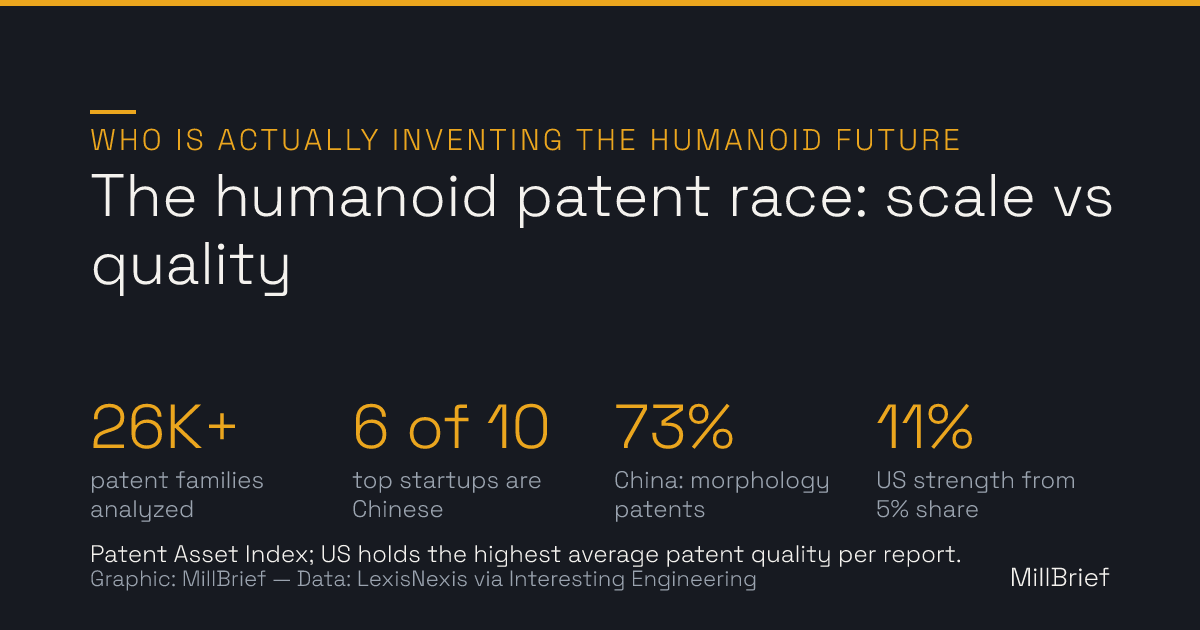
Why it matters: This is the measured version of the dependence picture we charted from the FCC-ban expert commentary earlier this week: China’s lead is real and accelerating on volume, while US strength is concentrated in fewer, higher-quality portfolios, many held by incumbents whose main business isn’t humanoids at all. For buyers the practical takeaway is about durability, not geopolitics: patent depth is one of the few forward indicators of which humanoid vendors will still exist to honor a support contract in five years, and it’s free to check. A startup with a thin patent position and rented foundation models has less defensible economics than its demo reel suggests; the same vendor-viability questions you’d ask an integrator apply doubly to a humanoid pilot.
Source: Interesting Engineering, August 1, 2026.
What the industry actually read in July: money, training, and the ban
The Robot Report’s most-read stories of July are a useful proxy for where the industry’s attention went. The money was loud: Shenzhen’s AI² Robotics raised roughly $735 million, and Walden Robotics came out of stealth with $300 million to build robots that “continuously learn and improve while performing real work.” Training approaches drew clicks too: London-based Humanoid introduced KinetIQ Ascend, a reinforcement-learning approach it says is designed to reach 99.9% manipulation reliability at human speed (a vendor target, not a measured result), as did new hardware: Apptronik’s Apollo 2 and its expanded Robot Park training facility in Austin, AMD’s full-stack robotics play (with vendor-claimed performance wins over NVIDIA’s Orin and Thor), and Weave Robotics’ $7,999 wheeled home humanoid Isaac 1, also offered at $449 a month. Rounding out the list at #10: the FCC’s import restrictions on foreign-made robots, the story that then dominated the wire’s final week.
Why it matters: Two reading-list signals stand out. First, the capital is concentrating in physical AI and humanoids at valuations that assume general-purpose robots arrive on schedule, while the deployments actually shipping tonnage this summer (the driverless sand fleet, the grocery AMR fleets) are narrow, boring, and per-task. That gap between where money flows and what works is worth remembering when a humanoid pitch reaches your plant. Second, a consumer home humanoid at $449/month is a pricing experiment the industrial side should watch: robots-as-subscription keeps entering the market from the consumer end, and it reshapes the payback math when it arrives in industrial form.
Source: The Robot Report, August 1, 2026.
Anduril’s manufacturing thesis: own the design, buy commercial parts
CNBC’s Tech Download interviewed Anduril CEO Brian Schimpf, and alongside the AI-weapons discussion (his position: autonomy with “human supervision of decision making,” noting autonomous weapons like torpedoes have long existed) sits a manufacturing argument relevant far outside defense. Schimpf’s thesis is that defense companies should own more of the design process, lean on commercial supply chains rather than the sector’s traditional slow, specialized supplier networks, and manufacture at tech-industry speed. The test case: Anduril signed a Pentagon deal to supply 1,000 missiles, which CNBC notes effectively requires ramping production from practically nothing; Schimpf credits the ramp speed to having “thought about the scalability of supply chain so much.”
Why it matters: Strip the defense context and this is the build-vs-buy argument every automation project runs into: bespoke, single-source components give you exactly what you specified and a supply chain that breaks exactly one way, while commercial off-the-shelf parts trade some fit for resilience, second sources, and spare-parts availability a decade out. The same logic belongs in your RFQ: ask which components of a proposed cell are commodity versus custom, and price the custom ones’ lifetime support risk, not just their invoice line. Defense rediscovering commercial supply chains is also a demand signal: if that model scales, the same industrial-grade commercial components your integrator uses will have a new, deep-pocketed customer competing for them.
Source: CNBC, July 31, 2026.
Sources
- China grabs six of top 10 humanoid robot spots, but US quality is higher: Report (Interesting Engineering, 2026-08-01)
- Top 10 robotics stories of July 2026 (The Robot Report, 2026-08-01)
- The Tech Download: Anduril CEO Brian Schimpf talks AI in warfare and manufacturing push (CNBC, 2026-07-31)