Industry Brief, September 1, 2026: One-video learning, microfactories, and the cost curve
September opens with a busy Monday: a $1.7 billion-funded startup claims robots can now learn tasks from one video, a team of Amazon-automation veterans raises $40 million to build houses in microfactories, a gripper maker argues the hand matters more than the brain, and TechCrunch maps the US-China robotics split. Our own words, links to the original outlet, vendor numbers labelled as vendor numbers.
Skild’s S1: learn a task from a single video, with caveats
Skild AI (founded 2023, nearly $1.7 billion raised toward a “general-purpose robot brain”) unveiled S1, its flagship robot foundation model. The headline claim, from co-founder Deepak Pathak: put a video of a human doing a task in the model’s prompt, and the robot follows it, including long-horizon jobs up to ten minutes such as repotting a plant or cooking pancakes. Pathak’s most striking anecdote is emergence: after a robot flipped a pancake, the team searched its training data for any flipping example and found none. The training approach mixes all four data sources (teleoperation, human video, simulation, and glove-captured demonstrations) on the argument that each covers another’s weaknesses. The model is “omni-bodied” (quadrupeds and beyond; humanoid scaling still to come), and Pathak himself supplies the caveat: this is not robotics’ ChatGPT moment yet, and it’s “not quite” ready for homes. Production results are promised “in the coming weeks”; all of this is the company’s own account, with no independent benchmark attached.
Why it matters: In-context task learning, if it holds up outside demos, would attack the single biggest line item in automation deployments: task-specific engineering and reprogramming. The buyer’s checklist doesn’t change, though: demand task success rates on your parts and your lighting, not curated videos. We said the same about simulation claims last week: the gap between a controlled demo and your third shift is where budgets die.
Source: The Robot Report, August 31, 2026.
Ex-Amazon automation leads raise $40M to build homes in microfactories
Reframe Systems raised $40 million, led by Energy Impact Partners, to scale a network of robotic microfactories for home construction. The founders (Vikas Enti, Felipe Polido, and Aaron Small, who helped deploy more than 500,000 robots across Amazon’s fulfillment network) are betting against construction’s fragmentation, where a single house involves 25-plus subcontractors drawing on a shrinking trades pool. The concrete numbers (all company-reported): ten homes completed so far, eight occupied; 114 more units planned in the next year; a new Billerica, Mass. microfactory, FAB1, targeted to open October 5 (70 days after getting the keys), with less than $5 million of equipment and annual capacity of 500 multifamily units or 250 single-family homes. A Somerville triple-decker in 180 days and Altadena wildfire rebuilds are the showcase projects; the stated long-term target is a million homes by 2040.
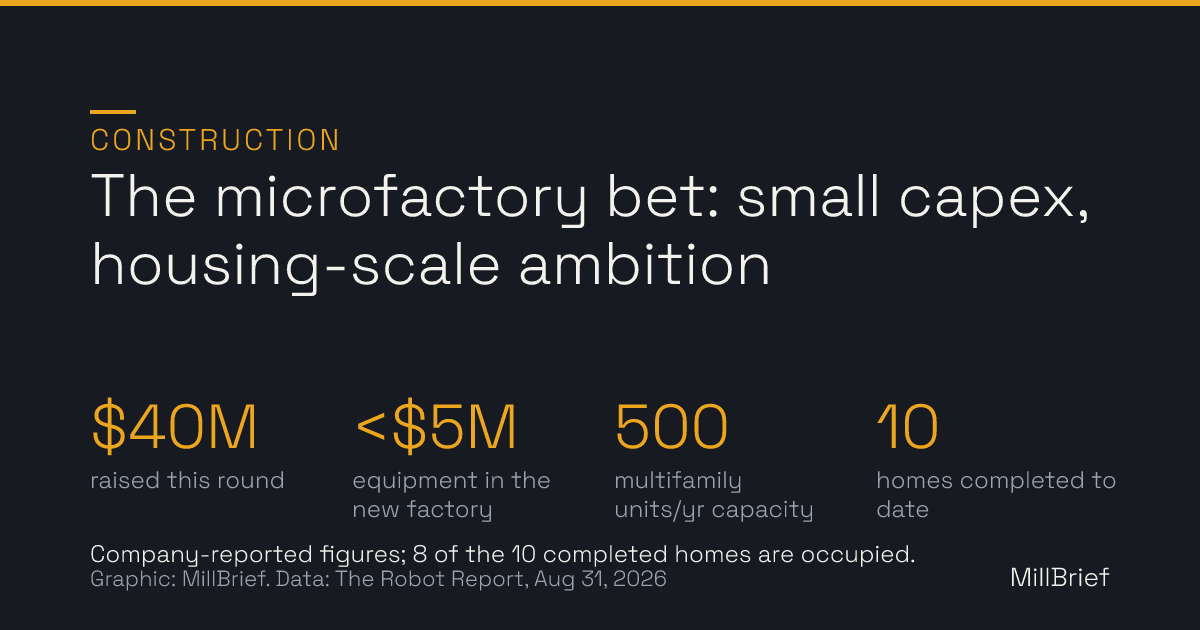
Why it matters: The interesting number isn’t the $40 million; it’s the sub-$5 million factory. That’s job-shop-scale capex applied to an industry with almost no automation, and the 70-day fit-out claim, if real, is the kind of repeatable playbook that payback math rewards: small, fast-to-deploy capacity you can replicate, instead of a monolithic plant you bet the company on. Note the ratio to watch as it scales: ten homes delivered against a million-home ambition; the claims are running thirty years ahead of the evidence, which is normal for a funding announcement and worth remembering anyway.
Source: The Robot Report, August 31, 2026.
The gripper maker’s case: the hand gates the brain
A contributed piece in The Robot Report from gripper maker OnRobot (a vendor argument, but a coherent one) contends that physical AI’s binding constraint is the end-of-arm tooling, not the model. The logic: a model can infer that an object should be picked up, but the gripper must make contact, apply the right force, detect whether the grasp held, and react when it didn’t, every time. Robot motion is relatively mature; manipulation isn’t, because friction, slip, and deformation can’t be modeled perfectly, and a grasp that works in simulation still fails on real parts. The piece argues for tooling with adjustable grip parameters, grip/part detection, and multimodal sensing (proximity before contact, force/torque during it), partly because that interaction data feeds back into training the learning systems themselves.
Why it matters: This is the vendor-side echo of what Locus’s grasping chief said from the operator side last week: pick reliability, not model intelligence, is where warehouse manipulation lives or dies. When a physical-AI pitch crosses your desk, ask what the end effector senses and what the system does on a failed grasp: a robot that knows it dropped the part is worth more than one with a smarter planner and no idea.
Source: The Robot Report, August 31, 2026.
Trade barriers vs the cost curve: where robot competition goes next
TechCrunch analyzes the widening US restrictions on Chinese robotics (FCC Covered List expansion to advanced robotic devices, drone tariffs starting in September with component tariffs to follow in 2027) against the scale on the other side: global humanoid shipments hit 22,000 units in the first half of 2026, and the five largest makers by shipments (AgiBot, Unitree, Galbot, UBTECH, Leju Robotics; all Chinese) accounted for 86 percent of them, per Counterpoint Research. The analysts’ view is blunt. TDK Ventures’ Ankur Saxena: “You cannot sanction your way around a cost curve. You can only out-build it.” Counterpoint’s Soumen Mandal expects Chinese humanoid makers to run the electric-vehicle playbook (scale at home, expand into price-sensitive markets across Europe, Southeast Asia, Latin America, and the Middle East, then localize production), leaving a fragmented market rather than a clean split.
Why it matters: For a US buyer, the practical readout of the FCC’s robotics move plus tariffs is that the cheap end of the robot market is being walled off faster than domestic alternatives are scaling up. If your automation plan assumed falling hardware prices, check which side of the wall your shortlisted vendors source from, and expect the security-requirements question (“where is the robot’s software maintained?”) to show up in more of your own customers’ audits too.
Source: TechCrunch, August 30, 2026.
Sources
- Skild AI unveils S1 flagship robot foundation model (The Robot Report, 2026-08-31)
- Reframe Systems raises $40M to scale its robotic microfactories for home building (The Robot Report, 2026-08-31)
- How better grippers can unlock physical AI (The Robot Report, 2026-08-31)
- The US is building barriers around drones and robots, but China has scale to get around them (TechCrunch, 2026-08-30)