Industry Brief, November 11, 2026: Path's $300M, a free robot panel, mail-in repair
Four items today. Path Robotics, whose AI-guided welding cells are sold to mid-sized manufacturers as well as shipbuilders, has raised $300 million and says it will move beyond welding. A small software company has released a free, offline screen for running robots from different vendors side by side. A field service firm makes the case for mailing small robots to a repair bench instead of waiting for a technician. And AGIBOT proposes a way to count how much useful work a robot fleet actually does. Vendor claims are labelled as such.
Path Robotics raises $300 million and plans to go beyond welding
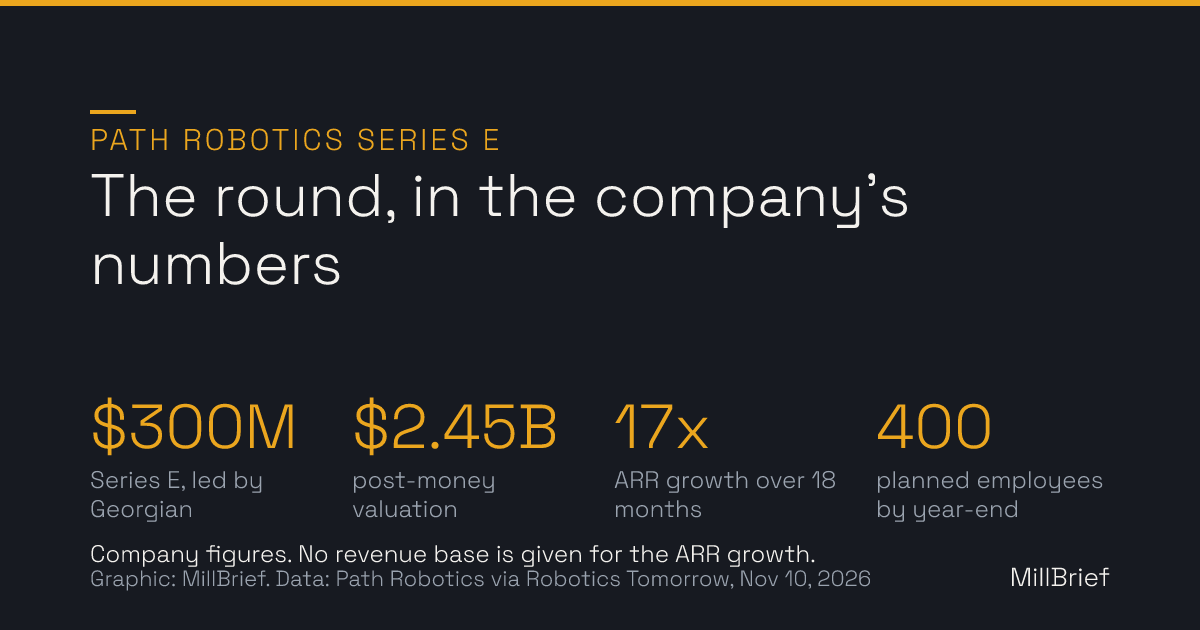
Path Robotics has raised $300 million in a Series E round at a post-money valuation of $2.45 billion, according to the company’s announcement published by Robotics Tomorrow and reported by Robotics & Automation News on November 10. The round was led by Georgian, a growth equity firm whose partner Emily Walsh joins the board; Tiger Global and Yamaha Motor Ventures are among the existing investors taking part. By our arithmetic, the pre-money valuation was about $2.15 billion ($2.45 billion less $300 million). The company says it has raised more than $610 million since it was founded in 2018.
The growth figures are the company’s: annual recurring revenue up 17-fold over the past 18 months (no revenue figure is given, so there is no base to judge that against), headcount up 97% year on year, and a plan to reach 400 employees by year-end. Customers named include HII, Lockheed Martin and Saronic, and mid-sized manufacturers EK Machine, Millerbernd Manufacturing Company, TransAmerican Power Products and TYCROP. The release describes the HII deal, which we covered on August 11, as a $600 million performance-based production agreement.
The money is meant to expand the welding business, push into “every task before and after welding” in chief executive Andy Lonsberry’s words, and fund more data, compute and AI model training. Path’s welding model is called Obsidian; it recently added Rove, which puts that model on a four-legged mobile robot so the welding can go to the part, wherever it is.
Why it matters: For a fabricator weighing an AI welding cell, a supplier with fresh capital is less likely to vanish halfway through a service contract, and four mid-sized shops are now named as customers you can ask for references. The flip side is focus: the money is aimed at new tasks, new robot types and model training, and the release says nothing about prices. Ask any vendor in this space how many cells it supports in shops your size, what the service and software subscription costs after year one, and what happens to your cell if the welding model is updated. Our questions to ask a system integrator cover the rest.
Sources: Robotics Tomorrow (company release), Robotics & Automation News, November 10, 2026.
A free, offline screen for robots from different vendors
Styri has released Styri 2.0, an open-source operator panel that shows robots from different vendors on one map and lets staff send, pause or stop them from any browser on the site network, with no cloud connection, according to its announcement in Robotics Tomorrow on November 10. It works with robots that use ROS 2, the open-source robot software framework, and VDA 5050, the vehicle interface standard that came out of German car manufacturing, and it includes a built-in message broker for VDA 5050 vehicles. Each command shows its status as reported by the robot, so nothing shows as done until the robot confirms it. User roles and a local log of every command are free.
Pricing is published. The free Core version, under the Apache 2.0 licence, covers up to three robots on one site. A Pilot licence for up to 20 robots costs $360 a month or $3,600 a year (paying yearly saves $720 against twelve monthly payments: $4,320 less $3,600). A remote installation service starts at $1,500, with a 10-business-day guarantee. Styri says plainly that its “Operator stop” is a software stop, not a safety function.
The limits are on Styri’s own site: it has been tested against simulators, with real-robot results to be added as they are run, and it does no traffic management or task allocation across vendors; it sits next to the fleet manager you already have. The project is young: its public GitHub repository was created on October 20, 2026.
Why it matters: A plant that adds a second mobile robot brand often gets a second dashboard, and the people on the floor need one place to see which robot is stuck. A free tool for three robots is a cheap way to test that idea, but treat it as an operator aid, not as fleet management and never as a safety device: your e-stops and safety-rated fields still do that job. If you try it, do so on a spare machine in a pilot area first. It sits alongside the questions we raised about ISO 21423, the mixed-fleet standard, on November 3 and about mobile robot charging on November 10.
Sources: Robotics Tomorrow (company release), November 10, 2026; styri.dev.
The case for mailing a small robot to a repair bench
When a robot fails, the industry’s reflex is to send a technician or swap the whole unit, argues Steve Urban, founder and chief operating officer of Robo Reliance, a Colorado-based robot field service company, in a column for Robotics Tomorrow on November 10. He makes the case for a third option common with laptops, medical devices and power tools: depot repair, where the unit is shipped to a bench, fixed and tested, and sent back. Many robots sold today, from floor scrubbers to small autonomous mobile robots, can be lifted by one or two people, he writes.
He keeps on-site service for robots that are large, built into a line, or where every hour of downtime is expensive. The bench wins, in his view, when the robot is small and the site remote (a technician driving four hours each way to fix a 60-pound, roughly 27 kg, robot “does not pencil out”), when the fault is intermittent and needs days of running to reproduce, when the repair is deep (board-level work, motor rebuilds, wiring harnesses), and when the owner keeps spares and can rotate a failed unit out. His checklist for any depot programme: authorisation before shipping, a written quote before work starts, a flat published diagnostic fee, testing before return, a failure report the manufacturer can use, and honest advice on when a robot should not be shipped.
The column is also a pitch. Robo Reliance has just added mail-in repair for robots of 150 pounds (about 68 kg) or less, with a flat $99 diagnostic fee at its U.S. repair facility, and offers the bench to robot makers, dealers and fleet operators.
Why it matters: For a small plant with a handful of mobile robots or cobots, the question to settle at purchase is what happens to a failed unit in year three, after the warranty. Ask the vendor whether it offers depot repair, what the diagnostic fee and typical turnaround are, and whether a spare unit is cheaper than a faster service level. Ask too whether a third-party repair voids the warranty. These clauses belong next to the service terms we covered on November 5, and repair downtime is one of the hidden costs of automation.
Source: Robotics Tomorrow (column by Robo Reliance), November 10, 2026.
AGIBOT proposes a count of useful robot work
Robot maker AGIBOT is proposing “Worken” (from “work” and “token”), a way to measure the useful work a robot fleet delivers after deployment, set out in an article in Robotics & Automation News on November 10. The formula multiplies three things: the number of robots actually doing tasks (not the number installed), the hours they work without continuous human control (not the hours powered on), and an output efficiency ratio, which compares acceptable output with a benchmark for the task, such as an established hourly production standard.
The article’s example is labelled hypothetical, not a deployment result: 10 robots, each working autonomously for six hours in a shift, at an efficiency ratio of 0.8, gives 10 x 6 x 0.8 = 48 Worken (we checked: 60 robot-hours times 0.8 is 48). AGIBOT says the figure is not a price for robot labour, only means something with clearly defined tasks and agreed benchmarks, and is still evolving.
Why it matters: The idea is close to OEE, which multiplies availability, performance and quality (see our OEE explainer and calculator). What it adds is that time spent waiting for a person does not count as working time. That is the right question for any vision-guided or AI-driven cell: a robot that runs all shift but needs someone every twenty minutes is not doing a full shift of work. You do not need AGIBOT’s name for it. Write into the acceptance test which hours count as autonomous, what counts as acceptable output, and what the benchmark is, and ask the vendor to report against those numbers during the pilot.
Source: Robotics & Automation News (AGIBOT’s proposal), November 10, 2026.
Sources
- Path Robotics Announces $300 Million Series E Financing at $2.45 Billion Valuation to Scale Physical AI for Manufacturing (Robotics Tomorrow, 2026-11-10)
- Path Robotics raises stunning $300 million at $2.45 billion valuation to expand physical AI in manufacturing (Robotics & Automation News, 2026-11-10)
- Styri launches a free, offline panel to see, send and stop robots from different vendors (Robotics Tomorrow, 2026-11-10)
- Styri: one offline panel for ROS 2 and VDA 5050 robots (Styri)
- Not every robot repair needs a truck roll. It's time to bring back the repair bench. (Robotics Tomorrow, 2026-11-10)
- How Much Work Do Robots Really Deliver? The Thinking Behind Worken (Robotics & Automation News, 2026-11-10)