Industry Brief, November 12, 2026: AI agents write robot code, recording workers
Three items today, two of them about where robot programs will come from. UC Berkeley and NVIDIA have released open-source tools that let teams of AI agents write, simulate and fix robot programs, and the paper behind them is unusually frank about how far the results are from production speed. Two companies want to record people doing their jobs so robots can learn from the footage, which raises questions a buyer should settle before anyone puts on a camera headset. And a maintenance services executive sets out what robot data to watch so failures are caught early. Vendor and researcher claims are labelled as such.
AI agents that write, test and fix robot programs
Researchers led by Ken Goldberg at UC Berkeley, working with NVIDIA, are presenting an approach they call “agentic robotics” at the Conference on Robot Learning this week, according to a Berkeley release dated November 9 and a report in The Robot Report on November 11. A framework called Graph-as-Policy (GaP) splits a task into skills such as finding an object, planning a grasp and moving without collisions. AI agents pick and connect those skills into a program, rehearse it in simulation across many variations of the task, find where it fails and revise it. The team is also releasing a benchmark of six industrial-style tasks (tool sorting, tool hanging, gear meshing, syringe packing, cable insertion and cable routing) and a tool called RoboSimStudio that makes a complex open-source physics simulator easier to tune.
Two details matter for anyone who has to maintain a cell. The output is readable Python that engineers can inspect, and it calls the robot maker’s existing modules (KUKA is the example given) for low-level motion; it does not replace the robot controller. The program graph can also be converted to ROS 2. The code is on GitHub under the Apache 2.0 licence. The Robot Report says Bosch is evaluating the approach. According to the release, Ambi Robotics (which Goldberg advises, The Robot Report notes) used the methods on its parcel-sorting data, and tests of the resulting changes showed capacity up by more than 15,000 packages a year per robot; the change now runs across 30% of its U.S. fleet. Those are Ambi’s figures.
In one demonstration described in the release, an AI model was given the simulation tool and a short video of a robot wiping ink off a metal bar with a sponge, and built a matching simulation in under an hour. The program it then wrote worked on the real robot, though in one trial the robot knocked the bar over because it had not judged the bar’s mass correctly.
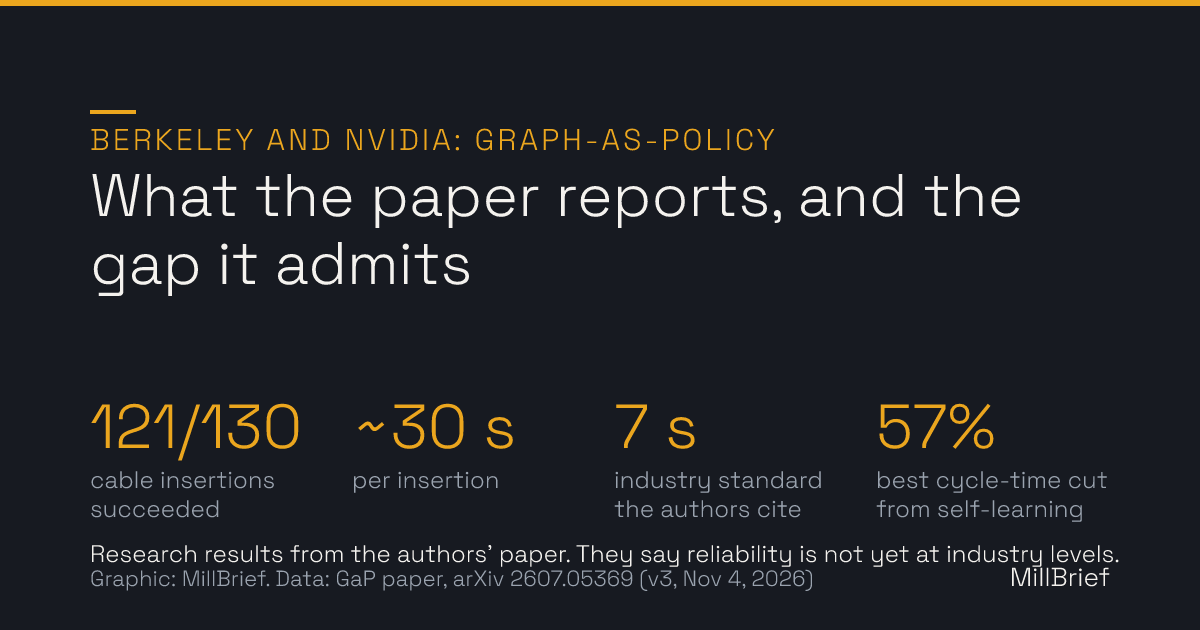
The paper gives the harder numbers. On a real UR5 arm, GaP succeeded on 121 of 130 USB-C cable insertions (0.93), at about 30 seconds per insertion. The authors write that execution reliability “is not yet at industry levels” and that their times fall well short of an industry standard of 500 units an hour, or 7 seconds per unit (3,600 seconds divided by 500 is 7.2). By our arithmetic, 30 seconds is about four times that (30 / 7.2 = 4.2). Letting the agents tune for speed cut cycle time by up to 57% on three of the benchmarks with no loss of success rate, the paper says.
Why it matters: Programming, tuning and troubleshooting a robot cell has long taken weeks to months, as The Robot Report notes, and that time is part of what you pay an integrator for. Tools that shorten it could eventually lower the cost of a small-batch cell. This is research, not a product: nobody is selling it to you, and the authors’ own numbers put it at a fraction of production speed. What to take from it now is the shape of the output. If an integrator or vendor proposes AI-generated robot code, ask for what this team chose: readable code your engineers can review, running on the standard robot controller and its safety functions, tested in simulation and then on your parts before acceptance. Our questions to ask a system integrator and integrator rates pages give the baseline to compare against. We covered Ambi’s peak-season fleet on November 7.
Sources: UC Berkeley via EurekAlert!, November 9, 2026; The Robot Report, November 11, 2026; arXiv paper (v3, November 4, 2026); GitHub.
Recording your workers to train robots
FMC³ Robotics, a German industrial AI company, has introduced Doceo, a set of tools for collecting data from people doing factory work so robots can learn the same tasks, according to Robotics & Automation News on November 11. Workers wear camera headsets, and optionally touch-sensitive gloves, while external cameras also record; the system captures video, depth, movement and touch during normal shifts rather than in a separate training facility. Other parts synchronise and label the recordings, train and test models in the cloud (using data and cloud technology from Vector Informatik), and connect the resulting skills to different robots and control systems. “The real shortage is not data in general,” said Joachim Fetzer, FMC³’s president for Europe, but data on how a task is actually done in a given place, including “the errors and corrections”.
There are no results yet. Two proof-of-concept projects are under way: a wheeled robot moving bins of different sizes to workstations in a consumer electronics plant, and a robot placing electrode sheets into trays at a battery cell plant. They will be judged on cycle time, positioning accuracy and continuous running time; the article gives no figures. FMC³ also plans a German joint venture with Vector Informatik and PEM Motion to standardise this kind of training data.
The same day, The Robot Report profiled Memories.ai, a San Francisco company that supplies data collectors and partners with a standard modular camera setup, gathers first-person video, labels it with its own models (hand pose and action segments, for example) and supplies it to robotics companies as training data. It plans to offer data on exclusive or non-exclusive terms.
Why it matters: A vendor that asks to record your operators is asking for two things: your people’s consent, and your process know-how. Before agreeing, get answers in writing. Who owns the recordings and any model trained on them? Can the vendor reuse them for other customers? (Memories.ai’s exclusive or non-exclusive choice shows that reuse is a term you can negotiate.) Where are they stored and for how long, and can you have them deleted? Check with HR and your legal adviser what notice or consent your employees must be given where you operate, and tell the people being filmed what the footage is for. Put the answers in the purchase terms; our RFQ guide shows where.
Sources: Robotics & Automation News (company announcement), November 11, 2026; The Robot Report, November 11, 2026.
Watching robot data to catch failures early
As plants add robots, a single unexpected failure can stop a cell, slow a line and delay work downstream, writes Rob Carbone, vice president of operations at Advanced Technology Services, a maintenance services company, in a column for The Robot Report on November 10. He cites the International Federation of Robotics figure of about 5 million industrial robots in operation worldwide in 2025, up 11% on the year before. Scheduled maintenance still has a place, he argues, but it can miss wear in a joint, reducer, motor or controller that develops between service visits.
The signals he lists as common examples are vibration, temperature and motor current, with torque, controller alarms, cycle data and maintenance history adding context. A rise in vibration may point to a mechanical problem, and changes in current or torque to extra resistance or abnormal loading. The aim is not to collect every data point, and the robot has to be read in the context of its cell, since a changed gripper, sensor or conveyor can shift its readings too. A useful alert, he writes, says what needs attention, how urgent it is and when the robot can be inspected without stopping production unnecessarily. Earlier warnings also give time to order the right part and to do the repair in a planned window, which he says supports safer work than fixing a failed robot under production pressure. The column gives no figures on savings or downtime, and its author sells maintenance services.
Why it matters: A shop with three or four robots does not need a monitoring platform to start. Ask your robot vendor which of these signals the controller already records (alarms, cycle times, motor current or torque) and how to export them, then look at a month of data for each robot so you know what normal looks like. Keep a parts list for the components he names, and compare the cost of a spare against a day of a stopped cell. It pairs with the mail-in repair option we covered yesterday and the August 16 argument that maintenance programmes fail in the follow-up, not the model; downtime is one of the hidden costs of automation.
Source: The Robot Report (column by Advanced Technology Services), November 10, 2026.
Sources
- Recent advances in AI are creating a 'paradigm shift' for robotics (University of California, Berkeley via EurekAlert!, 2026-11-09)
- Can AI agents program industrial robots without training data? Berkeley says yes (The Robot Report, 2026-11-11)
- GaP: A Graph-as-Policy Multi-Agent Self-Learning Harness For Variational Automation Tasks (arXiv, 2026-11-04)
- graph-as-policy (GitHub repository) (GitHub)
- FMC³ Robotics introduces Doceo system to help industrial robots learn from factory workers (Robotics & Automation News, 2026-11-11)
- Memories.ai builds standardized egocentric video pipeline (The Robot Report, 2026-11-11)
- Why predictive maintenance matters more as factories add robots (The Robot Report, 2026-11-10)