Industry Brief, August 3, 2026: Whole-body robot AI, $50 edge boards, recycled EVs
Sunday’s three items dig under two stories we’ve been tracking and add a new thread: the technical detail behind DeepMind’s whole-body robot model, an interview that explains why the prototype-to-production path for robots is about to get cheaper, and a materials study asking whether China’s EV industry can eventually feed itself with recycled inputs. Our own words, links to the original outlet, vendor numbers labelled as vendor numbers.
What Gemini Robotics 2 actually does, per DeepMind
The Robot Report has the technical rundown on Gemini Robotics 2, which we noted when it launched. The pieces that matter, all per DeepMind’s own description: the model extends control from tabletop arm work to whole-body humanoid motion: their demo has Apptronik’s Apollo 2 walking to a table, picking up a watering can, carrying it to a shelf, and placing it on request. Dexterity claims include operating the five-fingered, 22 degree-of-freedom SharpaWave hand (tying knots, sealing a ziplock bag) as well as ordinary two-finger parallel grippers on a Franka Duo. Architecturally, a separate reasoning model, Gemini Robotics ER 2, acts as the high-level brain: it plans multi-step tasks, coordinates the action model, tracks progress across sequences lasting minutes and “hundreds of decisions,” and self-corrects on failures. Two claims deserve the most buyer attention: an on-device variant runs without network connectivity and adapts to new two-arm robot bodies in a few hours with typically fewer than 200 examples, and a new safety benchmark (ASIMOV-Agentic) measures things like refusing unsafe actions and stopping when a human approaches, which DeepMind connects to collaborative-safety requirements. None of this is yet generally available: ER 2 is on Google AI Studio and in private enterprise preview, and the action models are early-access only.
Why it matters: Two of these claims map directly onto the questions industrial buyers already know how to ask. On-device operation addresses the what-happens-when-the-cloud-blinks problem that we keep flagging in connected-robot diligence: a robot brain that runs locally is a different risk profile from one that phones home. And “adapts with under 200 examples” is a vendor claim with a testable shape: if foundation-model retargeting gets that cheap, the integration cost structure that makes every new cell a bespoke engineering project starts to move. Neither claim is proven in production; treat both as the spec sheet for the pilot you’d run, not the reason to buy one.
Source: The Robot Report, August 2, 2026.
Arduino’s Qualcomm era: the prototype-to-production pitch
Robotics & Automation News interviewed Arduino chief product officer Marcello Majonchi about life after the October Qualcomm acquisition, and the roadmap is squarely aimed at robotics. Arduino frames its history as three phases (democratizing electronics, then IoT, now edge AI), and the new hardware makes the ambition concrete: the Uno Q, a Qualcomm-chipset board in the classic form factor that runs edge AI models “for just over $50,” and the Ventuno Q shipping in August, which Majonchi says delivers 40 TOPS of AI performance: enough, per the company’s Embedded World demo, to power an autonomous mobile robot with an arm. Majonchi’s claim that “more than 95 percent of automotive manufacturers already prototype on Arduino” (BMW and Mercedes-Benz are the named examples) is a vendor number, but the strategic logic is plain: Arduino stays an independent subsidiary, Qualcomm gets developer-market feedback, and the stated targets are robotics, industrial automation, and building automation.
Why it matters: The interesting number here is $50-to-40-TOPS, because it prices the floor of the edge-AI stack. When vision-capable compute costs less than a sensor bracket, the economics of small automation (a camera checking a fixture, a counter on a conveyor, condition monitoring on an old press) stop depending on an integrator’s platform and start looking like a what-to-automate-first exercise your own maintenance tech can prototype. The prototype-to- production gap is still real: a breadboard demo isn’t an IP-rated, safety-rated production cell, and the hidden costs live in that gap. But the direction of travel (commodity hardware, open tooling, ROS 2 support) is the same commercial-off-the-shelf logic we covered in yesterday’s brief, now reaching down to the component level.
Source: Robotics & Automation News (interview), July 31, 2026.
Can China build new EVs out of dead ones? A model says mostly yes
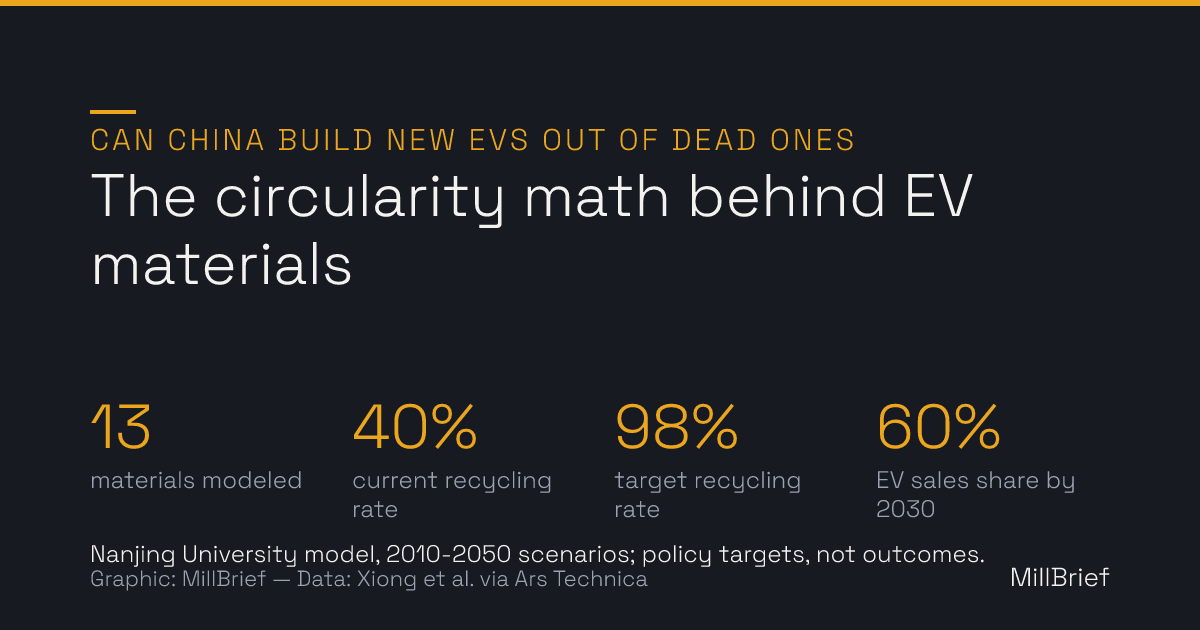
Ars Technica covers a study led by Xin Xiong at Nanjing University modeling whether recycled materials can meet China’s EV manufacturing demand between 2010 and 2050. The model spans 13 materials, eight battery-side (lithium, cobalt, nickel, manganese, phosphorus, sodium, sulfur, graphite) and five motor-side including the rare earths neodymium, dysprosium, samarium, and cerium, across four technology-transition scenarios. It bakes in current Chinese policy: raising battery recycling rates from today’s roughly 40% to a mandated standard of at least 98%, and pushing EVs from 45% to 60% of new-car sales by 2030. The headline: recycled supply can cover a high share of manufacturing demand for many materials by mid-century, with instructive wrinkles: cobalt goes to surplus as chemistries move away from it, nickel and manganese stay mining-dependent as demand grows, and cheap chemistries like sodium cut both ways because low-value contents give recyclers thin margins. The authors flag battery passports and licensed-recycler mandates as the plumbing that has to work, and note China has not yet mandated recycled content in new batteries.
Why it matters: This connects straight to the dependence picture behind the robot import ban: the rare earths in this model (neodymium, dysprosium) are the same ones in the motors of every industrial robot and cobot, and China already handles over 90% of the refining. A credible recycling loop would deepen, not dilute, that advantage: the country with the most magnets in circulation gets the cheapest secondary supply. For buyers the practical read-through is about long-term parts economics: motor and magnet pricing over a 10-year automation asset life is a supply-chain bet either way, and it’s one more reason end-of-life clauses and remanufacturing options belong in the RFQ alongside uptime terms.
Source: Ars Technica, July 31, 2026.
Sources
- Google DeepMind says Gemini Robotics 2 enables full body control (The Robot Report, 2026-08-02)
- Interview with Arduino's Marcello Majonchi: Qualcomm acquisition ushers in new era of edge AI and robotics (Robotics & Automation News (interview), 2026-07-31)
- China could supply EV manufacturing boom with recycled EVs (Ars Technica, 2026-07-31)